<?xml version="1.0" encoding="ISO-8859-1"?><article xmlns:mml="http://www.w3.org/1998/Math/MathML" xmlns:xlink="http://www.w3.org/1999/xlink" xmlns:xsi="http://www.w3.org/2001/XMLSchema-instance">
<front>
<journal-meta>
<journal-id>2224-5421</journal-id>
<journal-title><![CDATA[Revista Cubana de Química]]></journal-title>
<abbrev-journal-title><![CDATA[Rev Cub Quim]]></abbrev-journal-title>
<issn>2224-5421</issn>
<publisher>
<publisher-name><![CDATA[Ediciones UO, Universidad de Oriente]]></publisher-name>
</publisher>
</journal-meta>
<article-meta>
<article-id>S2224-54212016000200006</article-id>
<title-group>
<article-title xml:lang="es"><![CDATA[Obtención de un soporte de afinidad para la purificación de fosfolipasas A2]]></article-title>
<article-title xml:lang="en"><![CDATA[Obtaining an affinity support for phospholipase A2 purification]]></article-title>
</title-group>
<contrib-group>
<contrib contrib-type="author">
<name>
<surname><![CDATA[Guisado-Bourzac]]></surname>
<given-names><![CDATA[Frenkel]]></given-names>
</name>
<xref ref-type="aff" rid="A01"/>
</contrib>
<contrib contrib-type="author">
<name>
<surname><![CDATA[Romero-Del-Sol]]></surname>
<given-names><![CDATA[Dolores Lázara]]></given-names>
</name>
<xref ref-type="aff" rid="A02"/>
</contrib>
<contrib contrib-type="author">
<name>
<surname><![CDATA[Guisán- Seija]]></surname>
<given-names><![CDATA[José Manuel]]></given-names>
</name>
<xref ref-type="aff" rid="A03"/>
</contrib>
<contrib contrib-type="author">
<name>
<surname><![CDATA[González-Bacerio]]></surname>
<given-names><![CDATA[Jorge]]></given-names>
</name>
<xref ref-type="aff" rid="A02"/>
</contrib>
<contrib contrib-type="author">
<name>
<surname><![CDATA[Díaz Brito]]></surname>
<given-names><![CDATA[Joaquín]]></given-names>
</name>
<xref ref-type="aff" rid="A02"/>
</contrib>
<contrib contrib-type="author">
<name>
<surname><![CDATA[del Monte-Martínez]]></surname>
<given-names><![CDATA[Alberto]]></given-names>
</name>
<xref ref-type="aff" rid="A02"/>
</contrib>
</contrib-group>
<aff id="A01">
<institution><![CDATA[,Universidad de Oriente  ]]></institution>
<addr-line><![CDATA[Santiago de Cuba ]]></addr-line>
<country>Cuba</country>
</aff>
<aff id="A02">
<institution><![CDATA[,Universidad de La Habana Facultad de Biología Centro de Estudio de Proteínas (CEP)]]></institution>
<addr-line><![CDATA[ ]]></addr-line>
<country>Cuba</country>
</aff>
<aff id="A03">
<institution><![CDATA[,Instituto de Catálisis y Petroleoquímica, CSIC  ]]></institution>
<addr-line><![CDATA[Madrid ]]></addr-line>
<country>España</country>
</aff>
<pub-date pub-type="pub">
<day>00</day>
<month>08</month>
<year>2016</year>
</pub-date>
<pub-date pub-type="epub">
<day>00</day>
<month>08</month>
<year>2016</year>
</pub-date>
<volume>28</volume>
<numero>2</numero>
<fpage>595</fpage>
<lpage>609</lpage>
<copyright-statement/>
<copyright-year/>
<self-uri xlink:href="http://scielo.sld.cu/scielo.php?script=sci_arttext&amp;pid=S2224-54212016000200006&amp;lng=en&amp;nrm=iso"></self-uri><self-uri xlink:href="http://scielo.sld.cu/scielo.php?script=sci_abstract&amp;pid=S2224-54212016000200006&amp;lng=en&amp;nrm=iso"></self-uri><self-uri xlink:href="http://scielo.sld.cu/scielo.php?script=sci_pdf&amp;pid=S2224-54212016000200006&amp;lng=en&amp;nrm=iso"></self-uri><abstract abstract-type="short" xml:lang="es"><p><![CDATA[El objetivo de la presente invención es la síntesis de un soporte de afinidad con un fosfolípido inmovilizado (fofatidilcolina de yema de huevo inmovilizada a un gel amino) como ligando para la purificación de fosfolipasas A2. La Sepharose CL-4B fue activada, oxidada y aminada. La fosfatidilcolina fue inmovilizada covalentemente controlándose mediante la determinación de fosfatos en los materiales de partida y los lavados. La validez de los soportes cromatográficos obtenidos se verificó mediante la purificación de fracciones con actividad fosfolipásica provenientes de las anémonas marinas Condylactis gigantea y Stichodactyla helianthus, así como del veneno de la serpiente Crotalus durisus terrificus. Se obtuvieron perfiles de elución con un máximo típico para este procedimiento y tipo de enzima. La actividad fosfolipásica A2 se verificó cualitativamente a través de una TLC luego de la incubación de los picos obtenidos frente a la fosfatidilcolina purificada y a un sustrato fluorescente: 1-palmitoil-2-NBD-C12-PC.]]></p></abstract>
<abstract abstract-type="short" xml:lang="en"><p><![CDATA[The synthesis of a glyoxyl-Sepharose support was achieved departing from Sepharose CL-4B firstly activated, oxidized and aminated. Amination process is done in order to obtain an amino gel that could join specific ligands for phospholipases A2 purification. The egg yolk phosphatidylcholine (ePC) was immobilized by covalent method and was controlled by phosphate determination in the departure material and in laundries. This support has the advantage of being able to be chemically modified achieving different affinity supports. The validity of the supports obtained was checked by the addition of chromatography fractions from the sea anemones Condylactis gigantea and Stichodactyla helianthus, and the known snake venom from Crotalus durisus terrificus with phospholipase A2 activity. The typical elution maximum corresponding was obtained. Phospholipase A2 activity was corroborated qualitatively by a TLC-based method after exposure to purified ePC and fluorogenic substrate 1-palmitoil-2-NBD-C12-PC]]></p></abstract>
<kwd-group>
<kwd lng="es"><![CDATA[cromatografía de afinidad]]></kwd>
<kwd lng="es"><![CDATA[fosfolipasa A2]]></kwd>
<kwd lng="es"><![CDATA[inmovilización de fosfatidilcolina de yema de huevo inmovilizada]]></kwd>
<kwd lng="es"><![CDATA[anémona de mar]]></kwd>
<kwd lng="es"><![CDATA[gel amino]]></kwd>
<kwd lng="en"><![CDATA[affinity chromatography]]></kwd>
<kwd lng="en"><![CDATA[phospholipase A2]]></kwd>
<kwd lng="en"><![CDATA[egg yolk phosphatidylcholine immobilization]]></kwd>
<kwd lng="en"><![CDATA[sea anemone]]></kwd>
<kwd lng="en"><![CDATA[amine gel]]></kwd>
</kwd-group>
</article-meta>
</front><body><![CDATA[ <p align="right"><font face="Verdana" size="2"><b>ARTICULOS</b></font></p>     <p align="center">&nbsp;</p>     <p align="left"><font face="Verdana" size="2"><b><font size="4"><strong>Obtenci&oacute;n de un soporte de afinidad para la purificaci&oacute;n de fosfolipasas A<sub>2</sub></strong></font></b></font></p>     <p align="justify">&nbsp;</p>     <p align="justify"><font face="Verdana" size="2"><b><font size="3"> Obtaining an affinity support for phospholipase A<font face="Verdana"><b><strong><sub>2</sub></strong></b></font> purification</font></b></font></p>     <p align="justify">&nbsp;</p>     <p align="justify">&nbsp;</p>     <p align="justify"> <font face="Verdana" size="2"><b> MSc. Frenkel Guisado-Bourzac<sup>I</sup>,    MSc. Dolores L&aacute;zara Romero-Del-Sol<sup>II</sup>,    Dr. Jos&eacute; Manuel Guis&aacute;n- Seijas<sup>III</sup>,    Dr. Jorge Gonz&aacute;lez-Bacerio<sup>II</sup>,    Dr. Joaqu&iacute;n D&iacute;az Brito<sup>II</sup>,    Dr. Alberto del Monte-Mart&iacute;nez<sup>II</sup></b></font></p>     <p align="justify"><font face="Verdana" size="2"> <sup>I</sup>Universidad de Oriente, Santiago de Cuba, Cuba, <a href="mailto:fguisado@cnt.uo.edu.cu">fguisado@cnt.uo.edu.cu</a>    <br>       <sup>II</sup>Centro de Estudio de Prote&iacute;nas (CEP), Facultad de Biolog&iacute;a, Universidad de La Habana, Cuba,  <a href="mailto:jogoba@fbio.uh.cu">jogoba@fbio.uh.cu, <a href="mailto:joaquin43cu@yahoo.es">joaquin43cu@yahoo.es</a>, <a href="mailto:adelmonte@fbio.uh.cu">adelmonte@fbio.uh.cu</a>    ]]></body>
<body><![CDATA[<br> <sup>III</sup>Instituto de Cat&aacute;lisis y Petroleoqu&iacute;mica, CSIC, Madrid, Espa&ntilde;a, <a href="mailto:jmguisan@icp.csic.es">jmguisan@icp.csic.es</a></font></p>     <p align="justify">&nbsp;</p>     <p align="justify">&nbsp;</p> <hr>     <p align="justify"><font face="Verdana" size="2"><b>RESUMEN</b></font></p>     <p align="justify"><font face="Verdana" size="2"> El objetivo de la presente invenci&oacute;n es la s&iacute;ntesis de un soporte de afinidad con un fosfol&iacute;pido inmovilizado (fofatidilcolina de yema de huevo inmovilizada a un gel amino) como ligando para la purificaci&oacute;n de fosfolipasas A<font size="3"><font size="2" face="Verdana"><sub>2</sub></font></font>. La Sepharose CL-4B fue activada, oxidada y aminada. La fosfatidilcolina fue inmovilizada covalentemente control&aacute;ndose mediante la determinaci&oacute;n de fosfatos en los materiales de partida y los lavados. La validez de los soportes cromatogr&aacute;ficos obtenidos se verific&oacute; mediante la purificaci&oacute;n de fracciones con actividad fosfolip&aacute;sica provenientes de las an&eacute;monas marinas <em>Condylactis gigantea </em> y <em>Stichodactyla helianthus</em>, as&iacute; como del veneno de la serpiente <em>Crotalus durisus terrificus</em>. Se obtuvieron perfiles de eluci&oacute;n con un m&aacute;ximo t&iacute;pico para este procedimiento y tipo de enzima. La actividad fosfolip&aacute;sica A<font size="3"><font size="2" face="Verdana"><sub>2</sub></font></font> se verific&oacute; cualitativamente a trav&eacute;s de una TLC luego de la incubaci&oacute;n de los picos obtenidos frente a la fosfatidilcolina purificada y a un sustrato fluorescente: 1-palmitoil–2-NBD-C12-PC.</font></p>     <p align="justify"><font face="Verdana" size="2"><b>Palabras clave:</b> cromatograf&iacute;a de afinidad, fosfolipasa A<font size="3"><font size="2" face="Verdana"><sub>2</sub></font></font>, inmovilizaci&oacute;n de fosfatidilcolina de yema de huevo inmovilizada, an&eacute;mona de mar, gel amino.</font></p> <hr>     <p align="justify"><font face="Verdana" size="2"> <b>ABSTRACT</b></font></p>     <p align="justify"><font face="Verdana" size="2"> The synthesis of a glyoxyl-Sepharose support was achieved departing from Sepharose CL-4B firstly activated, oxidized and aminated. Amination process is done in order to obtain an amino gel that could join specific ligands for phospholipases A<font size="3"><font size="2" face="Verdana"><sub>2</sub></font></font> purification. The egg yolk phosphatidylcholine (ePC) was immobilized by covalent method and was controlled by phosphate determination in the departure material and in laundries. This support has the advantage of being able to be chemically modified achieving different affinity supports. The validity of the supports obtained was checked by the addition of chromatography fractions from the sea anemones <em>Condylactis gigantea </em> and <em>Stichodactyla helianthus</em>, and the known snake venom from <em>Crotalus durisus terrificus </em> with phospholipase A<font size="3"><font size="2" face="Verdana"><sub>2</sub></font></font> activity. The typical elution maximum corresponding was obtained. Phospholipase A<font size="3"><font size="2" face="Verdana"><sub>2</sub></font></font> activity was corroborated qualitatively by a TLC-based method after exposure to purified ePC and fluorogenic substrate 1-palmitoil–2-NBD-C12-PC.</font></p>     <p align="justify"><font face="Verdana" size="2"> <b>Keywords:</b> affinity chromatography, phospholipase A<font size="3"><font size="2" face="Verdana"><sub>2</sub></font></font>, egg yolk phosphatidylcholine immobilization, sea anemone, amine gel.</font></p> <hr>     <p>&nbsp;</p>     ]]></body>
<body><![CDATA[<p>&nbsp;</p>     <p><b><font face="Verdana" size="3">INTRODUCTION</font></b></p>     <p align="justify"><font size="2" face="Verdana">Phospholipases A<font size="3"><font size="2" face="Verdana"><sub>2</sub></font></font> (PLA2) are enzymes that participate in numerous important physiologic and metabolic processes in plants and animals [1-8]. The phospholipase A<font size="3"><font size="2" face="Verdana"><sub>2</sub></font></font> activity is also associated to different pathologies, that's why the purification and further characterization of these enzymes result from big interest, both for basic and applied studies with a leading role in medicine, physiology, nutrition, immunology, microbiology and toxicology [1; 9-14]. Their usefulness is growing in different biotechnological, pharmaceutical and general industries, such as food industry [15, 16] where is not always needed a highly purified enzyme.</font></p>     <p align="justify"><font size="2" face="Verdana">Until now, there has been described a diversity of purification procedures for the PLA2, nevertheless, the final yield of many of the proposed routes is low, due to the step numbers in case of complex sources and the natural expression of these enzymes [17-19]. Thus, more powerful procedures such as affinity chromatography are required for the purification of these enzymes.</font></p>     <p align="justify"><font size="2" face="Verdana">Affinity chromatography has been a very effective method for the purification of PLA2 [15, 16, 20, 21], therefore the obtainment of supports for this purpose has a great importance and utility when working with these enzymes and the nature of the ligand is essential for a successful affinity procedure, being useful a natural phospholipid for its known affinity [2].</font></p>     <p align="justify"><font size="2" face="Verdana">Our research group has achieved the synthesis of a glyoxyl-Sepharose support departing from Sepharose CL-4B firstly oxidized and joined to glycidol, according to Guis&aacute;n's method [22]. This support has the advantage of being able to be chemically modified achieving different affinity supports. In this work, amination process is done in order to obtain an amino gel that could join specific ligands for PLA2 purification such as presents in <em>Crotalus durisus terrificus </em> snake venoms and Caribbean Sea anemones venoms from <em>Condylactis gigantea </em> and <em>Stychodactyla helianthus</em>.</font></p>     <p align="justify"><font size="2" face="Verdana"><strong><em>Theoretical bases</em></strong></font></p>     <p align="justify"><font size="2" face="Verdana">One of the methods of more utility for the purification of proteins is the affinity chromatography [20], hence the importance of obtaining appropriate supports to achieve this end.</font></p>     <p align="justify"><font size="2" face="Verdana">For a successfully affinity interaction is essential the nature of the ligand and Leslie [2] proved that PC is a substrate where phospholipases show big affinity.</font></p>     <p align="justify"><font size="2" face="Verdana">In the specific case of <em>Condylactis gigantea, </em>it has been proved that soybean PC and egg yolk PC are the best substrates hydrolyzed for this type of enzyme [23], the reason why PC appears to be a ligand that is more adapted for the construction of an affinity support.</font></p>     ]]></body>
<body><![CDATA[<p align="justify"><font size="2" face="Verdana">In several affinity methods with the variant of a phospholipid ligand or a similar molecule, calcium is needed for the interaction during fixation [24, 25] and elution of fixed proteins is carried out incorporating EDTA, that's why a similar protocol is used herein. This system is essential for the purification of PLA2 and it was demonstrated by Rock and Snider [20], which obtained two enzymes with the above mentioned activity from snake poison with a yield higher than 90 %, while the retention of the enzymes did not happen when buffer fixation did not contained calcium which agrees with the enzyme mechanism proposed for Wells (1972), cited by Rock and Snider [20], and promotes enzyme-substrate interactions which confirms the specific union through affinity across his active center [26 27]. For such a reason, the buffer solution used contains CaCl</font><font size="2" face="Verdana, Arial, Helvetica, sans-serif"><sub>2</sub></font><font size="2" face="Verdana"> to the ideal concentration for the phospholipase activity of these enzymes in <em>Condylactis gigantea </em> determined by B&aacute;rcenas [23].</font></p>     <p align="justify">&nbsp;</p>     <p align="left"><font size="3" face="Verdana, Arial, Helvetica, sans-serif"><strong>MATERIALS AND METHODS</strong></font></p>     <p align="justify"><font size="2" face="Verdana"><strong><em>Support synthesis for the affinity chromatography. </em></strong></font></p>     <p align="justify"><font size="2" face="Verdana"><strong>Obtainment of the amine support</strong></font></p>     <p align="justify"><font size="2" face="Verdana">For synthesis, the Sepharose CL-4B support (Sigma-Aldrich, St. Louis, MO, USA) was activated with 1,2-epoxy-3-propanol (glycidol) (Merck &amp; Co., Inc., Whitehouse Station, NJ, USA) and the glycidyl Sepharose CL-4B obtained was then oxidized with NaIO</font><font size="2" face="Verdana, Arial, Helvetica, sans-serif"><sub>4</sub></font><font size="2" face="Verdana"> (Sigma Chemicals Co) according to the methodology reported by Guis&aacute;n [22]. Once obtained the glyoxyl-Sepharose CL-4B, the support was aminated according Fern&aacute;ndez-Lafuente <em>et al </em>[28]. Thus, the monoamimoethyl-N-aminoethyl-Sepharose CL-4B support (MANA-Sepharose CL-4B) was obtained. Different ethylendiamine concentrations (Merck &amp; Co., Inc., Whitehouse Station, NJ, USA) were used with the objective of achieving different amination degrees for the support.</font></p>     <p align="justify"><font size="2" face="Verdana"><strong><em>Phosphatidylcholine oxidation</em></strong></font></p>     <p align="justify"><font size="2" face="Verdana">Two native ligands for chromatographic supports immobilization were assayed, the phosphatidylcholine (PC) from commercial soybean (Merck &amp; Co., Inc., Whitehouse Station, NJ, USA) and from egg yolk purified according to the protocol of Singleton <em>et al </em>[29]. The phospholipids were oxidized, previously to the immobilization, according to the protocol reported by Natori <em>et al </em>[30].</font></p>     <p align="justify"><font size="2" face="Verdana">For the oxidation step, 1000 mg of PC were dissolved in 100 ml of acetic acid 90 %. Drop by drop, 200 ml of oxidizing solution (KMNO</font><font size="2" face="Verdana, Arial, Helvetica, sans-serif"><sub>4</sub></font><font size="2" face="Verdana"> 24 mM, NaIO</font><font size="2" face="Verdana, Arial, Helvetica, sans-serif"><sub>4</sub></font><font size="2" face="Verdana"> 20 mM, both Fluka) was added with magnetic stirring during 30 minutes at room temperature. Then, 15 ml of NaHSO</font><font size="2" face="Verdana, Arial, Helvetica, sans-serif"><sub>4</sub></font><font size="2" face="Verdana"> 20 % (Sigma Chemicals Co) are added and lipids extraction is carried out with 750 ml of chloroform: methanol (2:1) in a separative funnel, collecting the chloroform phase below, which is rewashed 3 times with 250 ml of distilled H</font><font size="2" face="Verdana, Arial, Helvetica, sans-serif"><sub>2</sub></font><font size="2" face="Verdana">O. The chloroform phase is evaporated and the lipid content is re-dissolved in the chloroform: methanol mixture (2:1). All solvents were analytical grade (Sigma Chemicals Co).</font></p>     <p align="justify"><font size="2" face="Verdana"><strong><em>Immobilization of oxidized phosphatidylcholine at MANA-Sepharose CL-4B support</em></strong></font></p>     ]]></body>
<body><![CDATA[<p align="justify"><font size="2" face="Verdana">The ligand immobilization was carried out according to the method reported by Natori <em> et al </em>[ 30 ] and oxidized egg yolk phosphatidylcholine was used in it. In order to compare, a commercial support AH Sepharose 4B (Pharmacia Biotech, Sweden) was submitted to the same procedure.</font></p>     <p align="justify"><font size="2" face="Verdana">Firstly, 10 ml of the monoaminoethyl-N-aminoethyl-Sepharose CL- 4B support were washed with 29,2 ml of dioxane: H</font><font size="2" face="Verdana, Arial, Helvetica, sans-serif"><sub>2</sub></font><font size="2" face="Verdana">O (V:V) and filtered in porous layer up to dryness.</font></p>     <p align="justify"><font size="2" face="Verdana">Next, 98,3 &micro;mol of oxidized phosphatidylcholine are dissolved in 56 ml of the mixture dioxane: H</font><font size="2" face="Verdana, Arial, Helvetica, sans-serif"><sub>2</sub></font><font size="2" face="Verdana">O (V:V) and the pH is fits to 5,3 with NaOH 0,5 M (Sigma Chemicals Co).</font></p>     <p align="justify"><font size="2" face="Verdana">Both, oxidized PC and the amino gel are mixed by a spade stirrer and 793,33 mg of 1-ethyl-3-(3-dimethylaminopropyl) carbodiimide (Sigma-Aldrich, St. Louis, MO, USA) are added gently. Agitation remains for 24 hours at room temperature, adjusting the pH to 5.</font></p>     <p align="justify"><font size="2" face="Verdana">When the reaction time finishes, the content from reaction mixture is filtered in porous layer and successive washes are realized with 100 ml of dioxane, 100 ml of methanol and finally with 200 ml of NaCl 1M (quality reagent).</font></p>     <p align="justify"><font size="2" face="Verdana"><strong><em>Immobilization process characterization</em></strong></font></p>     <p align="justify"><font size="2" face="Verdana"><strong>Characterization of the immobilization process by ligand immobilized evaluation</strong></font></p>     <p align="justify"><font size="2" face="Verdana">The PC immobilized was determined quantifying phosphates for at least 3 replicas by sample after support degradation by the direct method according to Fiske and Subarrow [31], cited and adjusted by Lanio [32], including a control with the oxidized and aminated support without immobilizing PC. The sample concentration is reported in mg/mL of phosphorous.</font></p>     <p align="justify"><font size="2" face="Verdana"><strong><em>Affinity chromatography</em></strong></font></p>     <p align="justify"><font size="2" face="Verdana">All samples were dialyzed with buffer TrisHCl 0,05 M, CaCl</font><font size="2" face="Verdana, Arial, Helvetica, sans-serif"><sub>2</sub></font><font size="2" face="Verdana"></font><font size="2" face="Verdana"> 0,04 M, pH 7,5 (fixation buffer) before application. Chromatography PC-MANA-Sepharose CL-4B was carried out at 25 &deg;C in a glass column (0,7 x 8 cm). Elution was performed with TrisHCl 0,05 M, EDTA 0,04 M, pH 7,5, at a flow rate of 90 cm/h and fraction of 3mL were collected.</font></p>     ]]></body>
<body><![CDATA[<p align="justify"><font size="2" face="Verdana">The elution was monitored at 280 nm in an Ultrospec 4000 spectrophotometer (Pharmacia Biotech. Sweden).</font></p>     <p align="justify"><font size="2" face="Verdana"><strong><em>Study of the proteins fixation capacity by affinity chromatography in the synthesized support</em></strong></font></p>     <p align="justify"><font size="2" face="Verdana">Proteins fixation capacity for the synthesized support and for commercial AH Sepharose 4 B with oxidized PC ligand was determined by the indirect method. The <em>Condylactis gigantea </em> extract, which contains PLA2 [33], was incubated during 24 hours in semi-batch in a ratio of 0,47 mg protein/g support. After incubation, samples were centrifuged before measuring the protein quantity by Bradford's method [34]. The capacity was calculated subtracting to the total protein applied those who were not fixed.</font></p>     <p align="justify"><font size="2" face="Verdana">The maximal adsorption capacity of the support was determined by dynamic methods [35]. Different quantities of proteins from the extract of <em>Condylactis gigantea </em> (10-300 mg) were applied to the column containing the synthesized support. The absorbance of the binding proteins was measured at 280 nm. We considered the maximal saturation where there is no increase in absorbance.</font></p>     <p align="justify"><font size="2" face="Verdana"><strong><em>Protein concentration</em></strong></font></p>     <p align="justify"><font size="2" face="Verdana">Protein concentration was determined by the Bradford's method [34] and measured at 280 nm for the protein detection during the chromatographic procedures considering &xi;= 1 mg/mL cm1 [ 36 ].</font></p>     <p align="justify"><font size="2" face="Verdana"><strong><em>Enzymatic activity</em></strong></font></p>     <p align="justify"><font size="2" face="Verdana">The phospholipase A<font size="3"><font size="2" face="Verdana"><sub>2</sub></font></font> activity was corroborated qualitatively by the method of Le&oacute;n <em>et al</em>. [37], a Thin Layer Chromatography (TLC)-based method on a Silica Gel 60 F-254 20x20 plate (Merck, Darmstadt, Germany), using the fluorogenic substrate 1-palmitoil–2-NBD-C12-PC (Avanti Polar Lipids Inc., Alabaster, AL, USA). The presence of the labeled fatty acid in the TLC corroborates this enzymatic activity [38]. </font></p>     <p align="justify"><font size="2" face="Verdana"><strong><em>Polyacrylamide gel electrophoresis</em></strong></font></p>     <p align="justify"><font size="2" face="Verdana">Polyacrylamide gel electrophoresis was carried out according to Laemmli [39], in a vertical chamber with a 12,5% concentration gel for <em>Condylactis gigantea </em> and 15 % for <em>Stichodactyla helianthus</em>. 20 &micro;L of samples previously concentrated and desalinated were applied, using blue bromephenol as indicator and free of 2-mercaptoethanol. As molecular weight standards were used BSA (66000 Da), Ovalbumin (45000 Da), Pepsin (34700 Da), Trypsinogen (24000 Da), ß-lactoalbumin (18400 Da), Lysozyme (14300 Da) and Aprotinin (6500 Da) purchased from Sigma Chem. Co.</font></p>     ]]></body>
<body><![CDATA[<p align="justify"><font size="2" face="Verdana">Electrophoretic running parameters were: 100 V, 50 mA y 12 watt for 30 minutes during samples concentration in concentrator gel, and a current of 150 V, 100 mA and 12 watt for 1:07 h was applied for separator gel by a power supply Pharmacia LKB- Multidrive XL.</font></p>     <p align="justify"><font size="2" face="Verdana">Tincture was effectuated with Coomasie blue R-250 at 0,25 % in methanol 25 %, acetic acid 10 % and water (V/V/V) during 20 minutes. Colorant excess was eliminated by washes with the methanol-acetic acid- water in proportions as previously described during 24 hours and gels were kept into this solution for preserving.</font></p>     <p align="justify"><font size="2" face="Verdana"><strong><em>Statistical analysis</em></strong></font></p>     <p align="justify"><font size="2" face="Verdana">STATGRAPHICS CENTURION XV was used for media and standard deviation comparison (Fisher's Least Significant Difference) in all measurements (at least 3 replicas for each tabulated point) for both gels.</font></p>     <p align="justify">&nbsp;</p>     <p align="justify"><font size="3" face="Verdana"><strong>RESULTS AND DISCUSSION</strong></font></p>     <p align="justify"><font size="2" face="Verdana">The maximum oxidation degree achieved is 50 &micro;moles aldehyde /mL support. During the amination process different degrees of amino groups in gels were obtained and it was selected the most similar aminated support to those of commercial AH-Sepharose CL-4B described by the manufacturer (11-17 &micro;mol NH</font><font size="2" face="Verdana, Arial, Helvetica, sans-serif"><sub>2</sub></font><font size="2" face="Verdana">/mL support) for later characterizations.</font></p>     <p align="justify"><font size="2" face="Verdana">The analysis of the PC oxidation products was realized by TLC comparing them with a known oxidized PC. Lipid products presence was revealed in a chamber with iodine. Several bands demonstrated that oxidized soybean PC by this methodology did not offer the oxidation product needed while the egg yolk PC did.</font></p>     <p align="justify"><font size="2" face="Verdana">The soybean PC oxidation, at tested conditions, does not produce similar reaction products of those who are obtained by the egg yolk PC oxidation. It could be explained by the proper nature of these natural phospholipids. The egg yolk PC possesses generally only a double bound in &omega;-9 position for the fatty acid placed in sn-2, therefore its oxidation produces a single reaction product preserving its hydrophobic nature while soybean PC is typically polyunsaturated inside the same fatty acid chain, even in both positions (sn-1, sn-2) by which several oxidation products could be obtained according to the assay conditions and a big reduction of the length of its chains, turning out the phospholipid in a hydrophilic polycarboxylated derivative, as observed in TLC with organic solvents. So, even soybean PC is verified as the best substrate hydrolyzed for the phospholipases A<font size="3"><font size="2" face="Verdana"><sub>2</sub></font></font> from <em>Condylactis gigantea </em>[23], it is not the best option during the ligand immobilization process.</font></p>     <p align="justify"><font size="2" face="Verdana">Oxidized egg yolk PC bound to amine support was determined by phosphorus (P) quantification (direct method) for both affinity supports, newly and 27 months synthetized by the same conditions (already in use). Results appear in <a href="#t1">table 1</a>.</font></p>     ]]></body>
<body><![CDATA[<p align="center"><font size="2" face="Verdana"><a name="t1"></a><strong>TABLE 1. IMMOBILIZATION EVALUATING PARAMETERS BY QUANTIFICATION OF OXIDIZED PC BINDING TO THE SUPPORTS</strong></font></p>      <div align="center">   <table border="1" cellpadding="0" cellspacing="0" bordercolor="#000000">     <tr>       <td width="203" height="31" valign="top">    <p align="center">&nbsp;</p></td>       <td width="118" valign="top">    <p align="center"><font size="2" face="Verdana"><strong>&micro;g P x g gel</strong></font><strong><font size="2" face="Verdana, Arial, Helvetica, sans-serif"><sup>-1</sup></font></strong></p></td>       <td width="146" valign="top">    <p align="center"><font size="2" face="Verdana"><strong>&micro;moles PC x g gel<font size="2" face="Verdana, Arial, Helvetica, sans-serif"><sup>-1</sup></font></strong></font></p></td>       <td width="158" valign="top">    <p align="center"><font size="2" face="Verdana"><strong>&micro;moles PC x mL gel<font size="2" face="Verdana, Arial, Helvetica, sans-serif"><sup>-1</sup></font></strong></font></p></td>     </tr>     <tr>       <td width="203" valign="top">    <p align="center"><font size="2" face="Verdana"><strong>Synthesized support </strong></font><font size="2" face="Verdana"><strong>(MANA-Sepharose CL-4B) </strong></font></p>       </td>       <td width="118" valign="top">    <p align="center"><font size="2" face="Verdana">6,83 &plusmn; 2,32 </font></p>          </td>       <td width="146" valign="top">    <p align="center"><font size="2" face="Verdana">0,22 &plusmn; 0,07 </font></p>          </td>       <td width="158" valign="top">    <p align="center"><font size="2" face="Verdana">0,31 &plusmn; 0,010 </font></p>          </td>     </tr>     <tr>       <td width="203" valign="top">    ]]></body>
<body><![CDATA[<p align="center"><font size="2" face="Verdana"><strong>Commercial support     <br>       </strong></font><font size="2" face="Verdana"><strong>(AH-Sepharose 4B) </strong></font></p>          </td>       <td width="118" valign="top">    <p align="center"><font size="2" face="Verdana">8,64 &plusmn; 2,07 </font></p>          </td>       <td width="146" valign="top">    <p align="center"><font size="2" face="Verdana">0,28 &plusmn; 0,07 </font></p>          </td>       <td width="158" valign="top">    <p align="center"><font size="2" face="Verdana">0,40 &plusmn; 0,010 </font></p>          </td>     </tr>   </table> </div>       <p align="justify"><font size="2" face="Verdana">The stability of this support was 92,34 &plusmn; 7,61 % (<a href="#t2">table 2</a>) which is not a statistically relevant reduction for an &alpha;= 0,05 and the same mechanism justifies the operational stability of the support, since the reduction of the fatty acid sn-2 prevents the access of the catalytic amino acids towards the bound to hydrolyze it.</font></p>     <p align="center"><font size="2" face="Verdana"><a name="t2"></a><strong>TABLE  2. LIGAND BINDING STABILITY IN TIME COMPARED IN TWO DIFFERENTS SYNTHESIZED SUPPORT, MEASURED BY FISKE AND SUBBAROW PHOSPHORUS DETERMINATION METHOD</strong></font></p>     <div align="center">   <table width="352" border="1" cellpadding="0" cellspacing="0" bordercolor="#000000">     <tr>       <td width="214" valign="top">    <p align="center">&nbsp; </p></td>       <td width="132" valign="top">    <p align="center"><font size="2" face="Verdana"><strong>&micro;g P x g gel<font size="2" face="Verdana, Arial, Helvetica, sans-serif"><sup>-1</sup></font></strong></font></p></td>     </tr>     <tr>       <td width="214" valign="top">    ]]></body>
<body><![CDATA[<p align="center"><font size="2" face="Verdana"><strong>Affinity support (time 0) </strong></font></p></td>       <td width="132" valign="top">    <p align="center"><font size="2" face="Verdana">6,83 &plusmn; 0,31 </font></p></td>     </tr>     <tr>       <td width="214" valign="top">    <p align="center"><font size="2" face="Verdana"><strong>Affinity support (27 months) </strong></font></p></td>       <td width="132" valign="top">    <p align="center"><font size="2" face="Verdana">6,31 &plusmn; 0,69 </font></p></td>     </tr>   </table> </div>       <p align="justify"><font size="2" face="Verdana">Due to known enzymatic mechanism, the buffer solution used contains CaCl<font face="Verdana, Arial, Helvetica, sans-serif"><sub>2</sub></font> to the ideal concentration for the phospholipase activity of these enzymes in <em>Condylactis gigantea </em> determined by B&aacute;rcenas [23] in order to promote enzyme-substrate interactions which confirms the specific union through affinity across his active center [26, 27].</font></p>       <p align="justify"><font size="2" face="Verdana">The comparative study of the protein capacity fixation between the AH-Sepharose 4B and MANA-Sepharose CL-4B is shown in <a href="#t3">table 3</a>. This capacity measured for the indirect method did not differ statistically for both supports.</font></p>       <p align="center"><font size="2" face="Verdana"><a name="t3"></a><strong>TABLE  3. COMPARISON ABOUT PROTEIN CAPACITY FIXATION OF COMMERCIAL AND     <br>   SYNTHETIZED    AFFINITY    SUPPORTS    BY SEMI-BATCH SYSTEM</strong></font></p>        <div align="center">   <table border="1" cellpadding="0" cellspacing="0" bordercolor="#000000">     <tr>       <td width="324" valign="top">    <p align="center">&nbsp; </p></td>       <td width="165" valign="top">    ]]></body>
<body><![CDATA[<p align="center"><font size="2" face="Verdana"><strong>Total proteins (mg) </strong></font></p></td>       <td width="125" valign="top">    <p align="center"><font size="2" face="Verdana"><strong>% Yield </strong></font></p></td>     </tr>     <tr>       <td width="324" valign="top">    <p align="center"><font size="2" face="Verdana"><strong><em>C. gigantea </em> eluted fraction (Sephadex G-50) </strong></font></p></td>       <td width="165" valign="top">    <p align="center"><font size="2" face="Verdana">0,047 &plusmn; 0,003 </font></p></td>       <td width="125" valign="top">    <p align="center"><font size="2" face="Verdana">100 </font></p></td>     </tr>     <tr>       <td width="324" valign="top">    <p align="center"><font size="2" face="Verdana"><strong>MANA-Sepharose (Affinity) </strong></font></p></td>       <td width="165" valign="top">    <p align="center"><font size="2" face="Verdana">0,015 2 &plusmn; 0,002 </font></p></td>       <td width="125" valign="top">    <p align="center"><font size="2" face="Verdana">32,38 &plusmn; 2,98 </font></p></td>     </tr>     <tr>       <td width="324" valign="top">    <p align="center"><font size="2" face="Verdana"><strong>AH-Sepharose (Affinity) </strong></font></p></td>       <td width="165" valign="top">    <p align="center"><font size="2" face="Verdana">0,015 4 &plusmn; 0,002 </font></p></td>       <td width="125" valign="top">    ]]></body>
<body><![CDATA[<p align="center"><font size="2" face="Verdana">32,86 &plusmn; 2,02 </font></p></td>     </tr>   </table> </div>       <p align="justify"><font size="2" face="Verdana">During affinity chromatography, protein concentration was followed by DO to 280 nm, choosing an arbitrary extinction coefficient at 280 nm of 1 mg/mL, since these proteins are characterized for presenting a high quantity of aromatic residues for molecule ranges between 13-18 [40], which influences greatly the reading of the D.O. 280 nm that is typical of these amino acids, making more sensitive the detection in front of low protein quantities.</font></p>     <p align="justify"><font size="2" face="Verdana">The maximum support aptitude to fix protein proceeding from the gel filtration for <em>Condylactis gigantea </em> whole extract was checked in order to minimize protein losses for extract excess during application to the column. The results of the dynamic support capacity [35] are shown in <a href="/img/revistas/ind/v28n2/f0106216.gif" target="_blank">figure 1</a>.</font></p>     
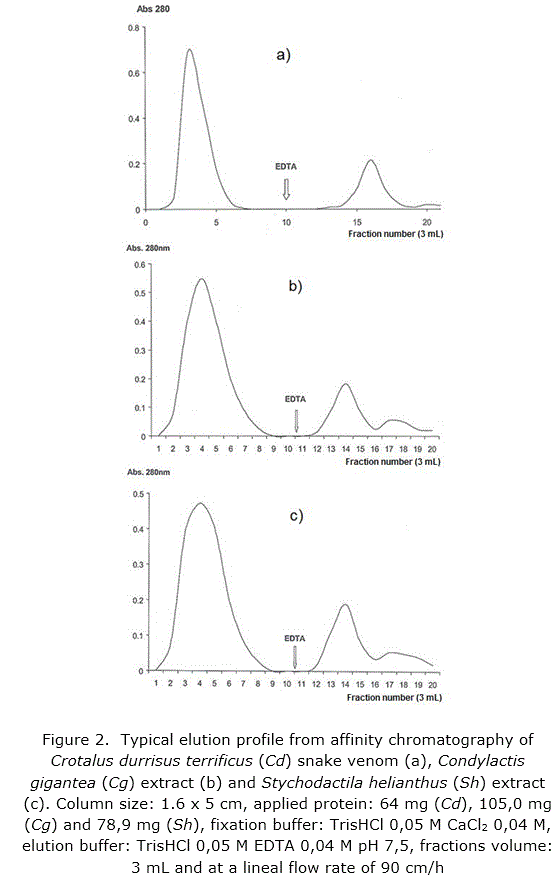
<p align="justify"><font size="2" face="Verdana">A lineal increment of the fixed protein is observed until 100 mg of the applied extract after which the tendency is to remains constant. For later affinity chromatography runs it was fixed at 105,0 mg.</font></p>     <p align="justify"><font size="2" face="Verdana">Functional characteristic of the synthesized support was corroborated through affinity chromatography runs in column of the <em>Crotalus durisus terrificus </em> snake venom, a recognized genus as source of PLA2 /20/, and the sea anemones <em>Stichodactyla helianthus </em>[11] and <em>Condylactis gigantea </em>[33] which offered a typical profile (<a href="#f2">figure 2a</a>, <a href="#f2">b</a> and <a href="#f2">c</a> respectively) when fractions elute after fixation with calcium ion by addition of EDTA to the elution buffer.</font></p>     <p align="center"><font size="2" face="Verdana"><a name="f2" id="f2"></a><img src="/img/revistas/ind/v28n2/f0206216.gif"></font></p>     
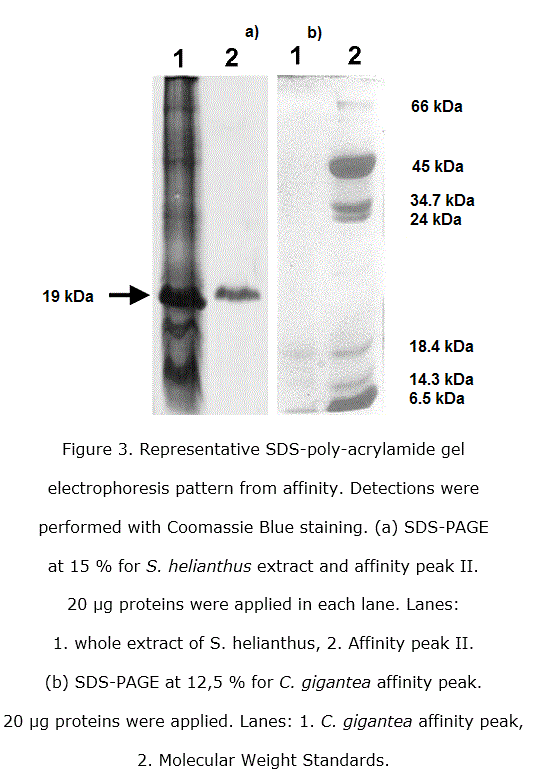
<p align="justify"><font size="2" face="Verdana">Both, <em>Stichodactyla helianthus </em> and <em>Condylactis gigantea</em>, were purified as showed in the SDS-PAGE applied (<a href="#f3">figure 3</a>).</font></p>     <p align="center"><font size="2" face="Verdana"><a name="f3"></a><img src="/img/revistas/ind/v28n2/f0306216.gif"></font></p>     
<p align="justify"><font size="2" face="Verdana">The presence of the fluorescence fatty acid in the TLC analysis was determined in protein profiles from affinity peaks of <em>Condylactis gigantea</em>, corroborating by first time the presence of <em>sn</em>-stereospecific activity for purified proteins, indicating that all applied extracts contain PLA2 activity.</font></p>     <p align="justify"><font size="2" face="Verdana">Three bands were obtained from electrophoresis in polyacrylamide gels of eluted fractions after concentrating big volumes from affinity peaks of <em>Condylactis gigantea</em>, being still two very tenuous. A similar feature is generally observed for secreted PLA2 from mammals, snakes and invertebrates in general [8]. The enzymatic activity phospholipase A<font size="3"><font size="2" face="Verdana"><sub>2</sub></font></font> was determined qualitatively in each purification step being the most intense, as it was of waiting, the last one from affinity. This result corroborates that the obtained proteins after affinity protocol presents PLA2 activity, at least in one of the three eluted components, a major one and two little bands which could be isoforms as discussed in previously papers [33].</font></p>     ]]></body>
<body><![CDATA[<p align="justify"><font size="2" face="Verdana">Quantitative results are optimal according to those reported in literature where a very low yield is expected [15, 19, 41].</font></p>     <p align="justify">&nbsp;</p>     <p align="justify"><strong><font size="3" face="Verdana">CONCLUSIONS</font></strong></p>     <p align="justify"><font size="2" face="Verdana">The synthesized support shows a great stability in the time and allows the PLA2 purification from different sources like those from snake venom Crotalus durrisus terrificus and the sea anemones Stichodactyla helianthus and Condylactis gigantea.</font></p>     <p align="justify">&nbsp;</p>     <p align="justify"><strong><font size="3" face="Verdana">BIBLIOGRAPHIC REFERENCES</font></strong></p>     <!-- ref --><p align="justify"><font size="2" face="Verdana">1. BAKER, J. E.; FABRICK, J. A.; ZHU, K. Y., &quot;Characterization of Esterases in Malathion-Resistant and Susceptible Strains of the Pteromalid Parasitoid Anisopteromalus Calandrae&quot;, <em>Insect Biochem Molec.</em>, 1998,  28(12),  1039-1050.    </font></p>     <!-- ref --><p align="justify"><font size="2" face="Verdana">2. LESLIE, C. C., &quot;Properties and Regulation of Cytosolic Phospholipase A<font size="3"><font size="2" face="Verdana"><sub>2</sub></font></font>&quot;, <em>The Journal of Biological Chemistry</em>, 1997, (272),  16709-16712.    </font></p>     ]]></body>
<body><![CDATA[<!-- ref --><p align="justify"><font size="2" face="Verdana">3. LESLIE, C. C.; VOELKER, D. R.; CHANNON, J. Y.; WALL, M. M.; ZELARNEY, P. T., &quot;Properties and Purification of an Arachidonoyl-Hydrolyzing Phospholipase A<font size="3"><font size="2" face="Verdana"><sub>2</sub></font></font> from a Macrophage Cell Line, Raw 264.7&quot;, <em>Biochimica et Biophysica Acta (BBA)</em>, 1988, 963(3),  476-492.    </font></p>     <!-- ref --><p align="justify"><font size="2" face="Verdana">4. PARTHASARATHY, S.; STEINBRECHER, U. P.; BARNETT, J.; WITZTUM, J. L.; STEINBERG, D., &quot;Essential Role of Phospholipase A<font size="3"><font size="2" face="Verdana"><sub>2</sub></font></font> Activity in Endothelial Cell-Induced Modification of Low Density Lipoprotein&quot;, <em>Proceedings of the National Academy of Sciences</em>, 1985, 82(9),  3000-3004.    </font></p>     <!-- ref --><p align="justify"><font size="2" face="Verdana">5. SCHOENBERG, H. M.; MAYER, J. M.; BEGER, H. G., &quot;Phospholipase A<font size="3"><font size="2" face="Verdana"><sub>2</sub></font></font>- from Basic Research to Clinical Reality&quot;, <em>Chirurg.</em>, 1997, 68(11),  1112-1118.    </font></p>     <!-- ref --><p align="justify"><font size="2" face="Verdana">6. TRONO, D.; SOCCIO, M.; LAUS, M. N.; PASTORE, D., &quot;The Existence of Phospholipase A<font size="3"><font size="2" face="Verdana"><sub>2</sub></font></font> Activity in Plant Mitochondria and Its Activation by Hyperosmotic Stress in Durum Wheat (Triticum Durum Desf.)&quot;, <em>Plant Science.</em>, 2013, 199–200,  91-102.    </font></p>     <!-- ref --><p align="justify"><font size="2" face="Verdana">7. VAN DEN BOSCH, H., &quot;Intracellular Phospholipase A&quot;, <em>Biochem. Biophys. Acta.</em>, 1980,  604(2),  191-246.    </font></p>     ]]></body>
<body><![CDATA[<!-- ref --><p align="justify"><font size="2" face="Verdana">8. VALENTIN, E.; LAMBEAU, G., &quot;What Can Venom Phospholipases a(2) Tell Us About the Functional Diversity of Mammalian Secreted Phospholipases a(2)?&quot;, <em>Biochimie.</em>,  2000,  82(9),  815-831.    </font></p>     <!-- ref --><p align="justify"><font size="2" face="Verdana">9. HUDSON, C. J.; LIN, A.; HORROBIN, D. F., &quot;Phospholipases in Search of a Genetic Base of Schizophrenia. Prostaglandin Leukot&quot;, <em>Essent. Fatty Acids.</em>, 1996, 55(1-2),  119-122.    </font></p>     <!-- ref --><p align="justify"><font size="2" face="Verdana">10. BONVENTRE, J. V., &quot;Roles of Phospholipases A<font size="3"><font size="2" face="Verdana"><sub>2</sub></font></font> in Brain Cell and Tissue Injury Associated with Ischemia and Excitotoxicity J&quot;, <em>Lipid Mediat. Cell Signal.</em>, 1996,  14(1-3), 15-23.    </font></p>     <!-- ref --><p align="justify"><font size="2" face="Verdana">11. CH&Aacute;VEZ, M. A.; WONG, L.; G&Oacute;MEZ, T., &quot;Identificaci&oacute;n de actividad fosfolip&aacute;sica en una toxina de la an&eacute;mona Stichodactyla Helianthus&quot;, <em>Scientia, </em>1988, (1),  76-79.    </font></p>     <!-- ref --><p align="justify"><font size="2" face="Verdana">12. ALBERT, D. H.; SNYDER, F., &quot;Biosynthesis of 1-Alkyl-2-Acetyl-Sn-Glycero-3-Phosphocholine (Platelet-Activating Factor) from 1-Alkyl-2-Acyl-Sn-Glycero-3-Phosphocholine by Rat Alveolar Macrophages. Phospholipase A<font size="3"><font size="2" face="Verdana"><sub>2</sub></font></font> and Acetyltransferase Activities During Phagocytosis and Ionophore Stimulation&quot;, <em>The Journal of Biological Chemistry</em>, 1983, (258),  97-102.    </font></p>     ]]></body>
<body><![CDATA[<!-- ref --><p align="justify"><font size="2" face="Verdana">13. SILVEIRA, L. B. <em>et al</em>., &quot;Isolation and Expression of a Hypotensive and Anti-Platelet Acidic Phospholipase A<font size="3"><font size="2" face="Verdana"><sub>2</sub></font></font> from Bothrops Moojeni Snake Venom&quot;, <em>Journal of Pharmaceutical and Biomedical Analysis</em>, 2013, (73),  35-43.    </font></p>     <!-- ref --><p align="justify"><font size="2" face="Verdana">14. QIU, S.; LAI, L., &quot;Antibacterial Properties of Recombinant Human Non-Pancreatic Secretory Phospholipase A<font size="3"><font size="2" face="Verdana"><sub>2</sub></font></font>&quot;, <em>Biochemical and Biophysical Research Communications</em>, 2013, 441(2),  453-456.    </font></p>     <!-- ref --><p align="justify"><font size="2" face="Verdana">15. MINCHIOTTI, M.; SCALAMBRO, M. B.; VARGAS, L.; CORONEL, C.; MADOERY, R., &quot;Isolation of Phospholipase A<font size="3"><font size="2" face="Verdana"><sub>2</sub></font></font> from Soybean (Glycine Max) Seeds: The Study of Its Enzymatic Properties&quot;, <em>Enzyme and Microbial Technology</em>, 2008,  42(5),  389-394.    </font></p>     <!-- ref --><p align="justify"><font size="2" face="Verdana">16. MADOERY, R.; MINCHIOTTI, M., &quot;Cibacron Blue-Eupergit, an Affinity Matrix for Soybean (Glycine Max) Phospholipase A<font size="3"><font size="2" face="Verdana"><sub>2</sub></font></font> Purification&quot;, <em>Enzyme and Microbial Technology</em>, 2006,  38(7), 869-872.    </font></p>     <!-- ref --><p align="justify"><font size="2" face="Verdana">17. IIJIMA, N.; NAKAMURA, M.; VENATSU, K.; KAYAMA, M., &quot;Partial Purification and Caracterization of Pla2 from Hepatopancreas of Red Sea Bream&quot;, <em>Nippon Suisan Gakkaishi</em>, 1990,  56(8),  1331-1339.    </font></p>     ]]></body>
<body><![CDATA[<!-- ref --><p align="justify"><font size="2" face="Verdana">18. VERGER, R.; FERRATO, F.; MANSBACH, C. M.; PIERONI, G., &quot;Novel Intestinal Phospholipase A<font size="3"><font size="2" face="Verdana"><sub>2</sub></font></font>: Purification and Some Molecular Characteristics&quot;, <em>Biochemistry</em>, 1982,  21(26),  6883-6889.    </font></p>     <!-- ref --><p align="justify"><font size="2" face="Verdana">19. ZHANG, Y.; XU, T.; CHEN, Q.; WANG, B.; LIU, J., &quot;Expression, Purification, and Refolding of Active Human and Mouse Secreted Group Iie Phospholipase A<font size="3"><font size="2" face="Verdana"><sub>2</sub></font></font>&quot;, <em>Protein Expression and Purification</em>, 2011,  80(1),  68-73.    </font></p>     <!-- ref --><p align="justify"><font size="2" face="Verdana">20. ROCK, C. O.; SNIDER, F., &quot;Rapid Purification of Phospholipase a from Crotalus Adamantheus Venom by Affinity Chromatography&quot;, <em>Journal of Biology, </em> 1975, (250),  6564-6566.    </font></p>     <!-- ref --><p align="justify"><font size="2" face="Verdana">21. TEKE, M.; TELEFONCU, A., &quot;Purification of Bovine Pancreatic Phospholipase A<font size="3"><font size="2" face="Verdana"><sub>2</sub></font></font> by an Affinity Ultrafiltration Technique&quot;, <em>Separation and Purification Technology</em>, 2008,  63(3),  716-720.    </font></p>     <!-- ref --><p align="justify"><font size="2" face="Verdana">22. GUIS&Aacute;N, J. M., &quot;Aldehyde- Agarose Gel as Activated Supports for Inmovilization- Stabilization of Enzimes&quot;, <em>Enzyme Microb. Technol</em>., 1988, (10),  375-382.    </font></p>     ]]></body>
<body><![CDATA[<!-- ref --><p align="justify"><font size="2" face="Verdana">23. B&Aacute;RCENAS, J., &quot;Estudio de algunas de las caracter&iacute;sticas funcionales de una fosfolipasa a de la an&eacute;mona marina condylactis gigantea&quot;, <em>Research University of Havana</em>, 1990.    </font></p>     <!-- ref --><p align="justify"><font size="2" face="Verdana">24. VERGER, R.; MIERAS, M. C. E.; DE HAAS, G. H., &quot;Action of Phospholipase a at Interfaces&quot;, <em>J. Biol. Chem</em>., 1973, (248),  4023-4034.    </font></p>     <!-- ref --><p align="justify"><font size="2" face="Verdana">25. DEL MONTE MART&Iacute;NEZ, A. <em>et al</em>., &quot;Improved Purification and Enzymatic Properties of a Mixture of Sticholysin I and Ii: Isotoxins with Hemolytic and Phospholipase A<font size="3"><font size="2" face="Verdana"><sub>2</sub></font></font> Activities from the Sea Anemone Stichodactyla Helianthus&quot;, <em>Protein Expression and Purification, </em>2014, (95),  57-66.    </font></p>     <!-- ref --><p align="justify"><font size="2" face="Verdana">26. SIX, D. A.; DENNIS, E. A., &quot;The Expanding Superfamily of Phospholipase A<font size="3"><font size="2" face="Verdana"><sub>2</sub></font></font> Enzymes: Classification and Characterization&quot;, <em>Biochim. Biophys. Acta, </em>2000,  1488(1-2),  1-19.    </font></p>     <!-- ref --><p align="justify"><font size="2" face="Verdana">27. BURKE, J. E.; DENNIS, E. A., &quot;Phospholipase A<font size="3"><font size="2" face="Verdana"><sub>2</sub></font></font> Biochemistry&quot;, <em>Cardiovasc. Drugs Ther</em>., 2009, (23),  49-59.    </font></p>     ]]></body>
<body><![CDATA[<!-- ref --><p align="justify"><font size="2" face="Verdana">28. FERN&Aacute;NDEZ LAFUENTE, R.; ROSEL, C. M.; RODR&Iacute;GUEZ, V.; SANTANA, C.; SOLER, G.; BASTIDA, A.; GUIS&Aacute;N, J. M., &quot;Preparation of Activated Supports Containing Low Pk Amino Group. A New Tool for Protein Inmovilization Via the Carboxyl Coupling Method&quot;, <em>Enzyme Microb. Technol</em>., 1993, (15),  550-556.    </font></p>     <!-- ref --><p align="justify"><font size="2" face="Verdana">29. SINGLETON, W. S.; GRAY, M. L.; WHITE, J. L., &quot;Chromatografically Homogeneus Lecithin from Egg Phospholipids&quot;, <em>The Journal of American Oil Chemistry</em>, 1965, (42),  53-56.    </font></p>     <!-- ref --><p align="justify"><font size="2" face="Verdana">30. NATORI, Y. K.; ARAI, H.; TAMARI NATORI, Y.; NAJONI, S., &quot;Partial Purification and Properties of Phospholipase a from Rat Liver Mitochondria&quot;, <em>Biochem</em>., 1983, (93),  631-637.    </font></p>     <!-- ref --><p align="justify"><font size="2" face="Verdana">31. FISKE, C.; SUBARROW, Y., &quot;The Colorimetric Determination of Phosphoronos J.&quot;, <em>Biol. Chem</em>., 1925, (66),  375-400.    </font></p>     <!-- ref --><p align="justify"><font size="2" face="Verdana">32. LANIO, M. E.; &Aacute;LVAREZ, C.; P&Eacute;REZ, P., <em>Manual De Pr&aacute;cticas De Biomembranas, </em> La Habana: Editorial Pueblo y Educaci&oacute;n, 1988.    </font></p>     ]]></body>
<body><![CDATA[<!-- ref --><p align="justify"><font size="2" face="Verdana">33. ROMERO, L. <em>et al. </em>, &quot;Enzymatic and Structural Characterization of a Basic Phospholipase a 2 from the Sea Anemone Condylactis Gigantea&quot;, <em>Biochimie</em>., 2010, (92),  1063-1071.    </font></p>     <!-- ref --><p align="justify"><font size="2" face="Verdana">34. BRADFORD, M. M., &quot;A Rapid and Sensitive Method for the Quantification of Microgram Quantities of Protein Utilizing the Principle of Protein-Dye Binding&quot;, <em>Anal. Biochem</em>., 1976, (86),  248-254.    </font></p>     <!-- ref --><p align="justify"><font size="2" face="Verdana">35. AIBA, S.; HUMPHREY, A. E.; MILLIS, N. F., <em>Biochemical Engineering, </em> New York: Academic Press Inc 1973, 434 p.    </font></p>     <!-- ref --><p align="justify"><font size="2" face="Verdana">36. SCOPE, R., <em>Protein Purification. Principles and Practice</em>, New York Springer Verlag, 1984.    </font></p>     <!-- ref --><p align="justify"><font size="2" face="Verdana">37. LE&Oacute;N, O. S.; HENR&Iacute;QUEZ, D. R.; D&Iacute;AZ BRITO, J., &quot;Algunas caracter&iacute;sticas qu&iacute;mico fisicas del trit&oacute;n x-100 y su relaci&oacute;n con la fosfolipasa a de la gorgonia Plexaura Homomalla&quot;, <em> Bolet&iacute;n de Inf. Cient&iacute;fica del I.Q.B.E. (ACC), </em> 1984,  3(2),  24-34.    </font></p>     ]]></body>
<body><![CDATA[<!-- ref --><p align="justify"><font size="2" face="Verdana">38. ABE, A.; KELLY, R.; SHAYMAN, J. A., &quot;The Measurement of Lysosomal Phospholipase A<font size="3"><font size="2" face="Verdana"><sub>2</sub></font></font> Activity in Plasma&quot;, <em>J. Lipid Res</em>., 2010, (51),  2464-2470.    </font></p>     <!-- ref --><p align="justify"><font size="2" face="Verdana">39. LAEMMLI, U. K., &quot;Cleavage of Structural Proteins During the Assembly of the Head of Bacteriophage T4&quot;, <em>Nature, </em> 1970, (227),  680-685.    </font></p>     <!-- ref --><p align="justify"><font size="2" face="Verdana">40. ALAG&Oacute;N, A. C.; MOLINER, R. R.; POSSANI, L. D.; FLETCHER, P. L.; CRONAN, J. E.; JULIA, J. I., &quot;Purification and Characterization of the Phospholipase A&quot;, <em>Biochem. J.</em>, 1980, (185),  695-704.    </font></p>     <!-- ref --><p align="justify"><font size="2" face="Verdana">41. ZHANG, F.; DONG, L.; CAI, M.; SHEN, J.; WANG, Y., &quot;Heterologous Expression of Lipoprotein-Associated Phospholipase A<font size="3"><font size="2" face="Verdana"><sub>2</sub></font></font> in Different Expression Systems&quot;, <em>Protein Expression and Purification</em>, 2006, 48(2),  300-306.    </font></p>     <p align="justify">&nbsp;</p>     <p align="justify">&nbsp;</p>     ]]></body>
<body><![CDATA[<p align="left"><font size="2" face="Verdana">Recibido: 10/07/2015    <br> Aceptado: 28/11/2015</font></p>     <p align="justify">&nbsp;</p>     <p align="justify">&nbsp;</p>     <p align="left"><font size="2" face="Verdana"><em>MSc. Frenkel Guisado-Bourzac</em>, Universidad de Oriente, Santiago de Cuba, Cuba, <a href="mailto:fguisado@cnt.uo.edu.cu">fguisado@cnt.uo.edu.cu</a></font></p>      ]]></body><back>
<ref-list>
<ref id="B1">
<label>1</label><nlm-citation citation-type="">
<person-group person-group-type="author">
<name>
<surname><![CDATA[BAKER]]></surname>
<given-names><![CDATA[J. E]]></given-names>
</name>
<name>
<surname><![CDATA[FABRICK]]></surname>
<given-names><![CDATA[J. A]]></given-names>
</name>
<name>
<surname><![CDATA[ZHU]]></surname>
<given-names><![CDATA[K. Y]]></given-names>
</name>
</person-group>
<article-title xml:lang="en"><![CDATA[Characterization of Esterases in Malathion-Resistant and Susceptible Strains of the Pteromalid Parasitoid Anisopteromalus Calandrae]]></article-title>
<source><![CDATA[]]></source>
<year>1998</year>
<volume>28</volume>
<numero>12</numero>
<issue>12</issue>
<page-range>1039-1050</page-range></nlm-citation>
</ref>
<ref id="B2">
<label>2</label><nlm-citation citation-type="">
<person-group person-group-type="author">
<name>
<surname><![CDATA[LESLIE]]></surname>
<given-names><![CDATA[C. C]]></given-names>
</name>
</person-group>
<article-title xml:lang="en"><![CDATA[Properties and Regulation of Cytosolic Phospholipase A2]]></article-title>
<source><![CDATA[]]></source>
<year>1997</year>
<numero>272</numero>
<issue>272</issue>
<page-range>16709-16712</page-range></nlm-citation>
</ref>
<ref id="B3">
<label>3</label><nlm-citation citation-type="">
<person-group person-group-type="author">
<name>
<surname><![CDATA[LESLIE]]></surname>
<given-names><![CDATA[C. C]]></given-names>
</name>
<name>
<surname><![CDATA[VOELKER]]></surname>
<given-names><![CDATA[D. R]]></given-names>
</name>
<name>
<surname><![CDATA[CHANNON]]></surname>
<given-names><![CDATA[J. Y]]></given-names>
</name>
<name>
<surname><![CDATA[WALL]]></surname>
<given-names><![CDATA[M. M]]></given-names>
</name>
<name>
<surname><![CDATA[ZELARNEY]]></surname>
<given-names><![CDATA[P. T]]></given-names>
</name>
</person-group>
<article-title xml:lang="en"><![CDATA[Properties and Purification of an Arachidonoyl-Hydrolyzing Phospholipase A2 from a Macrophage Cell Line, Raw 264.7]]></article-title>
<source><![CDATA[]]></source>
<year>1988</year>
<volume>963</volume>
<numero>3</numero>
<issue>3</issue>
<page-range>476-492</page-range></nlm-citation>
</ref>
<ref id="B4">
<label>4</label><nlm-citation citation-type="">
<person-group person-group-type="author">
<name>
<surname><![CDATA[PARTHASARATHY]]></surname>
<given-names><![CDATA[S]]></given-names>
</name>
<name>
<surname><![CDATA[STEINBRECHER]]></surname>
<given-names><![CDATA[U. P]]></given-names>
</name>
<name>
<surname><![CDATA[BARNETT]]></surname>
<given-names><![CDATA[J]]></given-names>
</name>
<name>
<surname><![CDATA[WITZTUM]]></surname>
<given-names><![CDATA[J. L]]></given-names>
</name>
<name>
<surname><![CDATA[STEINBERG]]></surname>
<given-names><![CDATA[D]]></given-names>
</name>
</person-group>
<article-title xml:lang="en"><![CDATA[Essential Role of Phospholipase A2 Activity in Endothelial Cell-Induced Modification of Low Density Lipoprotein]]></article-title>
<source><![CDATA[]]></source>
<year>1985</year>
<volume>82</volume>
<numero>9</numero>
<issue>9</issue>
<page-range>3000-3004</page-range></nlm-citation>
</ref>
<ref id="B5">
<label>5</label><nlm-citation citation-type="">
<person-group person-group-type="author">
<name>
<surname><![CDATA[SCHOENBERG]]></surname>
<given-names><![CDATA[H. M]]></given-names>
</name>
<name>
<surname><![CDATA[MAYER]]></surname>
<given-names><![CDATA[J. M]]></given-names>
</name>
<name>
<surname><![CDATA[BEGER]]></surname>
<given-names><![CDATA[H. G]]></given-names>
</name>
</person-group>
<article-title xml:lang="en"><![CDATA[Phospholipase A2- from Basic Research to Clinical Reality]]></article-title>
<source><![CDATA[]]></source>
<year>1997</year>
<volume>68</volume>
<numero>11</numero>
<issue>11</issue>
<page-range>1112-1118</page-range></nlm-citation>
</ref>
<ref id="B6">
<label>6</label><nlm-citation citation-type="">
<person-group person-group-type="author">
<name>
<surname><![CDATA[TRONO]]></surname>
<given-names><![CDATA[D]]></given-names>
</name>
<name>
<surname><![CDATA[SOCCIO]]></surname>
<given-names><![CDATA[M]]></given-names>
</name>
<name>
<surname><![CDATA[LAUS]]></surname>
<given-names><![CDATA[M. N]]></given-names>
</name>
<name>
<surname><![CDATA[PASTORE]]></surname>
<given-names><![CDATA[D]]></given-names>
</name>
</person-group>
<article-title xml:lang="en"><![CDATA[The Existence of Phospholipase A2 Activity in Plant Mitochondria and Its Activation by Hyperosmotic Stress in Durum Wheat (Triticum Durum Desf.)]]></article-title>
<source><![CDATA[]]></source>
<year>2013</year>
<page-range>199-200</page-range><page-range>91-102</page-range></nlm-citation>
</ref>
<ref id="B7">
<label>7</label><nlm-citation citation-type="">
<person-group person-group-type="author">
<name>
<surname><![CDATA[VAN DEN BOSCH]]></surname>
<given-names><![CDATA[H]]></given-names>
</name>
</person-group>
<article-title xml:lang="en"><![CDATA[Intracellular Phospholipase A]]></article-title>
<source><![CDATA[]]></source>
<year>1980</year>
<volume>604</volume>
<numero>2</numero>
<issue>2</issue>
<page-range>191-246</page-range></nlm-citation>
</ref>
<ref id="B8">
<label>8</label><nlm-citation citation-type="">
<person-group person-group-type="author">
<name>
<surname><![CDATA[VALENTIN]]></surname>
<given-names><![CDATA[E]]></given-names>
</name>
<name>
<surname><![CDATA[LAMBEAU]]></surname>
<given-names><![CDATA[G]]></given-names>
</name>
</person-group>
<article-title xml:lang="en"><![CDATA[What Can Venom Phospholipases a(2) Tell Us About the Functional Diversity of Mammalian Secreted Phospholipases a(2)?]]></article-title>
<source><![CDATA[]]></source>
<year>2000</year>
<volume>82</volume>
<numero>9</numero>
<issue>9</issue>
<page-range>815-831</page-range></nlm-citation>
</ref>
<ref id="B9">
<label>9</label><nlm-citation citation-type="">
<person-group person-group-type="author">
<name>
<surname><![CDATA[HUDSON]]></surname>
<given-names><![CDATA[C. J]]></given-names>
</name>
<name>
<surname><![CDATA[LIN]]></surname>
<given-names><![CDATA[A]]></given-names>
</name>
<name>
<surname><![CDATA[HORROBIN]]></surname>
<given-names><![CDATA[D. F]]></given-names>
</name>
</person-group>
<article-title xml:lang="en"><![CDATA[Phospholipases in Search of a Genetic Base of Schizophrenia. Prostaglandin Leukot]]></article-title>
<source><![CDATA[]]></source>
<year>1996</year>
<volume>55</volume>
<numero>1-2</numero>
<issue>1-2</issue>
<page-range>119-122</page-range></nlm-citation>
</ref>
<ref id="B10">
<label>10</label><nlm-citation citation-type="">
<person-group person-group-type="author">
<name>
<surname><![CDATA[BONVENTRE]]></surname>
<given-names><![CDATA[J. V]]></given-names>
</name>
</person-group>
<article-title xml:lang="en"><![CDATA[Roles of Phospholipases A2 in Brain Cell and Tissue Injury Associated with Ischemia and Excitotoxicity J]]></article-title>
<source><![CDATA[]]></source>
<year>1996</year>
<volume>14</volume>
<numero>1-3</numero>
<issue>1-3</issue>
<page-range>15-23</page-range></nlm-citation>
</ref>
<ref id="B11">
<label>11</label><nlm-citation citation-type="">
<person-group person-group-type="author">
<name>
<surname><![CDATA[CHÁVEZ]]></surname>
<given-names><![CDATA[M. A]]></given-names>
</name>
<name>
<surname><![CDATA[WONG]]></surname>
<given-names><![CDATA[L]]></given-names>
</name>
<name>
<surname><![CDATA[GÓMEZ]]></surname>
<given-names><![CDATA[T]]></given-names>
</name>
</person-group>
<article-title xml:lang="es"><![CDATA[Identificación de actividad fosfolipásica en una toxina de la anémona Stichodactyla Helianthus]]></article-title>
<source><![CDATA[]]></source>
<year>1988</year>
<numero>1</numero>
<issue>1</issue>
<page-range>76-79</page-range></nlm-citation>
</ref>
<ref id="B12">
<label>12</label><nlm-citation citation-type="">
<person-group person-group-type="author">
<name>
<surname><![CDATA[ALBERT]]></surname>
<given-names><![CDATA[D. H]]></given-names>
</name>
<name>
<surname><![CDATA[SNYDER]]></surname>
<given-names><![CDATA[F]]></given-names>
</name>
</person-group>
<article-title xml:lang="en"><![CDATA[Biosynthesis of 1-Alkyl-2-Acetyl-Sn-Glycero-3-Phosphocholine (Platelet-Activating Factor) from 1-Alkyl-2-Acyl-Sn-Glycero-3-Phosphocholine by Rat Alveolar Macrophages. Phospholipase A2 and Acetyltransferase Activities During Phagocytosis and Ionophore Stimulation]]></article-title>
<source><![CDATA[]]></source>
<year>1983</year>
<numero>258</numero><numero>97-102</numero>
<issue>258</issue><issue>97-102</issue>
</nlm-citation>
</ref>
<ref id="B13">
<label>13</label><nlm-citation citation-type="">
<person-group person-group-type="author">
<name>
<surname><![CDATA[SILVEIRA]]></surname>
<given-names><![CDATA[L. B]]></given-names>
</name>
</person-group>
<article-title xml:lang="en"><![CDATA[Isolation and Expression of a Hypotensive and Anti-Platelet Acidic Phospholipase A2 from Bothrops Moojeni Snake Venom]]></article-title>
<source><![CDATA[]]></source>
<year>2013</year>
<numero>73</numero>
<issue>73</issue>
<page-range>35-43</page-range></nlm-citation>
</ref>
<ref id="B14">
<label>14</label><nlm-citation citation-type="">
<person-group person-group-type="author">
<name>
<surname><![CDATA[QIU]]></surname>
<given-names><![CDATA[S]]></given-names>
</name>
<name>
<surname><![CDATA[LAI]]></surname>
<given-names><![CDATA[L]]></given-names>
</name>
</person-group>
<article-title xml:lang="en"><![CDATA[Antibacterial Properties of Recombinant Human Non-Pancreatic Secretory Phospholipase A2]]></article-title>
<source><![CDATA[]]></source>
<year>2013</year>
<volume>441</volume>
<numero>2</numero>
<issue>2</issue>
<page-range>453-456</page-range></nlm-citation>
</ref>
<ref id="B15">
<label>15</label><nlm-citation citation-type="">
<person-group person-group-type="author">
<name>
<surname><![CDATA[MINCHIOTTI]]></surname>
<given-names><![CDATA[M]]></given-names>
</name>
<name>
<surname><![CDATA[SCALAMBRO]]></surname>
<given-names><![CDATA[M. B]]></given-names>
</name>
<name>
<surname><![CDATA[VARGAS]]></surname>
<given-names><![CDATA[L]]></given-names>
</name>
<name>
<surname><![CDATA[CORONEL]]></surname>
<given-names><![CDATA[C]]></given-names>
</name>
<name>
<surname><![CDATA[MADOERY]]></surname>
<given-names><![CDATA[R]]></given-names>
</name>
</person-group>
<article-title xml:lang="en"><![CDATA[Isolation of Phospholipase A2 from Soybean (Glycine Max) Seeds: The Study of Its Enzymatic Properties]]></article-title>
<source><![CDATA[]]></source>
<year>2008</year>
<volume>42</volume>
<numero>5</numero>
<issue>5</issue>
<page-range>389-394</page-range></nlm-citation>
</ref>
<ref id="B16">
<label>16</label><nlm-citation citation-type="">
<person-group person-group-type="author">
<name>
<surname><![CDATA[MADOERY]]></surname>
<given-names><![CDATA[R]]></given-names>
</name>
<name>
<surname><![CDATA[MINCHIOTTI]]></surname>
<given-names><![CDATA[M]]></given-names>
</name>
</person-group>
<article-title xml:lang="en"><![CDATA[Cibacron Blue-Eupergit, an Affinity Matrix for Soybean (Glycine Max) Phospholipase A2 Purification]]></article-title>
<source><![CDATA[]]></source>
<year>2006</year>
<volume>38</volume>
<numero>7</numero>
<issue>7</issue>
<page-range>869-872</page-range></nlm-citation>
</ref>
<ref id="B17">
<label>17</label><nlm-citation citation-type="">
<person-group person-group-type="author">
<name>
<surname><![CDATA[IIJIMA]]></surname>
<given-names><![CDATA[N]]></given-names>
</name>
<name>
<surname><![CDATA[NAKAMURA]]></surname>
<given-names><![CDATA[M]]></given-names>
</name>
<name>
<surname><![CDATA[VENATSU]]></surname>
<given-names><![CDATA[K]]></given-names>
</name>
<name>
<surname><![CDATA[KAYAMA]]></surname>
<given-names><![CDATA[M]]></given-names>
</name>
</person-group>
<article-title xml:lang="en"><![CDATA[Partial Purification and Caracterization of Pla2 from Hepatopancreas of Red Sea Bream]]></article-title>
<source><![CDATA[]]></source>
<year>1990</year>
<volume>56</volume>
<numero>8</numero>
<issue>8</issue>
<page-range>1331-1339</page-range></nlm-citation>
</ref>
<ref id="B18">
<label>18</label><nlm-citation citation-type="">
<person-group person-group-type="author">
<name>
<surname><![CDATA[VERGER]]></surname>
<given-names><![CDATA[R]]></given-names>
</name>
<name>
<surname><![CDATA[FERRATO]]></surname>
<given-names><![CDATA[F]]></given-names>
</name>
<name>
<surname><![CDATA[MANSBACH]]></surname>
<given-names><![CDATA[C. M]]></given-names>
</name>
<name>
<surname><![CDATA[PIERONI]]></surname>
<given-names><![CDATA[G]]></given-names>
</name>
</person-group>
<article-title xml:lang="en"><![CDATA[Novel Intestinal Phospholipase A2: Purification and Some Molecular Characteristics]]></article-title>
<source><![CDATA[]]></source>
<year>1982</year>
<volume>21</volume>
<numero>26</numero>
<issue>26</issue>
<page-range>6883-6889</page-range></nlm-citation>
</ref>
<ref id="B19">
<label>19</label><nlm-citation citation-type="">
<person-group person-group-type="author">
<name>
<surname><![CDATA[ZHANG]]></surname>
<given-names><![CDATA[Y]]></given-names>
</name>
<name>
<surname><![CDATA[XU]]></surname>
<given-names><![CDATA[T]]></given-names>
</name>
<name>
<surname><![CDATA[CHEN]]></surname>
<given-names><![CDATA[Q]]></given-names>
</name>
<name>
<surname><![CDATA[WANG]]></surname>
<given-names><![CDATA[B]]></given-names>
</name>
<name>
<surname><![CDATA[LIU]]></surname>
<given-names><![CDATA[J]]></given-names>
</name>
</person-group>
<article-title xml:lang="en"><![CDATA[Expression, Purification, and Refolding of Active Human and Mouse Secreted Group Iie Phospholipase A2]]></article-title>
<source><![CDATA[]]></source>
<year>2011</year>
<volume>80</volume>
<numero>1</numero>
<issue>1</issue>
<page-range>68-73</page-range></nlm-citation>
</ref>
<ref id="B20">
<label>20</label><nlm-citation citation-type="">
<person-group person-group-type="author">
<name>
<surname><![CDATA[ROCK]]></surname>
<given-names><![CDATA[C. O]]></given-names>
</name>
<name>
<surname><![CDATA[SNIDER]]></surname>
<given-names><![CDATA[F]]></given-names>
</name>
</person-group>
<article-title xml:lang="en"><![CDATA[Rapid Purification of Phospholipase a from Crotalus Adamantheus Venom by Affinity Chromatography]]></article-title>
<source><![CDATA[]]></source>
<year>1975</year>
<numero>250</numero>
<issue>250</issue>
<page-range>6564-6566</page-range></nlm-citation>
</ref>
<ref id="B21">
<label>21</label><nlm-citation citation-type="">
<person-group person-group-type="author">
<name>
<surname><![CDATA[TEKE]]></surname>
<given-names><![CDATA[M]]></given-names>
</name>
<name>
<surname><![CDATA[TELEFONCU]]></surname>
<given-names><![CDATA[A]]></given-names>
</name>
</person-group>
<article-title xml:lang="en"><![CDATA[Purification of Bovine Pancreatic Phospholipase A2 by an Affinity Ultrafiltration Technique]]></article-title>
<source><![CDATA[]]></source>
<year>2008</year>
<volume>63</volume>
<numero>3</numero>
<issue>3</issue>
<page-range>716-720</page-range></nlm-citation>
</ref>
<ref id="B22">
<label>22</label><nlm-citation citation-type="">
<person-group person-group-type="author">
<name>
<surname><![CDATA[GUISÁN]]></surname>
<given-names><![CDATA[J. M]]></given-names>
</name>
</person-group>
<article-title xml:lang="en"><![CDATA[Aldehyde- Agarose Gel as Activated Supports for Inmovilization- Stabilization of Enzimes]]></article-title>
<source><![CDATA[]]></source>
<year>1988</year>
<numero>10</numero>
<issue>10</issue>
<page-range>375-382</page-range></nlm-citation>
</ref>
<ref id="B23">
<label>23</label><nlm-citation citation-type="">
<person-group person-group-type="author">
<name>
<surname><![CDATA[BÁRCENAS]]></surname>
<given-names><![CDATA[J]]></given-names>
</name>
</person-group>
<article-title xml:lang="es"><![CDATA[Estudio de algunas de las características funcionales de una fosfolipasa a de la anémona marina condylactis gigantea]]></article-title>
<source><![CDATA[]]></source>
<year>1990</year>
</nlm-citation>
</ref>
<ref id="B24">
<label>24</label><nlm-citation citation-type="">
<person-group person-group-type="author">
<name>
<surname><![CDATA[VERGER]]></surname>
<given-names><![CDATA[R]]></given-names>
</name>
<name>
<surname><![CDATA[MIERAS]]></surname>
<given-names><![CDATA[M. C. E]]></given-names>
</name>
<name>
<surname><![CDATA[DE HAAS]]></surname>
<given-names><![CDATA[G. H]]></given-names>
</name>
</person-group>
<article-title xml:lang="en"><![CDATA[Action of Phospholipase a at Interfaces]]></article-title>
<source><![CDATA[]]></source>
<year>1973</year>
<numero>248</numero>
<issue>248</issue>
<page-range>4023-4034</page-range></nlm-citation>
</ref>
<ref id="B25">
<label>25</label><nlm-citation citation-type="">
<person-group person-group-type="author">
<name>
<surname><![CDATA[DEL MONTE MARTÍNEZ]]></surname>
<given-names><![CDATA[A]]></given-names>
</name>
</person-group>
<article-title xml:lang="en"><![CDATA[Improved Purification and Enzymatic Properties of a Mixture of Sticholysin I and Ii: Isotoxins with Hemolytic and Phospholipase A2 Activities from the Sea Anemone Stichodactyla Helianthus]]></article-title>
<source><![CDATA[]]></source>
<year>2014</year>
<numero>95</numero>
<issue>95</issue>
<page-range>57-66</page-range></nlm-citation>
</ref>
<ref id="B26">
<label>26</label><nlm-citation citation-type="">
<person-group person-group-type="author">
<name>
<surname><![CDATA[SIX]]></surname>
<given-names><![CDATA[D. A]]></given-names>
</name>
<name>
<surname><![CDATA[DENNIS]]></surname>
<given-names><![CDATA[E. A]]></given-names>
</name>
</person-group>
<article-title xml:lang="en"><![CDATA[The Expanding Superfamily of Phospholipase A2 Enzymes: Classification and Characterization]]></article-title>
<source><![CDATA[]]></source>
<year>2000</year>
<volume>1488</volume>
<numero>1-2</numero>
<issue>1-2</issue>
<page-range>1-19</page-range></nlm-citation>
</ref>
<ref id="B27">
<label>27</label><nlm-citation citation-type="">
<person-group person-group-type="author">
<name>
<surname><![CDATA[BURKE]]></surname>
<given-names><![CDATA[J. E]]></given-names>
</name>
<name>
<surname><![CDATA[DENNIS]]></surname>
<given-names><![CDATA[E. A]]></given-names>
</name>
</person-group>
<article-title xml:lang="en"><![CDATA[Phospholipase A2 Biochemistry]]></article-title>
<source><![CDATA[]]></source>
<year>2009</year>
<numero>23</numero>
<issue>23</issue>
<page-range>49-59</page-range></nlm-citation>
</ref>
<ref id="B28">
<label>28</label><nlm-citation citation-type="">
<person-group person-group-type="author">
<name>
<surname><![CDATA[FERNÁNDEZ LAFUENTE]]></surname>
<given-names><![CDATA[R]]></given-names>
</name>
<name>
<surname><![CDATA[ROSEL]]></surname>
<given-names><![CDATA[C. M]]></given-names>
</name>
<name>
<surname><![CDATA[RODRÍGUEZ]]></surname>
<given-names><![CDATA[V]]></given-names>
</name>
<name>
<surname><![CDATA[SANTANA]]></surname>
<given-names><![CDATA[C]]></given-names>
</name>
<name>
<surname><![CDATA[SOLER]]></surname>
<given-names><![CDATA[G]]></given-names>
</name>
<name>
<surname><![CDATA[BASTIDA]]></surname>
<given-names><![CDATA[A]]></given-names>
</name>
<name>
<surname><![CDATA[GUISÁN]]></surname>
<given-names><![CDATA[J. M]]></given-names>
</name>
</person-group>
<article-title xml:lang="en"><![CDATA[Preparation of Activated Supports Containing Low Pk Amino Group. A New Tool for Protein Inmovilization Via the Carboxyl Coupling Method]]></article-title>
<source><![CDATA[]]></source>
<year>1993</year>
<numero>15</numero>
<issue>15</issue>
<page-range>550-556</page-range></nlm-citation>
</ref>
<ref id="B29">
<label>29</label><nlm-citation citation-type="">
<person-group person-group-type="author">
<name>
<surname><![CDATA[SINGLETON]]></surname>
<given-names><![CDATA[W. S]]></given-names>
</name>
<name>
<surname><![CDATA[GRAY]]></surname>
<given-names><![CDATA[M. L]]></given-names>
</name>
<name>
<surname><![CDATA[WHITE]]></surname>
<given-names><![CDATA[J. L]]></given-names>
</name>
</person-group>
<article-title xml:lang="en"><![CDATA[Chromatografically Homogeneus Lecithin from Egg Phospholipids]]></article-title>
<source><![CDATA[]]></source>
<year>1965</year>
<numero>42</numero>
<issue>42</issue>
<page-range>53-56</page-range></nlm-citation>
</ref>
<ref id="B30">
<label>30</label><nlm-citation citation-type="">
<person-group person-group-type="author">
<name>
<surname><![CDATA[NATORI]]></surname>
<given-names><![CDATA[Y. K]]></given-names>
</name>
<name>
<surname><![CDATA[ARAI]]></surname>
<given-names><![CDATA[H]]></given-names>
</name>
<name>
<surname><![CDATA[TAMARI NATORI]]></surname>
<given-names><![CDATA[Y]]></given-names>
</name>
<name>
<surname><![CDATA[NAJONI]]></surname>
<given-names><![CDATA[S]]></given-names>
</name>
</person-group>
<article-title xml:lang="en"><![CDATA[Partial Purification and Properties of Phospholipase a from Rat Liver Mitochondria]]></article-title>
<source><![CDATA[]]></source>
<year>1983</year>
<numero>93</numero>
<issue>93</issue>
<page-range>631-637</page-range></nlm-citation>
</ref>
<ref id="B31">
<label>31</label><nlm-citation citation-type="">
<person-group person-group-type="author">
<name>
<surname><![CDATA[FISKE]]></surname>
<given-names><![CDATA[C]]></given-names>
</name>
<name>
<surname><![CDATA[SUBARROW]]></surname>
<given-names><![CDATA[Y]]></given-names>
</name>
</person-group>
<article-title xml:lang="en"><![CDATA[The Colorimetric Determination of Phosphoronos J.]]></article-title>
<source><![CDATA[]]></source>
<year>1925</year>
<numero>66</numero>
<issue>66</issue>
<page-range>375-400</page-range></nlm-citation>
</ref>
<ref id="B32">
<label>32</label><nlm-citation citation-type="book">
<person-group person-group-type="author">
<name>
<surname><![CDATA[LANIO]]></surname>
<given-names><![CDATA[M. E]]></given-names>
</name>
<name>
<surname><![CDATA[ÁLVAREZ]]></surname>
<given-names><![CDATA[C]]></given-names>
</name>
<name>
<surname><![CDATA[PÉREZ]]></surname>
<given-names><![CDATA[P]]></given-names>
</name>
</person-group>
<source><![CDATA[Manual De Prácticas De Biomembranas]]></source>
<year>1988</year>
<publisher-loc><![CDATA[La Habana ]]></publisher-loc>
<publisher-name><![CDATA[Editorial Pueblo y Educación]]></publisher-name>
</nlm-citation>
</ref>
<ref id="B33">
<label>33</label><nlm-citation citation-type="">
<person-group person-group-type="author">
<name>
<surname><![CDATA[ROMERO]]></surname>
<given-names><![CDATA[L]]></given-names>
</name>
</person-group>
<article-title xml:lang="en"><![CDATA[Enzymatic and Structural Characterization of a Basic Phospholipase a 2 from the Sea Anemone Condylactis Gigantea]]></article-title>
<source><![CDATA[]]></source>
<year>2010</year>
<numero>92</numero>
<issue>92</issue>
<page-range>1063-1071</page-range></nlm-citation>
</ref>
<ref id="B34">
<label>34</label><nlm-citation citation-type="">
<person-group person-group-type="author">
<name>
<surname><![CDATA[BRADFORD]]></surname>
<given-names><![CDATA[M. M]]></given-names>
</name>
</person-group>
<article-title xml:lang="en"><![CDATA[A Rapid and Sensitive Method for the Quantification of Microgram Quantities of Protein Utilizing the Principle of Protein-Dye Binding]]></article-title>
<source><![CDATA[]]></source>
<year>1976</year>
<numero>86</numero>
<issue>86</issue>
<page-range>248-254</page-range></nlm-citation>
</ref>
<ref id="B35">
<label>35</label><nlm-citation citation-type="book">
<person-group person-group-type="author">
<name>
<surname><![CDATA[AIBA]]></surname>
<given-names><![CDATA[S]]></given-names>
</name>
<name>
<surname><![CDATA[HUMPHREY]]></surname>
<given-names><![CDATA[A. E]]></given-names>
</name>
<name>
<surname><![CDATA[MILLIS]]></surname>
<given-names><![CDATA[N. F]]></given-names>
</name>
</person-group>
<source><![CDATA[Biochemical Engineering]]></source>
<year>1973</year>
<page-range>434</page-range><publisher-loc><![CDATA[New York ]]></publisher-loc>
<publisher-name><![CDATA[Academic Press Inc]]></publisher-name>
</nlm-citation>
</ref>
<ref id="B36">
<label>36</label><nlm-citation citation-type="book">
<person-group person-group-type="author">
<name>
<surname><![CDATA[SCOPE]]></surname>
<given-names><![CDATA[R]]></given-names>
</name>
</person-group>
<source><![CDATA[Protein Purification. Principles and Practice]]></source>
<year>1984</year>
<publisher-loc><![CDATA[New York ]]></publisher-loc>
<publisher-name><![CDATA[Springer Verlag]]></publisher-name>
</nlm-citation>
</ref>
<ref id="B37">
<label>37</label><nlm-citation citation-type="">
<person-group person-group-type="author">
<name>
<surname><![CDATA[LEÓN]]></surname>
<given-names><![CDATA[O. S]]></given-names>
</name>
<name>
<surname><![CDATA[HENRÍQUEZ]]></surname>
<given-names><![CDATA[D. R]]></given-names>
</name>
<name>
<surname><![CDATA[DÍAZ BRITO]]></surname>
<given-names><![CDATA[J]]></given-names>
</name>
</person-group>
<article-title xml:lang="es"><![CDATA[Algunas características químico fisicas del tritón x-100 y su relación con la fosfolipasa a de la gorgonia Plexaura Homomalla]]></article-title>
<source><![CDATA[]]></source>
<year>1984</year>
<volume>3</volume>
<numero>2</numero>
<issue>2</issue>
<page-range>24-34</page-range></nlm-citation>
</ref>
<ref id="B38">
<label>38</label><nlm-citation citation-type="">
<person-group person-group-type="author">
<name>
<surname><![CDATA[ABE]]></surname>
<given-names><![CDATA[A]]></given-names>
</name>
<name>
<surname><![CDATA[KELLY]]></surname>
<given-names><![CDATA[R]]></given-names>
</name>
<name>
<surname><![CDATA[SHAYMAN]]></surname>
<given-names><![CDATA[J. A]]></given-names>
</name>
</person-group>
<article-title xml:lang="en"><![CDATA[The Measurement of Lysosomal Phospholipase A2 Activity in Plasma]]></article-title>
<source><![CDATA[]]></source>
<year>2010</year>
<numero>51</numero>
<issue>51</issue>
<page-range>2464-2470</page-range></nlm-citation>
</ref>
<ref id="B39">
<label>39</label><nlm-citation citation-type="">
<person-group person-group-type="author">
<name>
<surname><![CDATA[LAEMMLI]]></surname>
<given-names><![CDATA[U. K]]></given-names>
</name>
</person-group>
<article-title xml:lang="en"><![CDATA[Cleavage of Structural Proteins During the Assembly of the Head of Bacteriophage T4]]></article-title>
<source><![CDATA[]]></source>
<year>1970</year>
<numero>227</numero>
<issue>227</issue>
<page-range>680-685</page-range></nlm-citation>
</ref>
<ref id="B40">
<label>40</label><nlm-citation citation-type="">
<person-group person-group-type="author">
<name>
<surname><![CDATA[ALAGÓN]]></surname>
<given-names><![CDATA[A. C]]></given-names>
</name>
<name>
<surname><![CDATA[MOLINER]]></surname>
<given-names><![CDATA[R. R]]></given-names>
</name>
<name>
<surname><![CDATA[POSSANI]]></surname>
<given-names><![CDATA[L. D]]></given-names>
</name>
<name>
<surname><![CDATA[FLETCHER]]></surname>
<given-names><![CDATA[P. L]]></given-names>
</name>
<name>
<surname><![CDATA[CRONAN]]></surname>
<given-names><![CDATA[J. E]]></given-names>
</name>
<name>
<surname><![CDATA[JULIA]]></surname>
<given-names><![CDATA[J. I]]></given-names>
</name>
</person-group>
<article-title xml:lang="en"><![CDATA[Purification and Characterization of the Phospholipase A]]></article-title>
<source><![CDATA[]]></source>
<year>1980</year>
<numero>185</numero>
<issue>185</issue>
<page-range>695-704</page-range></nlm-citation>
</ref>
<ref id="B41">
<label>41</label><nlm-citation citation-type="">
<person-group person-group-type="author">
<name>
<surname><![CDATA[ZHANG]]></surname>
<given-names><![CDATA[F]]></given-names>
</name>
<name>
<surname><![CDATA[DONG]]></surname>
<given-names><![CDATA[L]]></given-names>
</name>
<name>
<surname><![CDATA[CAI]]></surname>
<given-names><![CDATA[M]]></given-names>
</name>
<name>
<surname><![CDATA[SHEN]]></surname>
<given-names><![CDATA[J]]></given-names>
</name>
<name>
<surname><![CDATA[WANG]]></surname>
<given-names><![CDATA[Y]]></given-names>
</name>
</person-group>
<article-title xml:lang="en"><![CDATA[Heterologous Expression of Lipoprotein-Associated Phospholipase A2 in Different Expression Systems]]></article-title>
<source><![CDATA[]]></source>
<year>2006</year>
<volume>48</volume>
<numero>2</numero>
<issue>2</issue>
<page-range>300-306</page-range></nlm-citation>
</ref>
</ref-list>
</back>
</article>