<?xml version="1.0" encoding="ISO-8859-1"?><article xmlns:mml="http://www.w3.org/1998/Math/MathML" xmlns:xlink="http://www.w3.org/1999/xlink" xmlns:xsi="http://www.w3.org/2001/XMLSchema-instance">
<front>
<journal-meta>
<journal-id>2224-5421</journal-id>
<journal-title><![CDATA[Revista Cubana de Química]]></journal-title>
<abbrev-journal-title><![CDATA[Rev Cub Quim]]></abbrev-journal-title>
<issn>2224-5421</issn>
<publisher>
<publisher-name><![CDATA[Ediciones UO, Universidad de Oriente]]></publisher-name>
</publisher>
</journal-meta>
<article-meta>
<article-id>S2224-54212017000300009</article-id>
<title-group>
<article-title xml:lang="es"><![CDATA[Actividad antibacteriana de fracciones obtenidas de las hojas de Cassia uniflora frente a Staphylococcus aureus resistente a la meticilina]]></article-title>
<article-title xml:lang="en"><![CDATA[Antibacterial activity of fractions obtained from Cassia uniflora leaves against methicillin-resistant Staphylococcus aureus]]></article-title>
</title-group>
<contrib-group>
<contrib contrib-type="author">
<name>
<surname><![CDATA[Morales León]]></surname>
<given-names><![CDATA[José Angel]]></given-names>
</name>
<xref ref-type="aff" rid="A01"/>
</contrib>
<contrib contrib-type="author">
<name>
<surname><![CDATA[Arias Cedeño]]></surname>
<given-names><![CDATA[Quirino]]></given-names>
</name>
<xref ref-type="aff" rid="A01"/>
</contrib>
<contrib contrib-type="author">
<name>
<surname><![CDATA[Torres Rodríguez]]></surname>
<given-names><![CDATA[Eugenio]]></given-names>
</name>
<xref ref-type="aff" rid="A01"/>
</contrib>
<contrib contrib-type="author">
<name>
<surname><![CDATA[Alarcón Zayas]]></surname>
<given-names><![CDATA[Alejandro]]></given-names>
</name>
<xref ref-type="aff" rid="A02"/>
</contrib>
<contrib contrib-type="author">
<name>
<surname><![CDATA[Sariego Tamay]]></surname>
<given-names><![CDATA[Orlando R]]></given-names>
</name>
<xref ref-type="aff" rid="A03"/>
</contrib>
</contrib-group>
<aff id="A01">
<institution><![CDATA[,Universidad de Granma Centro de Estudios de Química Aplicada ]]></institution>
<addr-line><![CDATA[ ]]></addr-line>
<country>Cuba</country>
</aff>
<aff id="A02">
<institution><![CDATA[,Universidad de Granma Departamento de Química ]]></institution>
<addr-line><![CDATA[ ]]></addr-line>
<country>Cuba</country>
</aff>
<aff id="A03">
<institution><![CDATA[,Universidad de Granma Departamento de Ingeniería Forestal ]]></institution>
<addr-line><![CDATA[ ]]></addr-line>
</aff>
<pub-date pub-type="pub">
<day>00</day>
<month>12</month>
<year>2017</year>
</pub-date>
<pub-date pub-type="epub">
<day>00</day>
<month>12</month>
<year>2017</year>
</pub-date>
<volume>29</volume>
<numero>3</numero>
<fpage>444</fpage>
<lpage>455</lpage>
<copyright-statement/>
<copyright-year/>
<self-uri xlink:href="http://scielo.sld.cu/scielo.php?script=sci_arttext&amp;pid=S2224-54212017000300009&amp;lng=en&amp;nrm=iso"></self-uri><self-uri xlink:href="http://scielo.sld.cu/scielo.php?script=sci_abstract&amp;pid=S2224-54212017000300009&amp;lng=en&amp;nrm=iso"></self-uri><self-uri xlink:href="http://scielo.sld.cu/scielo.php?script=sci_pdf&amp;pid=S2224-54212017000300009&amp;lng=en&amp;nrm=iso"></self-uri><abstract abstract-type="short" xml:lang="es"><p><![CDATA[En este trabajo se determina la actividad antibacteriana frente a Staphylococcus aureus resistente a la meticilina y la composición fitoquímica de fracciones bioactivas, obtenidas a partir de las hojas de Cassia uniflora. Se prepararon 8 fracciones mediante cromatografía de columna, a partir del extracto clorofórmico de las hojas que fueron sometidas a determinaciones de la actividad antibacteriana por el método de Bauer-Kirby y de la composición fitoquímica mediante tamizaje fitoquímico, cromatografía de capa delgada y espectroscopias UV e IR. Dos fracciones presentaron actividad antibacteriana frente a Staphylococcus aureus resistente a la meticilina. Los metabolitos secundarios asociados a la actividad biológica pudieran ser flavonoides y cumarinas. Los espectros UV e IR y la comparación del espectro IR de la fracción más activa con una base de datos con más de 100 000 compuestos, sugieren que el componente activo puede ser una cumarina, específicamente una aminocumarina.]]></p></abstract>
<abstract abstract-type="short" xml:lang="en"><p><![CDATA[In this work the antibacterial activity against Staphylococcus aureus resistant to methicillin was determined and the phytochemical composition of bioactive fractions was obtained from Cassia uniflora leaves. Eight fractions were prepared by column chromatography from the chloroform extract of the leaves, which were subjected to determinations of the antibacterial activity by the Bauer-Kirby method and the phytochemical composition by phytochemical screening, thin layer chromatography and UV and IR spectroscopies. Two fractions showed antibacterial activity against Staphylococcus aureus resistant to methicillin. Secondary metabolites associated with biological activity could be flavonoids and coumarins. UV and IR spectra and comparison of the IR spectrum of the most active fraction with a database with more than 100,000 compounds suggest that the active component may be a coumarin, specifically an aminocoumarin.]]></p></abstract>
<kwd-group>
<kwd lng="es"><![CDATA[actividad antibacteriana]]></kwd>
<kwd lng="es"><![CDATA[Staphylococcus aureus]]></kwd>
<kwd lng="es"><![CDATA[meticilina]]></kwd>
<kwd lng="es"><![CDATA[Cassia uniflora]]></kwd>
<kwd lng="es"><![CDATA[metabolitos secundarios]]></kwd>
<kwd lng="en"><![CDATA[antibacterial activity]]></kwd>
<kwd lng="en"><![CDATA[Staphylococcus aureus]]></kwd>
<kwd lng="en"><![CDATA[methicillin]]></kwd>
<kwd lng="en"><![CDATA[Cassia uniflora]]></kwd>
<kwd lng="en"><![CDATA[secondary metabolites]]></kwd>
</kwd-group>
</article-meta>
</front><body><![CDATA[ <p align="right"><font face="Verdana" size="2"><b>ARTICULOS</b></font></p>     <p align="center">&nbsp;</p>     <p align="left"><font face="Verdana" size="2"><b><font size="4"><strong> Actividad antibacteriana de fracciones obtenidas de las hojas de Cassia uniflora frente a Staphylococcus aureus resistente a la meticilina</strong></font></b></font></p>     <p align="justify">&nbsp;</p>     <p align="justify"><font face="Verdana" size="2"><b><font size="3"> Antibacterial activity of fractions obtained from Cassia uniflora leaves against methicillin-resistant Staphylococcus aureus</font></b></font></p>     <p align="justify">&nbsp;</p>     <p align="justify">&nbsp;</p>     <p align="justify"><font size="2" face="Verdana"><strong> </strong><strong> </strong><strong> </strong><strong> </strong><strong>MSc. Jos&eacute; Angel Morales Le&oacute;n</strong><b><sup>I</sup></b><strong>, Dr. C. Quirino Arias Cede&ntilde;o</strong><b><sup>I</sup></b><strong>, Dr. C. Eugenio Torres Rodr&iacute;guez</strong><b><sup>I</sup></b><strong>, Dr. C. Alejandro Alarc&oacute;n Zayas</strong><b><sup>I</sup></b><b><sup>I</sup></b><strong>, MSc. Orlando R. Sariego Tamay</strong><b><sup>I</sup><sup>I</sup><sup>I</sup></b></font></p>     <p>&nbsp;</p>     <p>&nbsp;</p>     ]]></body>
<body><![CDATA[<p align="justify"><font face="Verdana" size="2"><sup>I</sup>Centro de Estudios de Qu&iacute;mica Aplicada. Universidad de Granma, Cuba,</font> <a href="mailto:jmorales@udg.co.cu"><font size="2" face="Verdana">jmorales@udg.co.cu</font></a><font size="2" face="Verdana">    <br>   <sup>II</sup>Departamento de Qu&iacute;mica. Universidad de Granma. Cuba    <br>   <sup>III</sup>Departamento de Ingenier&iacute;a Forestal. Universidad de Granma. Cuba</font></p>     <p align="justify">&nbsp;</p> <hr>     <p align="justify"><font face="Verdana" size="2"><b>RESUMEN</b></font></p>     <p align="justify"><font face="Verdana" size="2"> </font><font face="Verdana" size="2"> </font><font face="Verdana" size="2"> En este trabajo se determina la actividad antibacteriana frente a <em>Staphylococcus aureus </em>resistente a la meticilina y la composici&oacute;n fitoqu&iacute;mica de fracciones bioactivas, obtenidas a partir de las hojas de <em>Cassia uniflora</em>. Se prepararon 8 fracciones mediante cromatograf&iacute;a de columna, a partir del extracto clorof&oacute;rmico de las hojas que fueron sometidas a determinaciones de la actividad antibacteriana por el m&eacute;todo de Bauer-Kirby y de la composici&oacute;n fitoqu&iacute;mica mediante tamizaje fitoqu&iacute;mico, cromatograf&iacute;a de capa delgada y espectroscopias UV e IR. Dos fracciones presentaron actividad antibacteriana frente a <em>Staphylococcus aureus </em> resistente a la meticilina. Los metabolitos secundarios asociados a la actividad biol&oacute;gica pudieran ser flavonoides y cumarinas. Los espectros UV e IR y la comparaci&oacute;n del espectro IR de la fracci&oacute;n m&aacute;s activa con una base de datos con m&aacute;s de 100 000 compuestos, sugieren que el componente activo puede ser una cumarina, espec&iacute;ficamente una aminocumarina.</font></p>     <p align="justify"><font face="Verdana" size="2"><b>Palabras clave:</b> actividad antibacteriana, <em>Staphylococcus aureus</em>, meticilina, <em>Cassia uniflora</em>, metabolitos secundarios.</font></p> <hr>     <p align="justify"><font face="Verdana" size="2"> <b>ABSTRACT</b></font></p>     <p align="justify"><font face="Verdana" size="2"> </font><font face="Verdana" size="2"> </font><font face="Verdana" size="2"> In this work the antibacterial activity against <em>Staphylococcus aureus </em> resistant to methicillin was determined and the phytochemical composition of bioactive fractions was obtained from <em>Cassia uniflora </em> leaves. Eight fractions were prepared by column chromatography from the chloroform extract of the leaves, which were subjected to determinations of the antibacterial activity by the Bauer-Kirby method and the phytochemical composition by phytochemical screening, thin layer chromatography and UV and IR spectroscopies. Two fractions showed antibacterial activity against <em>Staphylococcus aureus </em>resistant to methicillin<em>. </em>Secondary metabolites associated with biological activity could be flavonoids and coumarins. UV and IR spectra and comparison of the IR spectrum of the most active fraction with a database with more than 100,000 compounds suggest that the active component may be a coumarin, specifically an aminocoumarin.</font></p>     <p align="justify"><font face="Verdana" size="2"> <b>Keywords:</b> antibacterial activity, <em>Staphylococcus aureus</em>, methicillin, <em>Cassia uniflora</em>, secondary metabolites.</font></p> <hr>     ]]></body>
<body><![CDATA[<p align="justify">&nbsp;</p>     <p align="justify">&nbsp;</p>     <p><b><font face="Verdana" size="3">INTRODUCCI&Oacute;N</font></b></p>     <p align="justify"><font size="2" face="Verdana">Estudios de bioactividad realizados a extractos de las hojas de <em>Cassia uniflora</em>, demostraron actividades analg&eacute;sica, antinflamatoria y antiartr&iacute;tica asociadas a determinados componentes fitoqu&iacute;micos [1]. Otros evidenciaron que la propiedad invasiva y dominante de esta planta est&aacute; ligada a componentes aleloqu&iacute;micos de las hojas con actividad fitot&oacute;xica, capaz de inhibir la germinaci&oacute;n de semillas y el crecimiento de plantones de otras especies y con la actividad larvicida frente a <em>Aedes aegypti </em>[2, 3].</font></p>     <p align="justify"><font size="2" face="Verdana">En las hojas de <em>C. uniflora </em> se han encontrado terpenoides, esteroides, flavonoides, aceites esenciales amargos y purgantes, antocianidinas, fenoles, taninos, compuestos, quinonas y cumarinas [4]. Algunos de estos metabolitos secundarios est&aacute;n relacionados con la actividad antibacteriana de varias plantas [5].</font></p>     <p align="justify"><font size="2" face="Verdana">Roig [6] inform&oacute; que <em>C. uniflora </em> ha sido usada de forma emp&iacute;rica en el tratamiento de erupciones cut&aacute;neas que pueden ser de origen bacteriano. El imp&eacute;tigo es una de estas alteraciones y una de sus causas m&aacute;s importantes es la infecci&oacute;n provocada por <em>Staphylococcus aureus </em>resistente a la meticilina [7].</font></p>     <div align="justify"><font size="2" face="Verdana">El objetivo de este trabajo consisti&oacute; en determinar la actividad antibacteriana frente a <em>S. aureus </em> resistente al antibi&oacute;tico meticilina y la composici&oacute;n fitoqu&iacute;mica de fracciones bioactivas, obtenidas a partir de las hojas de <em>C. uniflora.</em></font></div>     <p align="justify">&nbsp;</p>     <p align="justify"><font size="3" face="Verdana, Arial, Helvetica, sans-serif"><strong>MATERIALES Y M&Eacute;TODOS</strong></font></p>     <p align="justify"><font size="2" face="Verdana"><strong><em>Material vegetal</em></strong></font></p>     ]]></body>
<body><![CDATA[<p align="justify"><font size="2" face="Verdana">Las hojas de plantas adultas de <em>C. uniflora </em> fueron seleccionadas y procesadas seg&uacute;n NRSP 309 [8]. Con posterioridad se desinfectaron mediante una limpieza con agua potable y remojo en una disoluci&oacute;n de hipoclorito de sodio al 2 % [4]. Luego, las hojas se secaron y fue obtenido un polvo a partir de ellas.</font></p>     <p align="justify"><font size="2" face="Verdana"><strong><em>Extracto y fracciones</em></strong></font></p>     <p align="justify"><font size="2" face="Verdana">10 g del polvo de las hojas se introdujeron en un bal&oacute;n de 250 mL cubierto con papel y se adicionaron 50 mL de cloroformo, se tap&oacute; y agit&oacute; en zaranda a 60 rpm durante 24 h. El extracto preparado se dej&oacute; reposar durante 2 h (T= 4-8 &deg;C) y despu&eacute;s se filtr&oacute; a presi&oacute;n reducida. El filtrado obtenido se concentr&oacute; hasta sequedad en un evaporador rotatorio y fue usado en cromatograf&iacute;a de capa delgada (CCD), con el fin de fijar una proporci&oacute;n adecuada de solventes para la separaci&oacute;n de los componentes fitoqu&iacute;micos del extracto. La CCD sirvi&oacute; como cromatograf&iacute;a preparativa. Una al&iacute;cuota del extracto se deposit&oacute; en la placa y se realiz&oacute; la corrida utilizando una mezcla tolueno-acetato de etilo 3:1 (v/v) como fase m&oacute;vil. La separaci&oacute;n de los componentes se observ&oacute; bajo luz visible (vis.) y UV ( &lambda; =365 nm).</font></p>     <p align="justify"><font size="2" face="Verdana">Las fracciones fueron obtenidas mediante cromatograf&iacute;a de columna (CC), empleando como fase estacionaria gel de s&iacute;lice. Las fases m&oacute;viles se prepararon teniendo en cuenta los resultados en la cromatograf&iacute;a preparativa, usando 3 mezclas tolueno-acetato de etilo (v/v) para conformar un gradiente de polaridad creciente (3:1, 1:1, 1:3). 10 mL del extracto clorof&oacute;rmico seco redisuelto en tolueno-acetato de etilo 3:1 (v/v) se verti&oacute; por las paredes de la columna. Por cada componente del gradiente de polaridad se eluyeron dos vol&uacute;menes de columna. La colecci&oacute;n de las fracciones se realiz&oacute; considerando la resoluci&oacute;n del cromatograma obtenido en CCD. Las fracciones colectadas fueron monitoreadas mediante CCD.</font></p>     <p align="justify"><font size="2" face="Verdana"><strong><em>Ensayos antibacterianos</em></strong></font></p>     <p align="justify"><font size="2" face="Verdana">La actividad antibacteriana fue determinada por el m&eacute;todo de Bauer-Kirby [9]. Se utiliz&oacute; una cepa salvaje de <em>S. aureus </em> aislada en el Laboratorio de Microbiolog&iacute;a del Hospital Provincial Cl&iacute;nico Quir&uacute;rgico &quot;Celia S&aacute;nchez&quot; de Manzanillo, Cuba.</font></p>     <p align="justify"><font size="2" face="Verdana">Las fracciones fueron evaporadas hasta sequedad y redisueltas en dimetilsulf&oacute;xido (DMSO). La concentraci&oacute;n final en los discos fue de 2,5 mg/disco.</font></p>     <p align="justify"><font size="2" face="Verdana">Se aplic&oacute; un tratamiento con 3 r&eacute;plicas, utilizando como control negativo DMSO, y como controles positivos los antibi&oacute;ticos comerciales meticilina y ciprofloxacino. La meticilina se us&oacute; para determinar la resistencia de la cepa de <em>S. aureus</em>. La variable medida fue di&aacute;metro del halo de inhibici&oacute;n (DI) (mm) y los resultados se informaron como el promedio del di&aacute;metro de los halos de inhibici&oacute;n.</font></p>     <p align="justify"><font size="2" face="Verdana"><strong><em>Composici&oacute;n fitoqu&iacute;mica </em></strong></font></p>     <p align="justify"><font size="2" face="Verdana">Teniendo en cuenta datos reportados [4] fue aplicado un conjunto de m&eacute;todos espec&iacute;ficos estandarizados de tamizaje fitoqu&iacute;mico [10], para la determinaci&oacute;n de los grupos de metabolitos secundarios presentes en las fracciones activas contra <em>S. aureus</em>. Los resultados obtenidos fueron corroborados mediante espectroscopias UV e IR. Los espectrogramas UV fueron procesados a trav&eacute;s del software UV2100 <em>Aplication </em> (Rayleigh, China) y se interpretaron utilizando una base de datos en l&iacute;nea [11]. La interpretaci&oacute;n del espectro IR se realiz&oacute; empleando tablas de correlaci&oacute;n [12] y fue confirmada mediante comparaciones con una base de datos con espectros IR de m&aacute;s de 100 000 compuestos [13].</font></p>     ]]></body>
<body><![CDATA[<p align="justify">&nbsp;</p>     <p><font size="3"><strong><font face="Verdana">RESULTADOS Y DISCUSI&Oacute;N</font></strong></font> </p>     <p align="justify"><font size="2" face="Verdana">En la <a href="#t1">tabla 1</a> est&aacute;n reflejados los valores de R f y los colores de las fracciones de elusi&oacute;n obtenidas en CC. El monitoreo mediante CCD permiti&oacute; unir los vol&uacute;menes de eluci&oacute;n colectados con R f similares para formar las fracciones finales.</font></p>     <p align="center"><font size="2" face="Verdana"><a name="t1"></a><strong>TABLA  1. R<sub>f</sub> Y COLORES DE LAS FRACCIONES DE ELUSI&Oacute;N OBTENIDAS</strong></font></p>     <div align="center">   <table border="1" cellpadding="0" cellspacing="0" bordercolor="#000000">     <tr>       <td width="100" rowspan="3">    <p align="center"><font size="2" face="Verdana"><strong>Fracciones </strong></font></p></td>       <td width="115" rowspan="3">    <p align="center"><font size="2" face="Verdana"><strong>R<sub>f</sub></strong></font></p></td>       <td height="30" colspan="3"><font size="2" face="Verdana"><strong>Colores </strong></font></td>     </tr>     <tr>       <td width="103" rowspan="2">    <p align="center"><font size="2" face="Verdana"><strong>L&iacute;quido (vis.) </strong></font></p></td>       <td colspan="2">    <p align="center"><font size="2" face="Verdana"><strong>CCD </strong></font></p></td>     </tr>     <tr>       <td>    <p align="center"><font size="2" face="Verdana"><strong>vis. </strong></font></p></td>       <td>    ]]></body>
<body><![CDATA[<p align="center"><font size="2" face="Verdana"><strong>UV (&lambda;=365 nm) </strong></font></p></td>     </tr>     <tr>       <td height="31">    <p align="center"><font size="2" face="Verdana">F<sub>1</sub></font></p></td>       <td>    <p align="center"><font size="2" face="Verdana">0,971 0 </font></p></td>       <td>    <p align="center"><font size="2" face="Verdana">Amarillo </font></p></td>       <td width="89">    <p align="center"><font size="2" face="Verdana">Amarillo </font></p></td>       <td width="107">    <p align="center"><font size="2" face="Verdana">Blanco </font></p></td>     </tr>     <tr>       <td height="33">    <p align="center"><font size="2" face="Verdana">F<sub>2</sub></font></p></td>       <td>    <p align="center"><font size="2" face="Verdana">0,862 0 </font></p></td>       <td>    <p align="center"><font size="2" face="Verdana">Verde oscuro </font></p></td>       <td>    <p align="center"><font size="2" face="Verdana">Verde </font></p></td>       <td>    ]]></body>
<body><![CDATA[<p align="center"><font size="2" face="Verdana">Marr&oacute;n </font></p></td>     </tr>     <tr>       <td height="27">    <p align="center"><font size="2" face="Verdana">F<sub>3</sub></font></p></td>       <td>    <p align="center"><font size="2" face="Verdana">0,836 3 </font></p></td>       <td>    <p align="center"><font size="2" face="Verdana">Verde </font></p></td>       <td>    <p align="center"><font size="2" face="Verdana">Verde-azul </font></p></td>       <td>    <p align="center"><font size="2" face="Verdana">Rosado intenso </font></p></td>     </tr>     <tr>       <td rowspan="4">    <p align="center"><font size="2" face="Verdana">F<sub>4</sub></font></p></td>       <td height="28">    <p align="center"><font size="2" face="Verdana">0,763 6 </font></p></td>       <td rowspan="4">    <p align="center"><font size="2" face="Verdana">Marr&oacute;n </font></p></td>       <td>    <p align="center"><font size="2" face="Verdana">Verde claro </font></p></td>       <td>    ]]></body>
<body><![CDATA[<p align="center"><font size="2" face="Verdana">Anaranjado </font></p></td>     </tr>     <tr>       <td>    <p align="center"><font size="2" face="Verdana">0,600 0 </font></p></td>       <td>    <p align="center"><font size="2" face="Verdana">Amarillo claro </font></p></td>       <td>    <p align="center"><font size="2" face="Verdana">Amarillo </font></p></td>     </tr>     <tr>       <td>    <p align="center"><font size="2" face="Verdana">0,518 1 </font></p></td>       <td>    <p align="center"><font size="2" face="Verdana">Blanco-amarillo </font></p></td>       <td>    <p align="center"><font size="2" face="Verdana">Azul claro </font></p></td>     </tr>     <tr>       <td>    <p align="center"><font size="2" face="Verdana">0,472 7 </font></p></td>       <td>    <p align="center"><font size="2" face="Verdana">Amarillo </font></p></td>       <td>    <p align="center"><font size="2" face="Verdana">Rosado </font></p></td>     </tr>     <tr>       <td height="33">    ]]></body>
<body><![CDATA[<p align="center"><font size="2" face="Verdana">F<sub>5</sub></font></p></td>       <td>    <p align="center"><font size="2" face="Verdana">0,518 1 </font></p></td>       <td>    <p align="center"><font size="2" face="Verdana">Verde-amarillo </font></p></td>       <td>    <p align="center"><font size="2" face="Verdana">Verde lim&oacute;n </font></p></td>       <td>    <p align="center"><font size="2" face="Verdana">Azul </font></p></td>     </tr>     <tr>       <td height="31">    <p align="center"><font size="2" face="Verdana">F<sub>6</sub></font></p></td>       <td>    <p align="center"><font size="2" face="Verdana">0,526 7 </font></p></td>       <td>    <p align="center"><font size="2" face="Verdana">Anaranjado intenso </font></p></td>       <td>    <p align="center"><font size="2" face="Verdana">Amarillo </font></p></td>       <td>    <p align="center"><font size="2" face="Verdana">Rosado azulado </font></p></td>     </tr>     <tr>       <td rowspan="2">    ]]></body>
<body><![CDATA[<p align="center"><font size="2" face="Verdana">F<sub>7</sub></font></p></td>       <td height="28">    <p align="center"><font size="2" face="Verdana">0,423 1 </font></p></td>       <td rowspan="2">    <p align="center"><font size="2" face="Verdana">Anaranjado </font></p></td>       <td>    <p align="center"><font size="2" face="Verdana">Rosado claro </font></p></td>       <td>    <p align="center"><font size="2" face="Verdana">Marr&oacute;n </font></p></td>     </tr>     <tr>       <td>    <p align="center"><font size="2" face="Verdana">0,399 7 </font></p></td>       <td>    <p align="center"><font size="2" face="Verdana">Carmelita claro </font></p></td>       <td>    <p align="center"><font size="2" face="Verdana">Rojo-marr&oacute;n </font></p></td>     </tr>     <tr>       <td rowspan="2">    <p align="center"><font size="2" face="Verdana">F<sub>8</sub></font></p></td>       <td height="27">    <p align="center"><font size="2" face="Verdana">0,362 3 </font></p></td>       <td rowspan="2">    ]]></body>
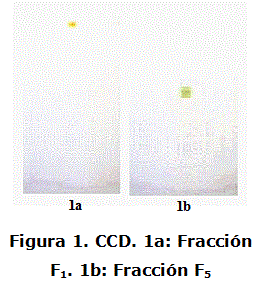
<body><![CDATA[<p align="center"><font size="2" face="Verdana">Anaranjado claro </font></p></td>       <td>    <p align="center"><font size="2" face="Verdana">Amarillo </font></p></td>       <td>    <p align="center"><font size="2" face="Verdana">Rosado </font></p></td>     </tr>     <tr>       <td>    <p align="center"><font size="2" face="Verdana">0,352 6 </font></p></td>       <td>    <p align="center"><font size="2" face="Verdana">Amarillo claro </font></p></td>       <td>    <p align="center"><font size="2" face="Verdana">Rosado </font></p></td>     </tr>   </table> </div>     <p align="justify"><font size="2" face="Verdana">Los diferentes colores observados en vis. y 365 nm demuestran la existencia de varias sustancias. La CCD mostr&oacute; que F<sub>1</sub> y F<sub>5</sub> pudieran estar formadas por un componente (<a href="#f1">figura 1</a>). El resto de las fracciones constituyen mezclas.</font></p>     <p align="center"><font size="2" face="Verdana"><a name="f1" id="f1"></a><img src="/img/revistas/ind/v29n3/f0109317.gif"></font></p>     
<p align="justify"><font size="2" face="Verdana">Los resultados de la actividad antibacteriana mostraron que <em>S. aureus </em> desarroll&oacute; resistencia frente al control meticilina, mientras que el antibi&oacute;tico ciprofloxacino y 2 fracciones de elusi&oacute;n presentaron actividad (<a href="#t2">tabla 2</a>).</font></p>     <p align="center"><font size="2" face="Verdana"><a name="t2"></a><strong>TABLA 2. ACTIVIDADANTIBACTERIANA DE LAS FRACCIONES DE ELUSI&Oacute;N FRENTE A <em>S. aureus</em></strong></font></p>      ]]></body>
<body><![CDATA[<div align="center">   <table border="1" cellpadding="0" cellspacing="0" bordercolor="#000000">     <tr>       <td>    <p align="center"><font size="2" face="Verdana"><strong>Fracciones </strong></font></p></td>       <td>    <p align="center"><font size="2" face="Verdana"><strong>Concentraci&oacute;n </strong></font></p>               <p align="center"><font size="2" face="Verdana"><strong>(&micro;g/disco) </strong></font></p></td>       <td>    <p align="center"><font size="2" face="Verdana"><strong>DI (mm) </strong></font></p></td>     </tr>     <tr>       <td height="27">    <p align="center"><font size="2" face="Verdana">F<sub>1</sub></font></p></td>       <td>    <p align="center"><font size="2" face="Verdana">2,5 </font></p></td>       <td>    <p align="center"><font size="2" face="Verdana">- </font></p></td>     </tr>     <tr>       <td height="29">    <p align="center"><font size="2" face="Verdana">F<sub>2</sub></font></p></td>       <td>    <p align="center"><font size="2" face="Verdana">2,5 </font></p></td>       <td>    ]]></body>
<body><![CDATA[<p align="center"><font size="2" face="Verdana">- </font></p></td>     </tr>     <tr>       <td height="30">    <p align="center"><font size="2" face="Verdana">F<sub>3</sub></font></p></td>       <td>    <p align="center"><font size="2" face="Verdana">2,5 </font></p></td>       <td>    <p align="center"><font size="2" face="Verdana">- </font></p></td>     </tr>     <tr>       <td height="32">    <p align="center"><font size="2" face="Verdana">F<sub>4</sub></font></p></td>       <td>    <p align="center"><font size="2" face="Verdana">2,5 </font></p></td>       <td>    <p align="center"><font size="2" face="Verdana">10,6&plusmn; 0,6 </font></p></td>     </tr>     <tr>       <td height="29">    <p align="center"><font size="2" face="Verdana">F<sub>5</sub></font></p></td>       <td>    <p align="center"><font size="2" face="Verdana">2,5 </font></p></td>       <td>    <p align="center"><font size="2" face="Verdana">16,6&plusmn; 0,6 </font></p></td>     </tr>     <tr>       <td height="30">    ]]></body>
<body><![CDATA[<p align="center"><font size="2" face="Verdana">F<sub>6</sub></font></p></td>       <td>    <p align="center"><font size="2" face="Verdana">2,5 </font></p></td>       <td>    <p align="center"><font size="2" face="Verdana">- </font></p></td>     </tr>     <tr>       <td height="29">    <p align="center"><font size="2" face="Verdana">F<sub>7</sub></font></p></td>       <td>    <p align="center"><font size="2" face="Verdana">2,5 </font></p></td>       <td>    <p align="center"><font size="2" face="Verdana">- </font></p></td>     </tr>     <tr>       <td height="27">    <p align="center"><font size="2" face="Verdana">F<sub>8</sub></font></p></td>       <td>    <p align="center"><font size="2" face="Verdana">2,5 </font></p></td>       <td>    <p align="center"><font size="2" face="Verdana">- </font></p></td>     </tr>     <tr>       <td>    <p align="center"><font size="2" face="Verdana">Ciprofloxacino </font></p></td>       <td>    ]]></body>
<body><![CDATA[<p align="center"><font size="2" face="Verdana">5 </font></p></td>       <td>    <p align="center"><font size="2" face="Verdana">18&plusmn; 0,6 </font></p></td>     </tr>     <tr>       <td>    <p align="center"><font size="2" face="Verdana">Meticilina </font></p></td>       <td>    <p align="center"><font size="2" face="Verdana">30 </font></p></td>       <td>    <p align="center"><font size="2" face="Verdana">- </font></p></td>     </tr>   </table> </div>       <p align="center"><font size="2" face="Verdana">(-): No present&oacute; actividad.</font></p>     <p align="justify"><font size="2" face="Verdana">La meticilina es un antibi&oacute;tico ß-lact&aacute;mico. La resistencia de <em>S. aureus </em> frente a este antibi&oacute;tico est&aacute; asociada a la adquisici&oacute;n de un gen no nativo que codifica una prote&iacute;na de uni&oacute;n a penicilina (PBP2a) con una afinidad menor por ß-lactamas. Esta resistencia permite la bios&iacute;ntesis de la pared celular, el blanco de ß-lactamas, para continuar incluso en presencia de concentraciones inhibidoras t&iacute;picas de antibi&oacute;tico [14].</font></p>     <p align="justify"><font size="2" face="Verdana">Seg&uacute;n los datos obtenidos el componente activo se encuentra en F<sub>4</sub> y F<sub>5</sub>. Los resultados de la actividad antibacteriana sugieren una mayor concentraci&oacute;n en F<sub>5</sub>, demostrando la existencia de dosis-dependencia. Por tanto, F<sub>4</sub> puede ser considerado como F<sub>5</sub> contaminado.</font></p>     <p align="justify"><font size="2" face="Verdana">Es interesante la relaci&oacute;n de los DI de los productos activos con las concentraciones utilizadas. La concentraci&oacute;n del antibi&oacute;tico es 2 veces superior a la de las fracciones, sin embargo, la diferencia entre los DI del ciprofloxacino y la fracci&oacute;n m&aacute;s activa no es relevante, demostrando la potencia del producto natural frente a <em>S. aureus</em>. Este es un resultado alentador, pues no son frecuentes DI de extractos de plantas similares a los de antibi&oacute;ticos [15].</font></p>     <p align="justify"><font size="2" face="Verdana">El tamizaje fitoqu&iacute;mico de las fracciones antibacterianas sugiere que los componentes activos de las hojas pueden ser flavonoides y cumarinas, con mayor incidencia en estas &uacute;ltimas pues en F<sub>5</sub> no se encontraron flavonoides (<a href="#t3">tabla 3</a>).</font></p>     ]]></body>
<body><![CDATA[<p align="center"><font size="2" face="Verdana"><a name="t3"></a><strong>TABLA  3. TAMIZAJE FITOQU&Iacute;MICO DE LAS FRACCIONES ANTIBACTERIANAS</strong></font></p>      <div align="center">   <table border="1" cellpadding="0" cellspacing="0" bordercolor="#000000">     <tr>       <td height="27" valign="top">    <p><font size="2" face="Verdana"><strong>Metabolitos </strong></font></p></td>       <td valign="top">    <p align="center"><font size="2" face="Verdana"><strong>F</strong><sub><strong>4</strong></sub></font></p></td>       <td valign="top">    <p align="center"><font size="2" face="Verdana"><strong>F</strong><sub><strong>5</strong></sub></font></p></td>     </tr>     <tr>       <td valign="top">    <p><font size="2" face="Verdana">Cumarinas </font></p></td>       <td valign="top">    <p align="center"><font size="2" face="Verdana">++ </font></p></td>       <td valign="top">    <p align="center"><font size="2" face="Verdana">++ </font></p></td>     </tr>     <tr>       <td valign="top">    <p><font size="2" face="Verdana">Fenoles y/o taninos </font></p></td>       <td valign="top">    <p align="center"><font size="2" face="Verdana">- </font></p></td>       <td valign="top">    ]]></body>
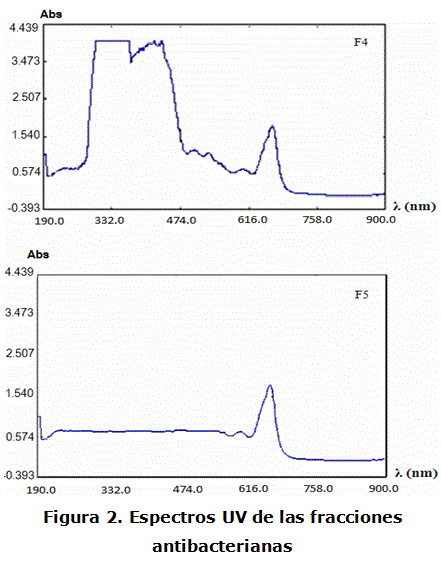
<body><![CDATA[<p align="center"><font size="2" face="Verdana">- </font></p></td>     </tr>     <tr>       <td valign="top">    <p><font size="2" face="Verdana">Quinonas </font></p></td>       <td valign="top">    <p align="center"><font size="2" face="Verdana">- </font></p></td>       <td valign="top">    <p align="center"><font size="2" face="Verdana">- </font></p></td>     </tr>     <tr>       <td valign="top">    <p><font size="2" face="Verdana">Flavonoides </font></p></td>       <td valign="top">    <p align="center"><font size="2" face="Verdana">+ </font></p></td>       <td valign="top">    <p align="center"><font size="2" face="Verdana">- </font></p></td>     </tr>   </table> </div>       <p align="center"><font size="2" face="Verdana">(-): ausente, (+): presente; (++): abundante</font></p>     <p align="justify"><font size="2" face="Verdana">F<sub>4</sub> y F<sub>5</sub> fueron sometidas a ensayos espectrosc&oacute;picos en UV. Los espectros obtenidos aparecen en la <a href="#f2">figura 2</a>.</font></p>     <p align="justify"><font size="2" face="Verdana">En el espectro UV de F<sub>4</sub> aparecen 13 m&aacute;ximos de absorci&oacute;n con distintos valores de absorbancia (<a href="#t4">tabla 4</a>), por tanto, puede ser una mezcla de varios compuestos. Est&aacute;n delimitadas 2 &aacute;reas de absorci&oacute;n, una entre 196 y 422 nm con 4 picos principales que se encuentran dentro de la zona de absorci&oacute;n de los flavonoides [16]; y la otra entre 522 y 850 nm, con un pico de absorci&oacute;n intenso a 666 nm, visible tambi&eacute;n en el espectro de F<sub>5</sub>. Considerando el resultado del tamizaje fitoqu&iacute;mico, esta se&ntilde;al pudiera corresponder a una cumarina muy conjugada pues presenta un corrimiento batocr&oacute;mico que puede estar relacionado con efectos combinados de dobles enlaces adicionales, sustituyentes como el –NH<sub>2</sub>, efectos del solvente y condensaci&oacute;n [17-19].</font></p>     ]]></body>
<body><![CDATA[<p align="center"><font size="2" face="Verdana"><a name="f2" id="f2"></a><img src="/img/revistas/ind/v29n3/f0209317.gif"></font></p>     
<p align="center"><font size="2" face="Verdana"><a name="t4"></a><strong>TABLA  4. M&Aacute;XIMOS DE ABSORCI&Oacute;N Y VALORES DE ABSORBANCIA     <br>   REGISTRADOS  EN LOS ESPECTROS UV DE F</strong><sub><strong>4</strong></sub><strong> Y F</strong><sub><strong>5</strong></sub></font></p>      <div align="center">   <table border="1" cellpadding="0" cellspacing="0" bordercolor="#000000">     <tr>       <td>    <p align="center"><font size="2" face="Verdana"><strong>Picos </strong></font></p></td>       <td width="92">    <p align="center"><font size="2" face="Verdana"><strong>&lambda; (nm) </strong></font></p></td>       <td width="105">    <p align="center"><font size="2" face="Verdana"><strong>Absorbancia </strong></font></p></td>     </tr>     <tr>       <td>    <p align="center"><font size="2" face="Verdana">1 </font></p></td>       <td width="92">    <p align="center"><font size="2" face="Verdana">900,00 </font></p></td>       <td width="105">    <p align="center"><font size="2" face="Verdana">0,045 5 </font></p></td>     </tr>     <tr>       <td>    ]]></body>
<body><![CDATA[<p align="center"><font size="2" face="Verdana">2 </font></p></td>       <td width="92">    <p align="center"><font size="2" face="Verdana">666,00 </font></p></td>       <td width="105">    <p align="center"><font size="2" face="Verdana">1,802 9 </font></p></td>     </tr>     <tr>       <td>    <p align="center"><font size="2" face="Verdana">3 </font></p></td>       <td width="92">    <p align="center"><font size="2" face="Verdana">604,00 </font></p></td>       <td width="105">    <p align="center"><font size="2" face="Verdana">0,691 6 </font></p></td>     </tr>     <tr>       <td>    <p align="center"><font size="2" face="Verdana">4 </font></p></td>       <td width="92">    <p align="center"><font size="2" face="Verdana">534,00 </font></p></td>       <td width="105">    <p align="center"><font size="2" face="Verdana">1,114 1 </font></p></td>     </tr>     <tr>       <td>    <p align="center"><font size="2" face="Verdana">5 </font></p></td>       <td width="92">    ]]></body>
<body><![CDATA[<p align="center"><font size="2" face="Verdana">504,00 </font></p></td>       <td width="105">    <p align="center"><font size="2" face="Verdana">1,1855 </font></p></td>     </tr>     <tr>       <td>    <p align="center"><font size="2" face="Verdana">6 </font></p></td>       <td width="92">    <p align="center"><font size="2" face="Verdana">436,00 </font></p></td>       <td width="105">    <p align="center"><font size="2" face="Verdana">4,0000 </font></p></td>     </tr>     <tr>       <td>    <p align="center"><font size="2" face="Verdana">7 </font></p></td>       <td width="92">    <p align="center"><font size="2" face="Verdana">422,00 </font></p></td>       <td width="105">    <p align="center"><font size="2" face="Verdana">3,975 5 </font></p></td>     </tr>     <tr>       <td>    <p align="center"><font size="2" face="Verdana">8 </font></p></td>       <td width="92">    <p align="center"><font size="2" face="Verdana">392,00 </font></p></td>       <td width="105">    ]]></body>
<body><![CDATA[<p align="center"><font size="2" face="Verdana">3,803 9 </font></p></td>     </tr>     <tr>       <td>    <p align="center"><font size="2" face="Verdana">9 </font></p></td>       <td width="92">    <p align="center"><font size="2" face="Verdana">302,00 </font></p></td>       <td width="105">    <p align="center"><font size="2" face="Verdana">4,000 0 </font></p></td>     </tr>     <tr>       <td>    <p align="center"><font size="2" face="Verdana">10 </font></p></td>       <td width="92">    <p align="center"><font size="2" face="Verdana">260,00 </font></p></td>       <td width="105">    <p align="center"><font size="2" face="Verdana">0,730 7 </font></p></td>     </tr>     <tr>       <td>    <p align="center"><font size="2" face="Verdana">11 </font></p></td>       <td width="92">    <p align="center"><font size="2" face="Verdana">250,00 </font></p></td>       <td width="105">    <p align="center"><font size="2" face="Verdana">0,727 4 </font></p></td>     </tr>     <tr>       <td>    ]]></body>
<body><![CDATA[<p align="center"><font size="2" face="Verdana">12 </font></p></td>       <td width="92">    <p align="center"><font size="2" face="Verdana">234,00 </font></p></td>       <td width="105">    <p align="center"><font size="2" face="Verdana">0,730 2 </font></p></td>     </tr>     <tr>       <td>    <p align="center"><font size="2" face="Verdana">13 </font></p></td>       <td width="92">    <p align="center"><font size="2" face="Verdana">196,00 </font></p></td>       <td width="105">    <p align="center"><font size="2" face="Verdana">1,060 2 </font></p></td>     </tr>   </table> </div>       <p align="justify"><font size="2" face="Verdana">Fuente: Espectrogramas UV de F<sub>4</sub> y F<sub>5</sub>.</font></p>     <p align="justify"><font size="2" face="Verdana">En la <a href="/img/revistas/ind/v29n3/f0309317.gif" target="_blank">figura 3</a> aparece el espectro IR obtenido para F<sub>5</sub>, indicando las bandas de absorci&oacute;n (<em>v</em>, cm<sup>-1</sup>).</font></p>     
<p align="justify"><font size="2" face="Verdana"><strong>F</strong><sub><strong>5</strong></sub>: IR (KBr) (<em>v</em><sub>m&aacute;x</sub>, cm<sup>-1</sup>) 3 630 (OH) ancha, 3 080 (-CH=) (arom&aacute;ticos), 1 715 (C=O) (arom&aacute;tico), 1 185 (C-O-C), 1 720-1 950, 750 (Ar) tonos arm&oacute;nicos.</font></p>     <p align="justify"><font size="2" face="Verdana">La existencia de bandas superpuestas a 3 080 y 1 715 cm<sup>-1</sup> pueden ser consecuencia de la presencia de varios grupos C=O; los tonos arm&oacute;nicos (1 720-1 950 y 750 cm<sup>-1</sup>) son caracter&iacute;sticos de anillos arom&aacute;ticos polisustituidos. La banda ancha (OH) es propia de los grupos involucrados en puentes de hidr&oacute;geno intramoleculares. El doblete de Ferming en 3 000-2 900 cm<sup>-1</sup> revela la presencia del grupo –NH<sub>2</sub> como sustituyente en anillos arom&aacute;ticos, por lo que pudiera tratarse de una aminocumarina (<a href="#t5">tabla 5</a>). Estos datos y la aparici&oacute;n de la banda C-O-C ayudan a confirmar que F<sub>5</sub> contiene los elementos principales de la estructura base de las cumarinas.</font></p>     ]]></body>
<body><![CDATA[<p align="center"><font size="2" face="Verdana"><a name="t5"></a><strong>Tabla 5. BANDAS DE ABSORCI&Oacute;N EN EL ESPECTRO IR DE F<sub>5</sub> (<em>v</em>, cm<sup>-1</sup>) ASIGNADAS     <br> A GRUPOS FUNCIONALES</strong></font></p>      <div align="center">   <table border="1" cellpadding="0" cellspacing="0" bordercolor="#000000">     <tr>       <td width="80">    <p align="center"><font size="2" face="Verdana"><strong>Grupo funcional </strong></font></p></td>       <td width="68">    <p align="center"><font size="2" face="Verdana">OH </font></p></td>       <td width="68">    <p align="center"><font size="2" face="Verdana">-CH= </font></p></td>       <td width="68">    <p align="center"><font size="2" face="Verdana">-NH<sub>2</sub></font></p></td>       <td width="92">    <p align="center"><font size="2" face="Verdana"><img src="/img/revistas/ind/v29n3/fo0109317.gif"></font></p></td>       <td width="60">    
<p align="center"><font size="2" face="Verdana">C=O </font></p></td>       <td width="68">    <p align="center"><font size="2" face="Verdana">C-O-C </font></p></td>       <td width="78">    ]]></body>
<body><![CDATA[<p align="center"><font size="2" face="Verdana">-N(CH<sub>3</sub>)n </font></p></td>     </tr>     <tr>       <td width="80">    <p align="center"><font size="2" face="Verdana"><strong>n (cm</strong><sup><strong>-1</strong></sup><strong>) </strong></font></p></td>       <td width="68">    <p align="center"><font size="2" face="Verdana">3 630 </font></p></td>       <td width="68">    <p align="center"><font size="2" face="Verdana">3 080 </font></p></td>       <td width="68">    <p align="center"><font size="2" face="Verdana">3 000-2 900 </font></p></td>       <td width="92">    <p align="center"><font size="2" face="Verdana">1 720-1 950, 750 </font></p></td>       <td width="60">    <p align="center"><font size="2" face="Verdana">1 715 </font></p></td>       <td width="68">    <p align="center"><font size="2" face="Verdana">1 185 </font></p></td>       <td width="78">    <p align="center"><font size="2" face="Verdana">1 210 </font></p></td>     </tr>   </table> </div>       <p align="justify"><font size="2" face="Verdana">El espectro IR de F<sub>5</sub> se introdujo en una base de datos con m&aacute;s de 100 000 compuestos, para realizar una comparaci&oacute;n basada en los valores de la distancia euclidiana y ratificar la asignaci&oacute;n de las se&ntilde;ales a los grupos funcionales. Las mayores aproximaciones se obtuvieron en 4 casos (<a href="/img/revistas/ind/v29n3/f0409317.gif" target="_blank">figura 4</a>).</font></p>     
]]></body>
<body><![CDATA[<p align="justify"><font size="2" face="Verdana">Las aproximaciones obtenidas sugieren la presencia de la agrupaci&oacute;n C-O-C=O en la estructura de F<sub>5</sub> (<a href="/img/revistas/ind/v29n3/f0409317.gif" target="_blank">figuras 4a</a> y <a href="/img/revistas/ind/v29n3/f0409317.gif" target="_blank">4b</a>), as&iacute; como de grupos nitrogenados probablemente contenidos en la agrupaci&oacute;n -N(CH<sub>3</sub>)<sub>n</sub>, con n=1, 2 (f<a href="/img/revistas/ind/v29n3/f0409317.gif" target="_blank">iguras 4c</a> y <a href="/img/revistas/ind/v29n3/f0409317.gif" target="_blank">figura 4d</a>).</font></p>     
<p align="justify"><font size="2" face="Verdana">Los datos IR revelan que F<sub>5</sub> presenta los grupos funcionales caracter&iacute;sticos del esqueleto 2 <em>H </em>-1-benzopiran-2-ona, concordando con estudios realizados que refieren que muchas cumarinas naturales y sint&eacute;ticas, incluidas las aminocumarinas, contienen grupos OH, libres o combinados [20-22]. Es probable que las se&ntilde;ales registradas en la huella dactilar de la mol&eacute;cula (por debajo de los 1 500 cm<sup>-1</sup>) pertenezcan a anillos arom&aacute;ticos condensados, fenoles prenilados, unidades isoprenoides sustituyentes o grupos glicos&iacute;dicos unidos al anillo cumar&iacute;nico.</font></p>     <p align="justify"><font size="2" face="Verdana">Los espectros UV e IR obtenidos confirman los resultados del tamizaje fitoqu&iacute;mico y permiten prever que el componente antibacteriano detectado en las hojas de <em>C. uniflora </em> sea una cumarina, espec&iacute;ficamente una aminocumarina. Los resultados de actividad antibacteriana del componente activo coinciden con otros en los que se ha demostrado la actividad de las cumarinas y sus derivados frente a <em>S. aureus </em> [23], donde se destacan las aminocumarinas novobiocina, clorobiocina y coumermicina A1 por su potente efecto inhibidor sobre la girasa bacteriana [24].</font></p>     <p>&nbsp;</p>     <p><font size="3" face="Verdana, Arial, Helvetica, sans-serif"><strong>CONCLUSIONES</strong></font></p>     <p align="justify"><font size="2" face="Verdana"> Fueron obtenidas 8 fracciones de elusi&oacute;n a partir de un extracto clorof&oacute;rmico de las hojas de C. uniflora. De ellas, 2 resultaron activas frente a una cepa de S. aureus resistente a la meticilina. Los metabolitos secundarios asociados a la actividad biol&oacute;gica pudieran ser flavonoides y cumarinas, con mayor relevancia para estas &uacute;ltimas. Los datos espectrosc&oacute;picos UV e IR conllevan a considerar que el componente activo pueda ser una cumarina, espec&iacute;ficamente una aminocumarina.</font></p>     <p align="justify">&nbsp;</p>     <p align="justify"><font size="3" face="Verdana, Arial, Helvetica, sans-serif"><strong>AGRADECIMIENTOS</strong></font></p>     <p align="justify"> <font size="2" face="Verdana">Ofrecemos nuestro agradecimiento al Servicio Alem&aacute;n de Intercambio Acad&eacute;mico (DAAD) por el apoyo t&eacute;cnico-material brindado en la realizaci&oacute;n de esta investigaci&oacute;n.</font></p>     <p align="justify">&nbsp;</p>     ]]></body>
<body><![CDATA[<p align="justify"><font size="2" face="Verdana, Arial, Helvetica, sans-serif"><strong><font size="3" face="Verdana">REFERENCIAS BIBLIOGR&Aacute;FICAS</font></strong></font></p>     <!-- ref --><p align="justify"><font size="2" face="Verdana">1.</font> <font size="2" face="Verdana"> CHAUDHARI, S. S.; CHAUDHARI, S. R.; CHAVAN, M. J. &quot;Analgesic, anti-inflammatory and anti-arthritic activity of <em>Cassia uniflora </em> Mill&quot;. <em>Asian Pac J Trop Biomed</em>. 2012, 2(1), S181-6.    </font></p>     <!-- ref --><p align="justify"><font size="2" face="Verdana">2. GHAYAL, N.; PADHYE, A.; DHUMAL, K. &quot;Larvicidal activity of invasive weeds <em>Cassia uniflora </em> and <em>Synedrella nodiflora</em>&quot;. <em>Int J Pharma Bio Sci</em>. 2010, 1(3), 1-10. ISSN 0975-6299.    </font></p>     <!-- ref --><p align="justify"><font size="2" face="Verdana">3. VITONDE, S.; THENGANE, R. J.; GHOLE, V. S. &quot;Allelopathic effects of <em>Cassia tora </em>and <em> Cassia uniflora </em> on <em>Parthenium hysterophorous </em> L&quot;. <em>J Med Plants Res</em>. 2014, 8(4), 194-196. ISSN 1996-0875.    </font></p>     <!-- ref --><p align="justify"><font size="2" face="Verdana">4. MORALES LE&Oacute;N, J. A.; FONSECA GARC&Iacute;A, A.; ALMEIDA SAAVEDRA, M.; MORALES TORRES, G.; TORRES RODR&Iacute;GUEZ, E. &quot;Tamizaje fitoqu&iacute;mico de <em>Cassia uniflora </em> Mill&quot;. <em>Rev Cub Plant Med</em>. 2011, 16(4), 331-336. ISSN 1028-4796.    </font></p>     <!-- ref --><p align="justify"><font size="2" face="Verdana">5. COMPEAN, K. L.; YNALVEZ, R. A. &quot;Antimicrobial Activity of Plant Secondary Metabolites: A Review&quot;. <em>Res J Med Plant</em>. 2014, 8(5), 204-213. ISSN 1819-3455.    </font></p>     <!-- ref --><p align="justify"><font size="2" face="Verdana">6. ROIG MESA, J. T. <em>Diccionario bot&aacute;nico de nombres vulgares cubanos</em>. 4ta ed. La Habana: Editorial Cient&iacute;fico-T&eacute;cnica. 2014. ISBN 959-05-0712-3.    </font></p>     <!-- ref --><p align="justify"><font size="2" face="Verdana">7. LADHANI, S.; JOANNOU, C. L.; LOCHRIE, D. P.; EVANS, R. W.; POSTON, S. M. &quot;Clinical, microbial, and biochemical aspects of the exfoliative toxins causing staphylococcal scalded-skin syndrome&quot;. <em>Clinical microbiology reviews</em>. 1999, 12(2), 224–242.    </font></p>     <!-- ref --><p align="justify"><font size="2" face="Verdana">8. MINISTERIO DE SALUD P&Uacute;BLICA. NRSP No. 309. Medicamentos de origen vegetal: droga cruda. M&eacute;todos de ensayos. La Habana: MINSAP, 1992.    </font></p>     <!-- ref --><p align="justify"><font size="2" face="Verdana">9. BAUER, A. W.; KIRBY, W. M. M.; SHERRIS, J. C.; TURCK, M. &quot;Antibiotic susceptibility testing by a standardized single disk method&quot;. <em>Amer Clin Pathol</em>. 1966, 45, 493-6.    </font></p>     <!-- ref --><p align="justify"><font size="2" face="Verdana">10. THANGARAJ, P. &quot;Extraction of Bioactive Compounds&quot;. En: <em>Pharmacological Assays of Plant-Based Natural Products </em>. Switzerland: Springer International Publishing; 2016. vol. 71, p. 188. ISBN 978-3-319-26810-1.    </font></p>     <p align="justify"><font size="2" face="Verdana">11. NATIONAL INSTITUTE OF STANDARDS AND TECNOLOGY. Libro del Web de Qu&iacute;mica del NIST [en l&iacute;nea]. [Consulta: 14 octubre 2016]. Disponible en: <a href="http://webbook.nist.gov/chemistry/" target="_blank">http://webbook.nist.gov/chemistry/</a></font></p>     <p align="justify"><font size="2" face="Verdana">12. UNIVERSITY OF CALIFORNIA. Infrared Spectroscopy Absorption Table - Chemistry LibreTexts [en l&iacute;nea]. [Consulta: 15 octubre 2016]. Disponible en: <a href="https://chem.libretexts.org/Reference/Reference_Tables/Spectroscopic_Parameters/Infrared_Spectroscopy_Absorption_Table" target="_blank">https://chem.libretexts.org/Reference/Reference_Tables/Spectroscopic_Parameters/Infrared_Spectroscopy_Absorption_Table</a></font></p>     <p align="justify"><font size="2" face="Verdana">13. NATIONAL INSTITUTE OF ADVANCED INDUSTRIAL SCIENCE AND TECHNOLOGY. AIST: Spectral Database for Organic Compounds, SDBS [en l&iacute;nea]. [Consulta: 15 octubre 2016]. Disponible en: <a href="http://sdbs.db.aist.go.jp/sdbs/cgi-bin/direct_frame_top.cgi%20" target="_blank">http://sdbs.db.aist.go.jp/sdbs/cgi-bin/direct_frame_top.cgi</a></font></p>     <!-- ref --><p align="justify"><font size="2" face="Verdana">14. PEACOCK, S. J.; PATERSON, G. K. &quot;Mechanisms of Methicillin Resistance in <em>Staphylococcus aureus</em>&quot;. <em>Annual Review of Biochemistry</em>. 2015, 84(1), 577-601. ISSN 0066-4154, 1545-4509.    </font></p>     <!-- ref --><p align="justify"><font size="2" face="Verdana">15. GYAWALI, R.; IBRAHIM, S. A. &quot;Natural products as antimicrobial agents&quot;. <em>Food Control</em>. 2014, 46, 412-429. ISSN 0956-7135.    </font></p>     <!-- ref --><p align="justify"><font size="2" face="Verdana">16. SISA, M.; BONNET, S. L.; FERREIRA, D.; VAN DER WESTHUIZEN, J. H. &quot;Photochemistry of Flavonoids&quot;. <em>Molecules</em>. 2010, 15(8), 5196-5245. ISSN 1420-3049.    </font></p>     ]]></body>
<body><![CDATA[<!-- ref --><p align="justify"><font size="2" face="Verdana">17. YAMAJI, M.; HAKODA, Y.; OKAMOTO, H.; TANI, F. &quot;Photochemical synthesis and photophysical properties of coumarins bearing extended polyaromatic rings studied by emission and transient absorption measurements&quot;. <em>Photochem. Photobiol. Sci. </em> 2017,  16(4), 555-563.    </font></p>     <!-- ref --><p align="justify"><font size="2" face="Verdana">18. LIU, X.; COLE, J. M.; LOW, K. S. &quot;Solvent Effects on the UV–vis Absorption and Emission of Optoelectronic Coumarins: a Comparison of Three Empirical Solvatochromic Models&quot;. <em>The Journal of Physical Chemistry C </em>. 2013, 117(28), 14731–14741. ISSN 1932-7447, 1932-7455.    </font></p>     <!-- ref --><p align="justify"><font size="2" face="Verdana">19. DONOVALOV&Aacute;, J. <em>et al. &quot; </em>Spectral Properties of Substituted Coumarins in Solution and Polymer Matrices&quot;. <em>Molecules</em>. 2012, 17(12), 3259–3276. ISSN 1420-3049.    </font></p>     <!-- ref --><p align="justify"><font size="2" face="Verdana">20. DAVIS, R. A.; VULLO, D.; MARESCA, A.; SUPURAN, C. T.; POULSEN, S. A. &quot;Natural product coumarins that inhibit human carbonic anhydrases&quot;. <em>Bioorganic Med Chem</em>. 2013, 21(6), 1539-1543.    </font></p>     <!-- ref --><p align="justify"><font size="2" face="Verdana">21. MOSTAFAVI, H.; NAJJAR, R.; MASKANI, E. &quot;Synthesis and characterization of novel 7-hydroxycoumarin derivatives&quot;. <em>Chemistry of Natural Compounds</em>. 2013, 49(3), 423-425.    </font></p>     ]]></body>
<body><![CDATA[<!-- ref --><p align="justify"><font size="2" face="Verdana">22. FYLAKTAKIDOU, K. C.; HADJIPAVLOU LITINA, D. J.; LITINAS, K. E.; NICOLAIDES, D. N. &quot;Natural and synthetic coumarin derivatives with anti-inflammatory/antioxidant activities&quot;. <em>Current pharmaceutical design</em>. 2004, 10(30), 3813-3833.    </font></p>     <p align="justify"><font size="2" face="Verdana">23. HOTI, R.; VEHAPI, I.; MULLIQI OSMANI, G.; ISMAILI, H.; VEPRIM, T. &quot;Synthesis of Some New Heteroarylamino-3-Nitro-2H-[1]-Benzopyran-2-ones and their Antibacterial Activity&quot;. <em>American Scientific Research Journal for Engineering, Technology, and Sciences</em>. 2016, 22(1), 1-9.</font></p>     <!-- ref --><p align="justify"><font size="2" face="Verdana">24. HEIDE, L. &quot;New aminocoumarin antibiotics as gyrase inhibitors&quot;. <em>International Journal of Medical Microbiology</em>. 2014, 304(1), 31-36. ISSN 14384221.    </font></p>     <p align="justify">&nbsp;</p>     <p align="justify">&nbsp;</p>     <p align="justify"><font size="2" face="Verdana">Recibido: 22/11/2016    <br> Aceptado: 11/03/2017</font></p>     <p>&nbsp;</p>     ]]></body>
<body><![CDATA[<p>&nbsp;</p>     <p align="justify"><font size="2" face="Verdana"><em>MSc. Jos&eacute; Angel Morales Le&oacute;n</em>, Centro de Estudios de Qu&iacute;mica Aplicada. Universidad de Granma, Cuba,</font> <a href="mailto:jmorales@udg.co.cu"><font size="2" face="Verdana">jmorales@udg.co.cu</font></a></p>      ]]></body><back>
<ref-list>
<ref id="B1">
<label>1</label><nlm-citation citation-type="">
<person-group person-group-type="author">
<name>
<surname><![CDATA[CHAUDHARI]]></surname>
<given-names><![CDATA[S. S]]></given-names>
</name>
<name>
<surname><![CDATA[CHAUDHARI]]></surname>
<given-names><![CDATA[S. R]]></given-names>
</name>
<name>
<surname><![CDATA[CHAVAN]]></surname>
<given-names><![CDATA[M. J]]></given-names>
</name>
</person-group>
<article-title xml:lang="en"><![CDATA[Analgesic, anti-inflammatory and anti-arthritic activity of Cassia uniflora Mill]]></article-title>
<source><![CDATA[]]></source>
<year>2012</year>
<volume>2</volume>
<numero>1</numero>
<issue>1</issue>
<page-range>S181-6</page-range></nlm-citation>
</ref>
<ref id="B2">
<label>2</label><nlm-citation citation-type="">
<person-group person-group-type="author">
<name>
<surname><![CDATA[GHAYAL]]></surname>
<given-names><![CDATA[N]]></given-names>
</name>
<name>
<surname><![CDATA[PADHYE]]></surname>
<given-names><![CDATA[A]]></given-names>
</name>
<name>
<surname><![CDATA[DHUMAL]]></surname>
<given-names><![CDATA[K]]></given-names>
</name>
</person-group>
<article-title xml:lang="en"><![CDATA[Larvicidal activity of invasive weeds Cassia uniflora and Synedrella nodiflora]]></article-title>
<source><![CDATA[]]></source>
<year>2010</year>
<volume>1</volume>
<numero>3</numero>
<issue>3</issue>
<page-range>1-10</page-range></nlm-citation>
</ref>
<ref id="B3">
<label>3</label><nlm-citation citation-type="">
<person-group person-group-type="author">
<name>
<surname><![CDATA[VITONDE]]></surname>
<given-names><![CDATA[S]]></given-names>
</name>
<name>
<surname><![CDATA[THENGANE]]></surname>
<given-names><![CDATA[R. J]]></given-names>
</name>
<name>
<surname><![CDATA[GHOLE]]></surname>
<given-names><![CDATA[V. S]]></given-names>
</name>
</person-group>
<article-title xml:lang="en"><![CDATA[Allelopathic effects of Cassia tora and Cassia uniflora on Parthenium hysterophorous L]]></article-title>
<source><![CDATA[]]></source>
<year>2014</year>
<volume>8</volume>
<numero>4</numero>
<issue>4</issue>
<page-range>194-196</page-range></nlm-citation>
</ref>
<ref id="B4">
<label>4</label><nlm-citation citation-type="">
<person-group person-group-type="author">
<name>
<surname><![CDATA[MORALES LEÓN]]></surname>
<given-names><![CDATA[J. A]]></given-names>
</name>
<name>
<surname><![CDATA[FONSECA GARCÍA]]></surname>
<given-names><![CDATA[A]]></given-names>
</name>
<name>
<surname><![CDATA[ALMEIDA SAAVEDRA]]></surname>
<given-names><![CDATA[M]]></given-names>
</name>
<name>
<surname><![CDATA[MORALES TORRES]]></surname>
<given-names><![CDATA[G]]></given-names>
</name>
<name>
<surname><![CDATA[TORRES RODRÍGUEZ]]></surname>
<given-names><![CDATA[E]]></given-names>
</name>
</person-group>
<article-title xml:lang="es"><![CDATA[Tamizaje fitoquímico de Cassia uniflora Mill]]></article-title>
<source><![CDATA[]]></source>
<year>2011</year>
<volume>16</volume>
<numero>4</numero>
<issue>4</issue>
<page-range>331-336</page-range></nlm-citation>
</ref>
<ref id="B5">
<label>5</label><nlm-citation citation-type="">
<person-group person-group-type="author">
<name>
<surname><![CDATA[COMPEAN]]></surname>
<given-names><![CDATA[K. L]]></given-names>
</name>
<name>
<surname><![CDATA[YNALVEZ]]></surname>
<given-names><![CDATA[R. A]]></given-names>
</name>
</person-group>
<article-title xml:lang="en"><![CDATA[Antimicrobial Activity of Plant Secondary Metabolites: A Review]]></article-title>
<source><![CDATA[]]></source>
<year>2014</year>
<volume>8</volume>
<numero>5</numero>
<issue>5</issue>
<page-range>204-213</page-range></nlm-citation>
</ref>
<ref id="B6">
<label>6</label><nlm-citation citation-type="book">
<person-group person-group-type="author">
<name>
<surname><![CDATA[ROIG MESA]]></surname>
<given-names><![CDATA[J. T]]></given-names>
</name>
</person-group>
<source><![CDATA[Diccionario botánico de nombres vulgares cubanos]]></source>
<year>2014</year>
<edition>4</edition>
<publisher-loc><![CDATA[La Habana ]]></publisher-loc>
<publisher-name><![CDATA[Editorial Científico-Técnica]]></publisher-name>
</nlm-citation>
</ref>
<ref id="B7">
<label>7</label><nlm-citation citation-type="">
<person-group person-group-type="author">
<name>
<surname><![CDATA[LADHANI]]></surname>
<given-names><![CDATA[S]]></given-names>
</name>
<name>
<surname><![CDATA[JOANNOU]]></surname>
<given-names><![CDATA[C. L]]></given-names>
</name>
<name>
<surname><![CDATA[LOCHRIE]]></surname>
<given-names><![CDATA[D. P]]></given-names>
</name>
<name>
<surname><![CDATA[EVANS]]></surname>
<given-names><![CDATA[R. W]]></given-names>
</name>
<name>
<surname><![CDATA[POSTON]]></surname>
<given-names><![CDATA[S. M]]></given-names>
</name>
</person-group>
<article-title xml:lang="en"><![CDATA[Clinical, microbial, and biochemical aspects of the exfoliative toxins causing staphylococcal scalded-skin syndrome]]></article-title>
<source><![CDATA[]]></source>
<year>1999</year>
<volume>12</volume>
<numero>2</numero>
<issue>2</issue>
<page-range>224-242</page-range></nlm-citation>
</ref>
<ref id="B8">
<label>8</label><nlm-citation citation-type="book">
<collab>MINISTERIO DE SALUD PÚBLICA</collab>
<source><![CDATA[NRSP No. 309. Medicamentos de origen vegetal: droga cruda. Métodos de ensayos]]></source>
<year>1992</year>
<publisher-loc><![CDATA[La Habana ]]></publisher-loc>
<publisher-name><![CDATA[MINSAP]]></publisher-name>
</nlm-citation>
</ref>
<ref id="B9">
<label>9</label><nlm-citation citation-type="">
<person-group person-group-type="author">
<name>
<surname><![CDATA[BAUER]]></surname>
<given-names><![CDATA[A. W]]></given-names>
</name>
<name>
<surname><![CDATA[KIRBY]]></surname>
<given-names><![CDATA[W. M. M]]></given-names>
</name>
<name>
<surname><![CDATA[SHERRIS]]></surname>
<given-names><![CDATA[J. C]]></given-names>
</name>
<name>
<surname><![CDATA[TURCK]]></surname>
<given-names><![CDATA[M]]></given-names>
</name>
</person-group>
<article-title xml:lang="en"><![CDATA[Antibiotic susceptibility testing by a standardized single disk method]]></article-title>
<source><![CDATA[]]></source>
<year>1966</year>
<volume>45</volume>
<page-range>493-6</page-range></nlm-citation>
</ref>
<ref id="B10">
<label>10</label><nlm-citation citation-type="book">
<person-group person-group-type="author">
<name>
<surname><![CDATA[THANGARAJ]]></surname>
<given-names><![CDATA[P]]></given-names>
</name>
</person-group>
<article-title xml:lang="en"><![CDATA[Extraction of Bioactive Compounds]]></article-title>
<source><![CDATA[Pharmacological Assays of Plant-Based Natural Products]]></source>
<year>2016</year>
<volume>71</volume>
<page-range>188</page-range><publisher-name><![CDATA[Springer International Publishing]]></publisher-name>
</nlm-citation>
</ref>
<ref id="B11">
<label>11</label><nlm-citation citation-type="">
<collab>NATIONAL INSTITUTE OF STANDARDS AND TECNOLOGY</collab>
<source><![CDATA[Libro del Web de Química del NIST]]></source>
<year></year>
</nlm-citation>
</ref>
<ref id="B12">
<label>12</label><nlm-citation citation-type="">
<collab>UNIVERSITY OF CALIFORNIA</collab>
<source><![CDATA[Infrared Spectroscopy Absorption Table - Chemistry LibreTexts]]></source>
<year></year>
</nlm-citation>
</ref>
<ref id="B13">
<label>13</label><nlm-citation citation-type="">
<collab>NATIONAL INSTITUTE OF ADVANCED INDUSTRIAL SCIENCE AND TECHNOLOGY</collab>
<source><![CDATA[AIST: Spectral Database for Organic Compounds, SDBS]]></source>
<year></year>
</nlm-citation>
</ref>
<ref id="B14">
<label>14</label><nlm-citation citation-type="">
<person-group person-group-type="author">
<name>
<surname><![CDATA[PEACOCK]]></surname>
<given-names><![CDATA[S. J]]></given-names>
</name>
<name>
<surname><![CDATA[PATERSON]]></surname>
<given-names><![CDATA[G. K]]></given-names>
</name>
</person-group>
<article-title xml:lang="en"><![CDATA[Mechanisms of Methicillin Resistance in Staphylococcus aureus]]></article-title>
<source><![CDATA[]]></source>
<year>2015</year>
<volume>84</volume>
<numero>1</numero>
<issue>1</issue>
<page-range>577-601</page-range></nlm-citation>
</ref>
<ref id="B15">
<label>15</label><nlm-citation citation-type="">
<person-group person-group-type="author">
<name>
<surname><![CDATA[GYAWALI]]></surname>
<given-names><![CDATA[R]]></given-names>
</name>
<name>
<surname><![CDATA[IBRAHIM]]></surname>
<given-names><![CDATA[S. A]]></given-names>
</name>
</person-group>
<article-title xml:lang="en"><![CDATA[Natural products as antimicrobial agents]]></article-title>
<source><![CDATA[]]></source>
<year>2014</year>
<volume>46</volume>
<page-range>412-429</page-range></nlm-citation>
</ref>
<ref id="B16">
<label>16</label><nlm-citation citation-type="">
<person-group person-group-type="author">
<name>
<surname><![CDATA[SISA]]></surname>
<given-names><![CDATA[M]]></given-names>
</name>
<name>
<surname><![CDATA[BONNET]]></surname>
<given-names><![CDATA[S. L]]></given-names>
</name>
<name>
<surname><![CDATA[FERREIRA]]></surname>
<given-names><![CDATA[D]]></given-names>
</name>
<name>
<surname><![CDATA[VAN DER WESTHUIZEN]]></surname>
<given-names><![CDATA[J. H]]></given-names>
</name>
</person-group>
<article-title xml:lang="en"><![CDATA[Photochemistry of Flavonoids]]></article-title>
<source><![CDATA[]]></source>
<year>2010</year>
<volume>15</volume>
<numero>8</numero>
<issue>8</issue>
<page-range>5196-5245</page-range></nlm-citation>
</ref>
<ref id="B17">
<label>17</label><nlm-citation citation-type="">
<person-group person-group-type="author">
<name>
<surname><![CDATA[YAMAJI]]></surname>
<given-names><![CDATA[M.]]></given-names>
</name>
<name>
<surname><![CDATA[HAKODA]]></surname>
<given-names><![CDATA[Y]]></given-names>
</name>
<name>
<surname><![CDATA[OKAMOTO]]></surname>
<given-names><![CDATA[H]]></given-names>
</name>
<name>
<surname><![CDATA[TANI]]></surname>
<given-names><![CDATA[F.]]></given-names>
</name>
</person-group>
<article-title xml:lang="en"><![CDATA[Photochemical synthesis and photophysical properties of coumarins bearing extended polyaromatic rings studied by emission and transient absorption measurements]]></article-title>
<source><![CDATA[]]></source>
<year>2017</year>
<volume>16</volume>
<numero>4</numero>
<issue>4</issue>
<page-range>555-563</page-range></nlm-citation>
</ref>
<ref id="B18">
<label>18</label><nlm-citation citation-type="">
<person-group person-group-type="author">
<name>
<surname><![CDATA[LIU]]></surname>
<given-names><![CDATA[X]]></given-names>
</name>
<name>
<surname><![CDATA[COLE]]></surname>
<given-names><![CDATA[J. M]]></given-names>
</name>
<name>
<surname><![CDATA[LOW]]></surname>
<given-names><![CDATA[K. S]]></given-names>
</name>
</person-group>
<article-title xml:lang="en"><![CDATA[Solvent Effects on the UV-vis Absorption and Emission of Optoelectronic Coumarins: a Comparison of Three Empirical Solvatochromic Models]]></article-title>
<source><![CDATA[]]></source>
<year>2013</year>
<volume>117</volume>
<numero>28</numero>
<issue>28</issue>
<page-range>14731-14741</page-range></nlm-citation>
</ref>
<ref id="B19">
<label>19</label><nlm-citation citation-type="">
<person-group person-group-type="author">
<name>
<surname><![CDATA[DONOVALOVÁ]]></surname>
<given-names><![CDATA[J]]></given-names>
</name>
</person-group>
<article-title xml:lang="en"><![CDATA[Spectral Properties of Substituted Coumarins in Solution and Polymer Matrices]]></article-title>
<source><![CDATA[]]></source>
<year>2012</year>
<volume>17</volume>
<numero>12</numero>
<issue>12</issue>
<page-range>3259-3276</page-range></nlm-citation>
</ref>
<ref id="B20">
<label>20</label><nlm-citation citation-type="">
<person-group person-group-type="author">
<name>
<surname><![CDATA[DAVIS]]></surname>
<given-names><![CDATA[R. A]]></given-names>
</name>
<name>
<surname><![CDATA[VULLO]]></surname>
<given-names><![CDATA[D]]></given-names>
</name>
<name>
<surname><![CDATA[MARESCA]]></surname>
<given-names><![CDATA[A]]></given-names>
</name>
<name>
<surname><![CDATA[SUPURAN]]></surname>
<given-names><![CDATA[C]]></given-names>
</name>
<name>
<surname><![CDATA[POULSEN]]></surname>
<given-names><![CDATA[S. A]]></given-names>
</name>
</person-group>
<article-title xml:lang="en"><![CDATA[Natural product coumarins that inhibit human carbonic anhydrase]]></article-title>
<source><![CDATA[]]></source>
<year>2013</year>
<volume>21</volume>
<numero>6</numero>
<issue>6</issue>
<page-range>1539-1543</page-range></nlm-citation>
</ref>
<ref id="B21">
<label>21</label><nlm-citation citation-type="">
<person-group person-group-type="author">
<name>
<surname><![CDATA[MOSTAFAVI]]></surname>
<given-names><![CDATA[H]]></given-names>
</name>
<name>
<surname><![CDATA[NAJJAR]]></surname>
<given-names><![CDATA[R]]></given-names>
</name>
<name>
<surname><![CDATA[MASKANI]]></surname>
<given-names><![CDATA[E]]></given-names>
</name>
</person-group>
<article-title xml:lang="en"><![CDATA[Synthesis and characterization of novel 7-hydroxycoumarin derivatives]]></article-title>
<source><![CDATA[]]></source>
<year>2013</year>
<volume>49</volume>
<numero>3</numero>
<issue>3</issue>
<page-range>423-425</page-range></nlm-citation>
</ref>
<ref id="B22">
<label>22</label><nlm-citation citation-type="">
<person-group person-group-type="author">
<name>
<surname><![CDATA[FYLAKTAKIDOU]]></surname>
<given-names><![CDATA[K. C]]></given-names>
</name>
<name>
<surname><![CDATA[HADJIPAVLOU LITINA]]></surname>
<given-names><![CDATA[D. J]]></given-names>
</name>
<name>
<surname><![CDATA[LITINAS]]></surname>
<given-names><![CDATA[K. E]]></given-names>
</name>
<name>
<surname><![CDATA[NICOLAIDES]]></surname>
<given-names><![CDATA[D. N]]></given-names>
</name>
</person-group>
<article-title xml:lang="en"><![CDATA[Natural and synthetic coumarin derivatives with anti-inflammatory/antioxidant activities]]></article-title>
<source><![CDATA[]]></source>
<year>2004</year>
<volume>10</volume>
<numero>30</numero>
<issue>30</issue>
<page-range>3813-3833</page-range></nlm-citation>
</ref>
<ref id="B23">
<label>23</label><nlm-citation citation-type="">
<person-group person-group-type="author">
<name>
<surname><![CDATA[HOTI]]></surname>
<given-names><![CDATA[R]]></given-names>
</name>
<name>
<surname><![CDATA[VEHAPI]]></surname>
<given-names><![CDATA[I]]></given-names>
</name>
<name>
<surname><![CDATA[MULLIQI OSMANI]]></surname>
<given-names><![CDATA[G]]></given-names>
</name>
<name>
<surname><![CDATA[ISMAILI]]></surname>
<given-names><![CDATA[H]]></given-names>
</name>
<name>
<surname><![CDATA[VEPRIM]]></surname>
<given-names><![CDATA[T]]></given-names>
</name>
</person-group>
<article-title xml:lang="en"><![CDATA[Synthesis of Some New Heteroarylamino-3-Nitro-2H-ENT#091;1ENT#093;-Benzopyran-2-ones and their Antibacterial Activity]]></article-title>
<source><![CDATA[]]></source>
<year>2016</year>
<volume>22</volume>
<numero>1</numero>
<issue>1</issue>
<page-range>1-9</page-range></nlm-citation>
</ref>
<ref id="B24">
<label>24</label><nlm-citation citation-type="">
<person-group person-group-type="author">
<name>
<surname><![CDATA[HEIDE]]></surname>
<given-names><![CDATA[L]]></given-names>
</name>
</person-group>
<article-title xml:lang="en"><![CDATA[New aminocoumarin antibiotics as gyrase inhibitors]]></article-title>
<source><![CDATA[]]></source>
<year>2014</year>
<volume>304</volume>
<numero>1</numero>
<issue>1</issue>
<page-range>31-36</page-range></nlm-citation>
</ref>
</ref-list>
</back>
</article>