<?xml version="1.0" encoding="ISO-8859-1"?><article xmlns:mml="http://www.w3.org/1998/Math/MathML" xmlns:xlink="http://www.w3.org/1999/xlink" xmlns:xsi="http://www.w3.org/2001/XMLSchema-instance">
<front>
<journal-meta>
<journal-id>2224-5421</journal-id>
<journal-title><![CDATA[Revista Cubana de Química]]></journal-title>
<abbrev-journal-title><![CDATA[Rev Cub Quim]]></abbrev-journal-title>
<issn>2224-5421</issn>
<publisher>
<publisher-name><![CDATA[Ediciones UO, Universidad de Oriente]]></publisher-name>
</publisher>
</journal-meta>
<article-meta>
<article-id>S2224-54212018000200009</article-id>
<title-group>
<article-title xml:lang="en"><![CDATA[A new potentiometric sensor for nitrate using diethylphthalate (DEP) as plasticizer and triocthylmethylammonium chloride (TOMACl) as ionophore]]></article-title>
<article-title xml:lang="es"><![CDATA[Nuevo sensor potenciométrico para nitrato, usando el dietiloftalato (DEP) como plastificante y el cloruro de trioctilmetilamonio (ClTOMA) como ionóforo]]></article-title>
</title-group>
<contrib-group>
<contrib contrib-type="author">
<name>
<surname><![CDATA[Arada-Pérez]]></surname>
<given-names><![CDATA[María de los Ángeles]]></given-names>
</name>
<xref ref-type="aff" rid="A01"/>
</contrib>
<contrib contrib-type="author">
<name>
<surname><![CDATA[Nápoles-Florián]]></surname>
<given-names><![CDATA[Karel Yasmany]]></given-names>
</name>
<xref ref-type="aff" rid="A02"/>
</contrib>
</contrib-group>
<aff id="A01">
<institution><![CDATA[,Universidad de Oriente Facultad de Ciencias Naturales y Exactas Departamento de Química]]></institution>
<addr-line><![CDATA[Santiago de Cuba ]]></addr-line>
<country>Cuba</country>
</aff>
<aff id="A02">
<institution><![CDATA[,Geominera Oriente Company BEU Laboratory ]]></institution>
<addr-line><![CDATA[ ]]></addr-line>
</aff>
<pub-date pub-type="pub">
<day>00</day>
<month>08</month>
<year>2018</year>
</pub-date>
<pub-date pub-type="epub">
<day>00</day>
<month>08</month>
<year>2018</year>
</pub-date>
<volume>30</volume>
<numero>2</numero>
<fpage>277</fpage>
<lpage>288</lpage>
<copyright-statement/>
<copyright-year/>
<self-uri xlink:href="http://scielo.sld.cu/scielo.php?script=sci_arttext&amp;pid=S2224-54212018000200009&amp;lng=en&amp;nrm=iso"></self-uri><self-uri xlink:href="http://scielo.sld.cu/scielo.php?script=sci_abstract&amp;pid=S2224-54212018000200009&amp;lng=en&amp;nrm=iso"></self-uri><self-uri xlink:href="http://scielo.sld.cu/scielo.php?script=sci_pdf&amp;pid=S2224-54212018000200009&amp;lng=en&amp;nrm=iso"></self-uri><abstract abstract-type="short" xml:lang="en"><p><![CDATA[In this work, a potentiometric sensor for nitrate using diethylphthalate (DEP) as plasticizer, triocthylmethylammonium chloride (TOMACl) as ionophore and poly (vinylchloride) (PVC) as matrix is valued. Some parameters of evaluation of the electrode are presented: slope (S), practical detection limit (PDL), lower limit of linear response (LLLR), lifetime, influence of the pH on the response of the electrode and the potentiometric selectivity coefficients (K AB POT). The constructed electrode exhibited a Nernstian response to NO3- over a wide concentration range (10-6 to 10-2 mol·dm-3), with a slope of -70,71 ± 1,05 mV/dec. It showed a fast response time (20 s). The electrode showed a good performance in the pH range 3 - 9 and lifetime of 2 - 2,5 months. The selectivity coefficients for various ions were calculated.]]></p></abstract>
<abstract abstract-type="short" xml:lang="es"><p><![CDATA[Fue evaluado un sensor potenciométrico a nitrato, empleando el cloruro de trioctilmetilamonio (ClTOMA) como ionóforo y como plastificante el dietiloftalato (DEP) en una matriz de cloruro de polivinilo (PVC). Algunos parámetros de evaluación del electrodo son presentados: pendiente (S), límite práctico de detección (LPD), límite inferior de respuesta lineal (LIRL), tiempo de vida, influencia del pH en la respuesta del electrodo y los coeficientes de selectividad potenciométricos (K AB POT). El electrodo construido mostró una rápida respuesta potenciométrica al ion nitrato en el rango de concentración 10-6 a 10-2 mol·dm-3 con pendiente de -70,71 ± 1,05 mV·déc-1 y un tiempo de respuesta de 20 s. El electrodo mostró una buena respuesta en el rango de pH entre 3 - 9 y tiempo de vida de 2 - 2,5 meses. Los coeficientes de selectividad de varios iones fueron calculados.]]></p></abstract>
<kwd-group>
<kwd lng="en"><![CDATA[Ion Selective Electrode (ISE)]]></kwd>
<kwd lng="en"><![CDATA[Triocthylmethylammonium Chloride (TOMACl)]]></kwd>
<kwd lng="en"><![CDATA[Diethilphthalate (DEP)]]></kwd>
<kwd lng="en"><![CDATA[Selectivity Coefficient]]></kwd>
<kwd lng="es"><![CDATA[Electrodo de Ion Selectivo (ESI)]]></kwd>
<kwd lng="es"><![CDATA[Cloruro de Trioctilmetilamonio (ClTOMA)]]></kwd>
<kwd lng="es"><![CDATA[Dietiloftalato (DEP)]]></kwd>
<kwd lng="es"><![CDATA[Coeficiente de Selectividad]]></kwd>
</kwd-group>
</article-meta>
</front><body><![CDATA[ <p align="right"><font face="Verdana" size="2"><b>ARTICULOS</b></font></p>     <p align="center">&nbsp;</p>     <p align="justify"><font face="Verdana" size="2"><b> <font face="Verdana" size="2"><b> <font face="Verdana" size="2"><b><font size="4">A new potentiometric sensor for nitrate using diethylphthalate (DEP) as plasticizer and triocthylmethylammonium chloride (TOMACl) as ionophore</font></b></font></b></font></b></font></p>     <p align="justify">&nbsp;</p>     <p align="justify"><font face="Verdana" size="2"><b> <font face="Verdana" size="2"><b> <font size="3" face="Verdana"><strong>Nuevo sensor potenciom&eacute;trico para nitrato, usando el dietiloftalato (DEP) como plastificante y el cloruro de trioctilmetilamonio (ClTOMA) como ion&oacute;foro</strong></font></b></font></b></font></p>     <p align="justify">&nbsp;</p>     <p align="justify">&nbsp;</p>     <p align="justify"> <font face="Verdana" size="2"><b>     </b><strong>Dra. C. Mar&iacute;a de los &Aacute;ngeles Arada-P&eacute;rez</strong><b><sup>I</sup></b><strong>, Lic. Karel Yasmany N&aacute;poles-Flori&aacute;n</strong><b><sup>I</sup></b><b><sup>I</sup></b></font></p>     <p align="justify">&nbsp;</p>     <p align="justify"><font size="2" face="Verdana"><sup>I</sup>Departamento de Qu&iacute;mica. Facultad de Ciencias Naturales y Exactas, Universidad de Oriente, Santiago de Cuba, Cuba, <a href="mailto:mayarada@uo.edu.cu">mayarada@uo.edu.cu</a>    ]]></body>
<body><![CDATA[<br>       <sup>II</sup>Geominera Oriente Company. BEU Laboratory, <a href="mailto:karel.napoles@sclab.minem.cu">karel.napoles@sclab.minem.cu</a></font></p>     <p>&nbsp;</p>     <p>&nbsp;</p> <hr>     <p align="justify"><font face="Verdana" size="2"><b>ABSTRACT</b></font></p>     <p align="justify"> <font face="Verdana" size="2"> In this work, a potentiometric sensor for nitrate using diethylphthalate (DEP) as plasticizer, triocthylmethylammonium chloride (TOMACl) as ionophore and poly (vinylchloride) (PVC) as matrix is valued. Some parameters of evaluation of the electrode are presented: slope (S), practical detection limit (PDL), lower limit of linear response (LLLR), lifetime, influence of the pH on the response of the electrode and the potentiometric selectivity coefficients (<em>K<sub>AB</sub><sup>POT</sup></em>). The constructed electrode exhibited a Nernstian response to NO<sub>3-</sub> over a wide concentration range (10<sup>-6</sup> to 10<sup>-2</sup> mol&middot;dm<sup>-3</sup>), with a slope of -70,71 &plusmn; 1,05 mV/dec. It showed a fast response time (20 s). The electrode showed a good performance in the pH range 3 – 9 and lifetime of 2 – 2,5 months. The selectivity coefficients for various ions were calculated.</font></p>     <p align="justify"><font face="Verdana" size="2"> <b>Keywords:</b> Ion Selective Electrode (ISE), Triocthylmethylammonium Chloride (TOMACl), Diethilphthalate (DEP), Selectivity Coefficient.</font></p> <hr>     <p align="justify"><font face="Verdana" size="2"><b>RESUMEN</b></font></p>     <p align="justify"> <font face="Verdana" size="2"> Fue evaluado un sensor potenciom&eacute;trico a nitrato, empleando el cloruro de trioctilmetilamonio (ClTOMA) como ion&oacute;foro y como plastificante el dietiloftalato (DEP) en una matriz de cloruro de polivinilo (PVC). Algunos par&aacute;metros de evaluaci&oacute;n del electrodo son presentados: pendiente (S), l&iacute;mite pr&aacute;ctico de detecci&oacute;n (LPD), l&iacute;mite inferior de respuesta lineal (LIRL), tiempo de vida, influencia del pH en la respuesta del electrodo y los coeficientes de selectividad potenciom&eacute;tricos (<em>K<sub>AB</sub><sup>POT</sup></em>). El electrodo construido mostr&oacute; una r&aacute;pida respuesta potenciom&eacute;trica al ion nitrato en el rango de concentraci&oacute;n 10<sup>-6</sup> a 10<sup>-2</sup> mol&middot;dm<sup>-3</sup> con pendiente de -70,71 &plusmn; 1,05 mV&middot;d&eacute;c<sup>-1</sup> y un tiempo de respuesta de 20 s. El electrodo mostr&oacute; una buena respuesta en el rango de pH entre 3 – 9 y tiempo de vida de 2 – 2,5 meses. Los coeficientes de selectividad de varios iones fueron calculados.</font></p>     <p align="justify"><font face="Verdana" size="2"><b>Palabras clave:</b> Electrodo de Ion Selectivo (ESI), Cloruro de Trioctilmetilamonio (ClTOMA), Dietiloftalato (DEP), Coeficiente de Selectividad.</font></p> <hr>     <p align="justify">&nbsp;</p>     ]]></body>
<body><![CDATA[<p align="justify">&nbsp;</p>     <p><b><font face="Verdana" size="3">INTRODUCTION</font></b></p>     <p align="justify"><font size="2" face="Verdana">The importance of controlling the level environmental pollutants in potable and natural water has generated the interest in the development of new ion selective electrodes (ISEs) for the detection of nitrate [1-3]. Many ionophore have been investigated as sensing agents in electrodes for nitrate ion determination, based on poly (vinylchloride) (PVC) as polymeric membrane, by using salts quaternary ammonium (QAS) [4-7].</font></p>     <p align="justify"><font size="2" face="Verdana">Nitrate is an important environmental element. The anion nitrate is rapidly absorbed in the system gastrointestinal itself and it can be reduced to nitrite for effect of present microorganisms in foodstuff of very systems [8]. The nitrite ion, it is when it absorbed time, which rusts iron in the hemoglobin molecule of the ferrous status to the ferric, it is unable to bind reversibly oxygen. The nitrate cause another disease like cancer, defects in the birth, upsets in the central nervous system, etc. For this reason, a variety of methods have been used for determination of ion nitrate such as spectrophotometric [9, 10], chromatography [11], etc., the selective electrodes based on ion exchangers have been reported for nitrate determination [12-15].</font></p>     <p align="justify"><font size="2" face="Verdana">Schwake <em>et al. </em> [16] correlate the potentiometric and impedance spectroscopic properties of the membranes with the nature of the plasticizer and the structure of a QAS in a concentration range where the intermediate case of dissociation is realized, membrane selectives do not correspond to the Hofmeister series.</font></p>     <p align="justify"><font size="2" face="Verdana">These obtained of QAS structure influences the potentiometric and impedance spectroscopic data for PVC membranes when the QAS molecules are present in the partially dissociated form. The evaluation of bionic potentials showed that an increasing number of carbon atoms in the alkyl chains of the QAS lead to a diminished influence of lipophilic anions. This is explained by the smaller degree of dissociation for the QASs with longer alkyl chain lengths. The decreasing number of cationic sites is the reason for the low selectivity. In contrast, the selectivity towards hydrophilic anions increases with increasing alkyl chain lengths because the association constant increases in this pattern. Membranes with QASs of intermediate lipophilicity show practically no change of bulk resistance with time, a fact that indicates a stable membrane composition.</font></p>     <p align="justify"><font size="2" face="Verdana">Kharitonov [17] employed Quaternary ammonium salts containing different functional substituents were tested as ionophore groups in ion exchangers. He calculated the association constants of ionophores in membrane media, solubility products, and partition coefficients in the aqueous solution – membrane solvent system.</font></p>     <div align="justify"><font size="2" face="Verdana">The behavior of some parameters of the prepared sensor respect to some of physical properties was obtained by comparing the results obtained by using the properties reported in the literature for the employed ionophore [18]. In this paper, we report on a selective nitrate electrode using diethylphthalate (DEP) as plasticizer and triocthylmethylammonium chloride (TOMACl) an positively charged ionophore for the determination of nitrate.</font></div>     <p align="justify"><font size="2"><strong><font face="Verdana">Experimental part</font></strong></font></p>     <p align="justify">&nbsp;</p>     ]]></body>
<body><![CDATA[<p align="justify"><font size="3" face="Verdana, Arial, Helvetica, sans-serif"><strong>MATERIALS         AND METHODS</strong></font></p>     <p align="justify"><font size="2" face="Verdana">All the reagents used in this study were of analytical grade. Poly (vinylchloride) (PVC) from Fluka as polymeric matrix was used. Triocthylmethylammonium chloride (TOMACl) as ionophore. The plasticizer used was diethylphthalate (DEP) from Merck and Tetrahydrofurane (THF) was analytical grade from Merck. The epoxy conducting resin was prepared by mixing Araldite M and Hardener H form Ciba-Geigy and graphite powder from Merck. The water used in this work was bidistilled water with a conductivity of less than 2 &micro;S/cm<sup>-1</sup>. The membrane obtained presented a resistance of = 2 k?.</font></p>     <p align="justify"><font size="2" face="Verdana">A pH/mv/ o C meter OAKLON digital pH meter with a precision of &plusmn; 0,1 mV was used for measuring the potential difference between reference and indicator electrodes. The reference electrode used in this study was a Ag/AgCl HI 5311 double junction electrode and a solution of 0,1 mol·dm<sup>-3</sup> of K<sub>2</sub>SO<sub>4</sub> was employed in the external electrode compartment, Microprocessor pH meter 213 Hanna was used for measuring the pH with a combined electrode OAKLON Epoxy boody WD – 35881 – 00 and hot plate y stirner Jenway 1000. LT</font></p>     <p align="justify"><strong><em><font size="2" face="Verdana">Preparation of the membranes</font></em></strong></p>     <p align="justify"><font size="2" face="Verdana">The preparation of the electrode body and the application of the membrane was carried out in a similar manner as the method used for the construction of the all-solid-state ion selective electrodes reported in the literature [19]. The prepared membranes contained 7 % of the ionophore, 64 % of the plasticizer and 29 % of the polymeric matrix (PVC).</font></p>     <p align="justify"> <font size="2" face="Verdana"><strong>Determination of the electromotive force (EMF)</strong></font></p>     <p align="justify"><font size="2" face="Verdana">The electromotive force (EMF) determinations were carried out by using a cell to room ambient temperature. The composition of the electrochemical cell was: Ag/AgCl|KCl 0,1 mol·dm<sup>-3</sup> |K<sub>2</sub>SO<sub>4</sub> 0,1 mol·dm<sup>-3</sup> ||Sol.Invest.||memb.PVC|soporte.cond| Cu (s). The calibration curves were used to calculate such parameters as slope (S), practical detection limit (PDL) and lower limit of linear response (LLLR). This was done following the Nernst law through data adjustment by linear regression method. The calibration parameters were obtained by applying the additions method [20], determining the activity of the principal ion by using the Debye-H&uuml;ckel equation (<a href="#e1">equation 1</a>):</font></p>     <p align="center"><font size="2" face="verdana"><a name="e1" id="e1"></a><img src="/img/revistas/ind/v30n2/e0109218.gif"></font></p>     
<p align="justify"><font size="2" face="Verdana"><strong>The effect of the pH response on electrode</strong></font></p>     <p align="justify"><font size="2" face="Verdana">The influence of the pH in the response of the PVC membrane electrode was tested using 1,0 x 10<sup>-2</sup> mol · dm<sup>-3</sup> KNO<sub>3</sub> solutions over. The pH was adjusted by using small drops of nitric acid or sodium hydroxide solutions.</font></p>     ]]></body>
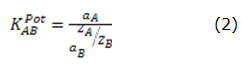
<body><![CDATA[<p align="justify"><font size="2" face="Verdana"><strong>The selectivity coefficients</strong></font></p>     <p align="justify"><font size="2" face="Verdana">The selectivity coefficients (<em>K<sub>AB</sub><sup>POT</sup></em>) were determined by using the method of mixed solutions [20] through the <a href="#e2">equation 2</a>:</font></p>     <p align="center"><font size="2" face="verdana"><a name="e2" id="e2"></a><img src="/img/revistas/ind/v30n2/e0209218.gif"></font></p>     
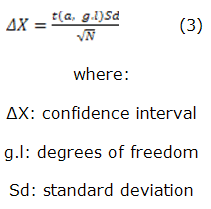
<p align="justify"><font size="2" face="Verdana">All the experimental information was processed using the programs Origin 6.0 [21] and Statgraphics 5.1[22].</font></p>     <p align="justify"><font size="2" face="Verdana">The calculation of the confidence interval of the slope, a = 0,05 were determined for a grade of reliability of 95 %, through the <a href="#e3">equation (3)</a>:</font></p>     <p align="center"><font size="2" face="verdana"><a name="e3" id="e3"></a><img src="/img/revistas/ind/v30n2/e0309218.gif"></font></p>     
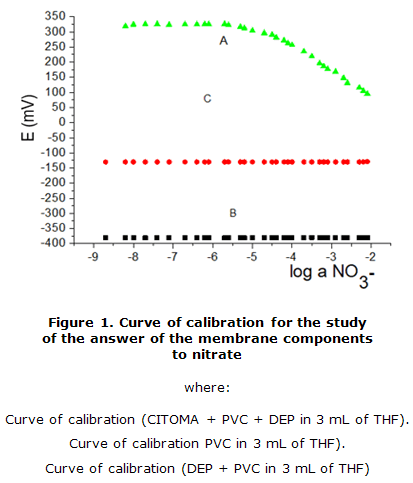
<p align="justify">&nbsp;</p>     <p><font size="3" face="verdana"><strong>RESULTS Y DISCUSSION</strong></font></p>     <p align="justify"><font size="2" face="Verdana">Three blank proofs to corroborate the answer of the membrane came true. As can be seen in <a href="#f1">figure 1</a>, it could be checked than if membranes did not contain the quaternary salt; the answer of electrodes lacks analytical utility (<a href="#f1">figure 1</a>).</font></p>     <p align="center"><font size="2" face="verdana"><a name="f1" id="f1"></a><img src="/img/revistas/ind/v30n2/f0109218.gif"></font></p>     
]]></body>
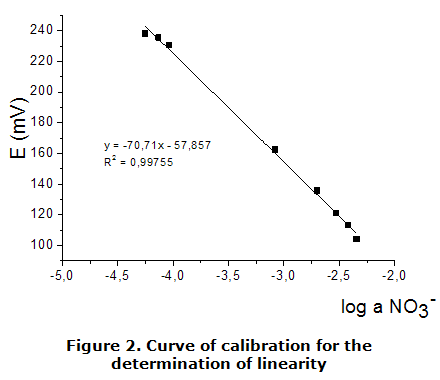
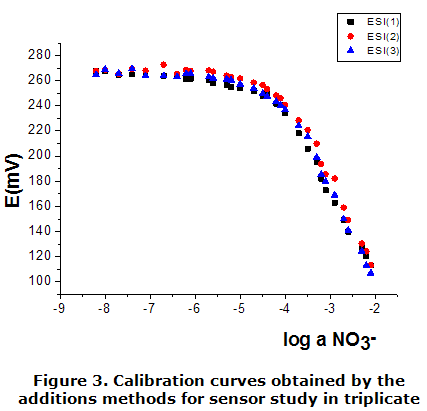
<body><![CDATA[<p align="justify"><font size="2" face="Verdana">The calibration parameters of the constructed ESIs are shown in <a href="#t1">table 1</a>. The calibration curves were used to calculate parameters such as: slope (S), practical detection limit (PDL) and lower limit of linear response (LLLR), are shown in <a href="#f2">figure 2</a> and <a href="#f3">figure 3</a>. This was done through data adjustment by linear regression method following the Nernst law.</font></p>     <p align="center"><font size="2" face="verdana"><a name="f2" id="f2"></a><img src="/img/revistas/ind/v30n2/f0209218.gif"></font></p>     
<p align="center"><font size="2" face="verdana"><a name="f3" id="f3"></a><img src="/img/revistas/ind/v30n2/f0309218.gif"></font></p>     
<p align="center"><font size="2" face="Verdana"><a name="t1"></a><strong>TABLE  1. CALIBRATION PARAMETERS FOR ELECTRODES OBTAINED BY    EMPLOYING  THE ADDITION METHOD</strong></font></p>     <div align="center">   <table border="1" cellpadding="0" cellspacing="0" bordercolor="#000000">     <tr>       <td width="126" valign="top">    <p><font size="2" face="Verdana"><strong>Parameters</strong></font></p></td>       <td width="150" valign="top">    <p><font size="2" face="Verdana"><strong>DEP (in this works) </strong></font></p>               <p><font size="2" face="verdana"><img src="/img/revistas/ind/v30n2/fo0109218.gif"></font></p></td>       <td width="112" valign="top">    
<p><font size="2" face="Verdana"><strong>DOP [18] </strong></font></p>               <p><font size="2" face="verdana"><img src="/img/revistas/ind/v30n2/fo0209218.gif"></font></p></td>       <td width="136" valign="top">    
]]></body>
<body><![CDATA[<p><font size="2" face="Verdana"><strong>DBP [18] </strong></font></p>               <p><font size="2" face="verdana"><img src="/img/revistas/ind/v30n2/fo0309218.gif"></font></p></td>     </tr>     <tr>       <td width="126" valign="top">    
<p><font size="2" face="Verdana">S (mV/dec) </font></p></td>       <td width="150" valign="top">    <p><font size="2" face="Verdana">-70,71 &plusmn; 1,05 </font></p></td>       <td width="112" valign="top">    <p><font size="2" face="Verdana">-57,62 &plusmn; 0.91 </font></p></td>       <td width="136" valign="top">    <p><font size="2" face="Verdana">-59,22 &plusmn; 0,93 </font></p></td>     </tr>     <tr>       <td width="126" valign="top">    <p><font size="2" face="Verdana">R<sup>2</sup></font></p></td>       <td width="150" valign="top">    <p><font size="2" face="Verdana">0,997 55 </font></p></td>       <td width="112" valign="top">    <p><font size="2" face="Verdana">0,999 14 </font></p></td>       <td width="136" valign="top">    <p><font size="2" face="Verdana">0,999 77 </font></p></td>     </tr>     <tr>       <td width="126" valign="top">    ]]></body>
<body><![CDATA[<p><font size="2" face="Verdana">PDL (mol·dm<sup>-3</sup>) </font></p></td>       <td width="150" valign="top">    <p><font size="2" face="Verdana">4,88·10<sup>-5</sup> </font></p></td>       <td width="112" valign="top">    <p><font size="2" face="Verdana">2,41·10<sup>-5</sup></font></p></td>       <td width="136" valign="top">    <p><font size="2" face="Verdana">1,90 &times; 10<sup>-5</sup></font></p></td>     </tr>     <tr>       <td width="126" valign="top">    <p><font size="2" face="Verdana">LLLR (mol·dm<sup>-3</sup>) </font></p></td>       <td width="150" valign="top">    <p><font size="2" face="Verdana">5,99·10<sup>-5</sup> </font></p></td>       <td width="112" valign="top">    <p><font size="2" face="Verdana">5,88 &times; 10<sup>-5</sup></font></p></td>       <td width="136" valign="top">    <p><font size="2" face="Verdana">3,89 &times; 10<sup>-5</sup></font></p></td>     </tr>     <tr>       <td width="126" valign="top">    <p><font size="2" face="Verdana">Life time(months) </font></p></td>       <td width="150" valign="top">    <p><font size="2" face="Verdana">2-2,5 </font></p></td>       <td width="112" valign="top">    ]]></body>
<body><![CDATA[<p><font size="2" face="Verdana">6,0 </font></p></td>       <td width="136" valign="top">    <p><font size="2" face="Verdana">2,6 </font></p></td>     </tr>     <tr>       <td width="126" valign="top">    <p><font size="2" face="Verdana">Sd (S) </font></p></td>       <td width="150" valign="top">    <p><font size="2" face="Verdana">1,43 </font></p></td>       <td width="112" valign="top">    <p><font size="2" face="Verdana">1,87 </font></p></td>       <td width="136" valign="top">    <p><font size="2" face="Verdana">1,76 </font></p></td>     </tr>   </table> </div>     <p align="center"><font size="2" face="Verdana"><strong>Sd (S): Standard deviation of the slope</strong></font></p>     <p align="justify"><font size="2" face="Verdana">As can be seen from <a href="#t1">table 1</a>, the value of the over Nernst slope (S) correspond to those expected by Nernst for a monovalent anion, the values obtained for correlation coefficients evidenced the good linearity of the calibration curves. The sensor prepared showed a lower limit of linear response (LLLR) and PDL in order 10<sup>-5</sup> mol·dm<sup>-3</sup>, similar to the obtained with the DOP and DBP [18]. They follow the following order in terms of the solvent mediator employed: DBP (1,90 · 10<sup>-5</sup> mol·dm<sup>-3</sup>) DOP ( 2,41 · 10<sup>-5</sup> mol·dm<sup>3</sup>) DEP ( 4,7&middot;10<sup>-5</sup> mol·dm<sup>-3</sup>). The one for which a dependence as to the PDL and the lipophilicity of the plasticizer used in the membrane cannot be assured sensors.</font></p>     <p align="justify"><font size="2" face="Verdana">Analysis of variance (ANOVA) to compare the ESIs's slopes came true. They show the results in the <a href="#t2">table 2</a>. Previously a contrast to verify if homogeneity among variances existed was accomplished to the comparison. The p Value of Levene's test was 0,922 9 considering that he is superior to the significance level (a = 0,05), statistically significant differences among variances for the 95 % confidence level do not exist.</font></p>     <p align="center"><font size="2" face="Verdana"><a name="t2"></a><strong>TABLE  2. ANALYSIS OF VARIANCE ACCOMPLISHED TO THE  ESI s</strong></font></p>      ]]></body>
<body><![CDATA[<div align="center">   <table border="1" cellpadding="0" cellspacing="0" bordercolor="#000000">     <tr>       <td width="163">    <p><font size="2" face="Verdana"><strong>Source </strong></font></p></td>       <td width="80">    <p><font size="2" face="Verdana"><strong>C.S. </strong></font></p></td>       <td width="52">    <p><font size="2" face="Verdana"><strong>l.g. </strong></font></p></td>       <td width="76">    <p><font size="2" face="Verdana"><strong>M.C. </strong></font></p></td>       <td width="104">    <p><font size="2" face="Verdana"><strong>Quotient -F </strong></font></p></td>       <td width="78">    <p><font size="2" face="Verdana"><strong>Value p </strong></font></p></td>     </tr>     <tr>       <td width="163">    <p><font size="2" face="Verdana">Amonggroups </font></p></td>       <td width="80">    <p><font size="2" face="Verdana">10,129 5 </font></p></td>       <td width="52">    <p><font size="2" face="Verdana">2 </font></p></td>       <td width="76">    ]]></body>
<body><![CDATA[<p><font size="2" face="Verdana">5,064 74 </font></p></td>       <td width="104">    <p><font size="2" face="Verdana">0,03 </font></p></td>       <td width="78">    <p><font size="2" face="Verdana">0,973 7 </font></p></td>     </tr>     <tr>       <td width="163">    <p><font size="2" face="Verdana">Intra groups </font></p></td>       <td width="80">    <p><font size="2" face="Verdana">6 256,05 </font></p></td>       <td width="52">    <p><font size="2" face="Verdana">33 </font></p></td>       <td width="76">    <p><font size="2" face="Verdana">189,577 </font></p></td>       <td width="104">    <p>&nbsp; </p></td>       <td width="78">    <p>&nbsp; </p></td>     </tr>   </table> </div>     <p align="center"><font size="2" face="Verdana"><strong>C. S.: sumof squares, l.g.: degrees of freedom , M. C.: square means</strong></font></p>     ]]></body>
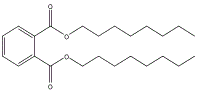
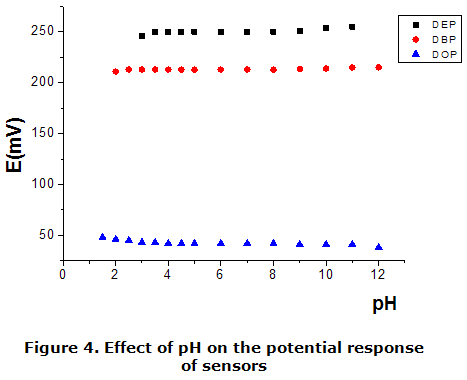
<body><![CDATA[<p align="justify"><font size="2" face="Verdana">The p-value is bigger than the significance level ( a = 0,05), which as suggest that statistical differences among the means of three ESIs constructed for a confidence level of the 95 % by which, do not exist they can use indistinctly the ESIs to evaluate his response to nitrate.</font></p>     <p align="justify"><font size="2" face="Verdana"><strong>Lifetime</strong></font></p>     <p align="justify"><font size="2" face="Verdana">The lifetime of the sensors constructed, by using plasticizer DEP, is shown in <a href="#t1">table 1</a>. As can be seen from <a href="#t1">table 1</a>, the sensors shown shortest lifetime. When observing the structures of plasticizers in <a href="#t1">table 1</a>, justifies the reason of why our membrane have the younger time to live, because it has in composition the DEP, since only he has two aliphatic carbon atoms in relation to the DBP and DOP that they have four and eight atoms, respectively; This is what he does that the ionophore exude toward the aqueous phase with bigger facility in relation to the DBP that they have four eight atoms respectively and DOP; This is what he does that the ionophore exude toward the aqueous phase with bigger facility.</font></p>     <p align="justify"><font size="2" face="Verdana"><strong>Influence of the pH on the response of the electrode</strong></font></p>     <p align="justify"><font size="2" face="Verdana">The effect of pH on the response of the electrode was studied over a wide range , by using 1,0 · 10<sup>-2</sup> mol · dm<sup>-3</sup>, by using the correspon ding Reilleys diagrams, are shows in <a href="#f3">figure 3</a>. An adjustment of pH was performed using dilute sodium hydroxide and sulphuric acid. It is seen from <a href="#f4">figure 4</a>, that the electrode potential remains constant in pH intervals of 3 to 9,0.</font></p>     <p align="center"><font size="2" face="verdana"><a name="f4" id="f4"></a><img src="/img/revistas/ind/v30n2/f0409218.gif"></font></p>     
<p align="justify"><font size="2" face="Verdana"><strong>Study of the effect of interfering ions on the selectivity of the constructed ESIs</strong></font></p>     <p align="justify"><font size="2" face="Verdana">The potentiometric selectivity coefficients (<em>K<sub>AB</sub><sup>POT</sup></em>) for a number of mono valence anions were determinated by the mixed solution method, according to IUPAC recommendation. The results are shown in <a href="#t3">table 3</a>, (interfering 1 · 10<sup>-2</sup> mol · dm<sup>-3</sup>).</font></p>     <p align="center"><font size="2" face="Verdana"><a name="t3"></a><strong>TABLE  3. SELECTIVITY COEFFICIENTS  (</strong><em><strong>K<sub>AB</sub><sup>POT</sup></strong></em><strong>) OF VARIOUS INTERFERING ANIONS</strong></font> </p>      <div align="center">   <table border="1" cellpadding="0" cellspacing="0" bordercolor="#000000">     <tr>       <td width="102" valign="top">    ]]></body>
<body><![CDATA[<p><font size="2" face="Verdana"><strong>Intf. ions </strong></font></p></td>       <td width="135" valign="top">    <p><font size="2" face="Verdana"><strong>DEP (in this work) </strong></font></p></td>       <td width="82" valign="top">    <p><font size="2" face="Verdana"><strong>DBP [18] </strong></font></p></td>       <td width="104" valign="top">    <p><font size="2" face="Verdana"><strong>DOP [18] </strong></font></p></td>     </tr>     <tr>       <td width="102" valign="top">    <p><font size="2" face="Verdana">Cl<sup>-</sup></font></p></td>       <td width="135" valign="top">    <p><font size="2" face="Verdana">1,5 &times; 10<sup>-2</sup></font></p></td>       <td width="82" valign="top">    <p><font size="2" face="Verdana">1,72 &times; 10<sup>-2</sup></font></p></td>       <td width="104" valign="top">    <p><font size="2" face="Verdana">6,16 &times; 10<sup>-2</sup></font></p></td>     </tr>     <tr>       <td width="102" valign="top">    <p><font size="2" face="Verdana">Br<sup>-</sup></font></p></td>       <td width="135" valign="top">    <p><font size="2" face="Verdana">3,9 &times; 10<sup>-2</sup></font></p></td>       <td width="82" valign="top">    ]]></body>
<body><![CDATA[<p><font size="2" face="Verdana">1,65 &times; 10<sup>-1</sup></font></p></td>       <td width="104" valign="top">    <p><font size="2" face="Verdana">2,64 &times; 10<sup>-1</sup></font></p></td>     </tr>     <tr>       <td width="102" height="27" valign="top">    <p><font size="2" face="Verdana">IO<sub>3-</sub></font></p></td>       <td width="135" valign="top">    <p><font size="2" face="Verdana">5,61 &times; 10<sup>-2</sup></font></p></td>       <td width="82" valign="top">    <p><font size="2" face="Verdana">6,77 &times; 10<sup>-2</sup></font></p></td>       <td width="104" valign="top">    <p><font size="2" face="Verdana">1,48 &times; 10<sup>-2</sup></font></p></td>     </tr>     <tr>       <td width="102" height="28" valign="top">    <p><font size="2" face="Verdana">BrO<sub>3-</sub></font></p></td>       <td width="135" valign="top">    <p><font size="2" face="Verdana">5,23 &times; 10<sup>-2</sup> </font></p></td>       <td width="82" valign="top">    <p><font size="2" face="Verdana">5,71 &times; 10<sup>-2</sup></font></p></td>       <td width="104" valign="top">    <p><font size="2" face="Verdana">1,35 &times; 10<sup>-1</sup></font></p></td>     </tr>   </table> </div>     ]]></body>
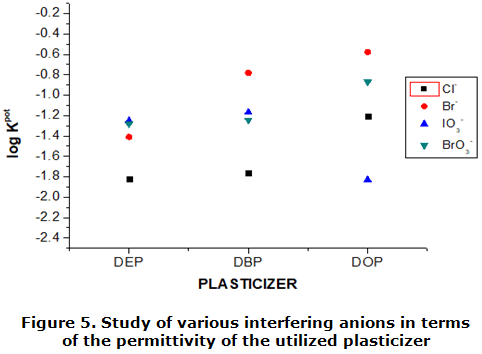
<body><![CDATA[<p align="justify"><font size="2" face="Verdana">The behavior of the level of interference found in this study in relation to the permitivity of the employed plasticizer can be observed in <a href="#t3">table 3</a>; as well as the behavior with the same family's another plasticizers using the same ionophore.</font></p>     <p align="center"><font size="2" face="verdana"><a name="f5" id="f5"></a><img src="/img/revistas/ind/v30n2/f0509218.gif"></font></p>     
<p align="justify"><font size="2" face="Verdana">As it is observed <a href="#f5">figure 5</a>, the plasticizer used in this study it has the minor lipophilic character, being the one that presents higher value of dielectric constant (permittivity) (DOP=5,22; DBP=6,58; DEP=7,86) [23]; being the fact that lower interference presents so much for ions chlorides like bromides. It can be observed same as for a same ion his level increases in interference to measure than the plasticizer used not only that lipophilic (bigger carbon chain load). Also, it is noticed that the case of these studied ions stops, the difference in his values of log dies down (<em>K<sub>AB</sub><sup>POT</sup></em>) to measure than the plasticizer shows bigger value of his dielectric constant.</font></p>     <p align="justify"><font size="2" face="Verdana">We can say that examined ions constitute interferences for the determination of the primary ion for which, to be present the same to the hour to examine a sign, it is necessary to take the necessary precautions.</font></p>     <p align="justify">&nbsp;</p>     <p align="justify"><font size="3" face="verdana"><strong>CONCLUSIONS</strong></font></p>     <p align="justify"> <font size="2" face="verdana"> A new ion selective electrode for nitrate was constructed using TOMACl as ionophore. The nitrate ISEs prepared showed Nernstian slope for nitrate of -70,71 &plusmn; 1,05 mV/dec, with a practical detection limit (PDL) of 4,88·10</font><font size="2" face="Verdana"><sup>-5</sup></font><font size="2" face="verdana"> mol · dm</font><font face="Verdana" size="2"><sup>-3</sup></font><font size="2" face="verdana"> and a response time of 20 s. The nitrate ISE developed show a good performance in the pH range of 3 – 9 and had a lifetime of 2 – 2,5 months. The new plasticizer employed DEP with the quaternary ammonium salt TOMACl like ionophore turned out to be the best membrane as to sensibility in relation to the family of plasticizers compared in this research.</font></p>     <p align="justify">&nbsp;</p>     <p align="justify"><font size="3" face="verdana"><strong>REFERENCES</strong></font></p>     <!-- ref --><p align="justify"><font size="2" face="Verdana">1. LE, G.; BRAVEN, J.; EBDON, L.; SCHOLEFIELD, D. &quot;High-performance nitrate-selective electrodes containing immobilized amino acid betaines as sensors&quot;. <em>Anal. Chem. </em>2002, 74, 2596-2602. ISSN 0003-2700</font><!-- ref --><p align="justify"><font size="2" face="Verdana">2. GEORGE, E. <em>et al. </em>&quot;Theoretical and experimental studies of metallated phenanthroline derivatives as carriers for the optimization of the nitrate sensor&quot;. <em>Anal. Chim. Acta. </em> 2001, 439, 273–280. ISSN 0003-2670</font><!-- ref --><p align="justify"><font size="2" face="Verdana">3. KONG THOO, L P.; ARAUJO, A. N.; MONTENEGRO, M. C. B. S. M.; PE&Auml; REZ OLMOS, R. &quot;New PVC Nitrate-Selective Electrode: Application to Vegetables and Mineral Waters&quot;. <em> J. Agric. Food Chem. </em>2005, 53(2), 211–215. ISSN 0021-8561</font><!-- ref --><p align="justify"><font size="2" face="Verdana">4. P&Eacute;REZ, J.; RIOS, A.; FERN&Aacute;NDEZ, J. R.; LAPA, R. A. S.; LIMA, J. L. F. C. &quot;Construction and evaluation of ion selective electrodes for nitrate with a summing operational amplifier. Application to tobacco analysis&quot;. <em>Talanta</em>. 2001. 53(4) 741–748. ISSN 0039-9140</font><!-- ref --><p align="justify"><font size="2" face="Verdana">5. EL DEEN ABBAS, M. N. &quot;Chemically Modified Carbon Paste Electrode for Iodide Determination on the Basis of Cetyl- trimethylammonium Iodide Ion-Pair&quot;. Analytical Sciences. 2003, 19(2), 229–233<em>. </em> ISSN 0910-6340</font><!-- ref --><p align="justify"><font size="2" face="Verdana">6. OZAWA,S.; MIYAGI, H.; SHIBATA, Y.; OKI, N.; KUNITAKE, T.; KELLER, W. E. &quot;Anion-selective electrodes based on long-chain methyltrialkylammonium salts&quot;. <em>Anal Chem. </em> 1996, 68(23), 4149–4152. ISSN 0003-2700</font><!-- ref --><p align="justify"><font size="2" face="Verdana">7. HARA, H.; OHKUBO, H.; SAWAI, K. &quot;Nitrate ion-selective coated-wire electrode based on tetraoctadecylammonium nitrate in solid solvents and the effect of additives on its selectivity&quot;. Analyst. 1993, 118(5), 549<em>–</em>552. ISSN 0003-2654</font><!-- ref --><p align="justify"><font size="2" face="Verdana">8. SAWYER, A.; MC CARTY, C. N. <em>Chemistry for environmental engineering</em>. 3ra Edici&oacute;n. Singapur: Mc Graw–Hill, 1978. ISBN 0070549710, 9780070549715.    </font></p>     <!-- ref --><p align="justify"><font size="2" face="Verdana">9. SANDER, J.; SEIF, F. &quot;Bacterial reduction of nitrate in human stomach as a cause for nitrosamine formation&quot;. <em>Arzneim.-Forsch</em>. 1969, 19, 1091–1093. ISSN 2194-9387</font><!-- ref --><p align="justify"><font size="2" face="Verdana">10. BELGRANO, R.; COLASURDO, V.; D&Iacute;AZ, O. &quot;M&eacute;todos ultravioleta selectivo y de reducci&oacute;n con hidracina en la determinaci&oacute;n del ion nitrato en aguas subterr&aacute;neas&quot;. <em>Qu&iacute;m. Nova. </em> 2003, 26(5), 766-768. ISSN 1678-7064</font><!-- ref --><p align="justify"><font size="2" face="Verdana">11. BOY FERN&Aacute;NDEZ, M. E. &quot;Utilizaci&oacute;n de la cromatograf&iacute;a i&oacute;nica en el an&aacute;lisis de muestras de agua de drenaje y de soluci&oacute;n de suelo&quot;. Tesis Doctoral. Universidad de Sevilla, 1992.    </font></p>     <!-- ref --><p align="justify"><font size="2" face="Verdana">12. ARADA P&Eacute;REZ, M. de los A.; YAZDANI PEDRAM, M. &quot;Chemical sensor based on tetradecil ammonium nitrate&quot;. <em>J. Chil. Chem. Soc. </em> 2013, 58(1), 1415–1418. ISSN 0001-9704</font><!-- ref --><p align="justify"><font size="2" face="Verdana">13. ARADA, M. de los A.; YAZDANI, M.; MARIN, J.; SPECK, A. &quot;Estudio del reconocimiento molecular de un portador m&oacute;vil neutro usado como un electrodo all solid stated a nitrato&quot;. <em>Revista Afinidad. </em> 2009, 66(540), 134–138. ISSN 0925-4005</font><!-- ref --><p align="justify"><font size="2" face="Verdana">14. ARADA, M. de los A.; YAZDANI, M.; P&Eacute;REZ SAAVEDRA, J. J. &quot;Sensores Electroqu&iacute;micos basados en Sales cuaternarias de am&ocirc;nio&quot;. <em>Revista Cubana de Qu&iacute;mica</em>. 2008, 20(1), 31–38. ISSN 2224-5421</font><!-- ref --><p align="justify"><font size="2" face="Verdana">15. RADA P&Eacute;REZ, M. de los A.; P&Eacute;REZ MAR&Iacute;N, L.; CALVO QUINTANA, J,; YAZDANI PEDRAM, M. &quot;Influence of different plasticizer on the response of chemical sensors based on polymeric membrane for nitrate ion determination&quot;. <em>Sensors and Actuator B Chemical. </em> 2003, 89(3), 262–268. ISSN 0925-4005.    </font></p>     <!-- ref --><p align="justify"><font size="2" face="Verdana">16. SCHWAKE, A. <em>et al. </em>&quot;Potentiometric properties and impedance spectroscopic data of poly(vinyl chloride) membranes containing quaternary ammonium salts of different chemical structure&quot;. <em>Anal. Chim. </em>Acta. 1999, 393, 19 – 28. ISSN 0003-2670</font><!-- ref --><p align="justify"><font size="2" face="Verdana">17. KHARITONOV, S. V. &quot;Ion selective electrode for the determination of sulfadimezine&quot;<em>. J. of Anal</em>. 2001,  56(7), 671–675. ISSN 1588-2780</font><!-- ref --><p align="justify"><font size="2" face="Verdana">18. ARADA P&Eacute;REZ, M. de los A. <em>et al. </em> &quot;Effect of plasticizer type on the potentiometric selectivity coefficient (KPot) of electrodes for nitrate ion determination constructed by using PVC as polymeric membrane&quot;. <em>Revista Cubana de Qu&iacute;mica. </em> 2003, 15(3), 36–43. ISSN 0258-5995</font><!-- ref --><p align="justify"><font size="2" face="Verdana">19. MART&Iacute;NEZ, E. <em>Sensores potenciom&eacute;tricos all-solid-state d&acute;uera</em>. Tesis Doctoral. Universidad Aut&oacute;noma de Barcelona, 1989.    </font></p>     <!-- ref --><p align="justify"><font size="2" face="Verdana">20. IUPAC. Recommendations for publishing manuscripts on ion selective electrodes. <em>Pure Appl. Chem</em>. 1980, 53(1), 139-143. ISSN 1365-3075</font><!-- ref --><p align="justify"><font size="2" face="Verdana">21. ORIGIN. Microcal (TM). Vers. 6.0. Computer software. Copyright Microcal Software Inc, 1990-1999.    </font></p>     <!-- ref --><p align="justify"><font size="2" face="Verdana">22. WINDOWS, Statgraphics Plus. Vers. 5.1. Computer software. Statiscal Graphics Corp, 1997.    </font></p>     <!-- ref --><div align="justify"><font size="2" face="Verdana">23. WYPYCH, G. <em>Handbook of Plasticizers</em>. Toronto-New York: ChemTec Toronto, 2004. ISBN: 1-895198-29-1.    </font></div>     <p align="justify">&nbsp;</p>     ]]></body>
<body><![CDATA[<p align="justify">&nbsp;</p>     <p align="justify"><font size="2" face="Verdana">Recibido: 16/11/2017    <br> Aceptado: 8/01/2018</font></p>     <p>&nbsp;</p>     <p>&nbsp;</p>     <p><font size="2" face="Verdana"><em>Dra. C. Mar&iacute;a de los &Aacute;ngeles Arada-P&eacute;rez</em>, Departamento de Qu&iacute;mica. Facultad de Ciencias Naturales y Exactas, Universidad de Oriente, Santiago de Cuba, Cuba, <a href="mailto:mayarada@uo.edu.cu">mayarada@uo.edu.cu</a></font></p>      ]]></body><back>
<ref-list>
<ref id="B1">
<label>1</label><nlm-citation citation-type="">
<person-group person-group-type="author">
<name>
<surname><![CDATA[LE]]></surname>
<given-names><![CDATA[G]]></given-names>
</name>
<name>
<surname><![CDATA[BRAVEN]]></surname>
<given-names><![CDATA[J]]></given-names>
</name>
<name>
<surname><![CDATA[EBDON]]></surname>
<given-names><![CDATA[L]]></given-names>
</name>
<name>
<surname><![CDATA[SCHOLEFIELD]]></surname>
<given-names><![CDATA[D]]></given-names>
</name>
</person-group>
<article-title xml:lang="en"><![CDATA[High-performance nitrate-selective electrodes containing immobilized amino acid betaines as sensors]]></article-title>
<source><![CDATA[]]></source>
<year>2002</year>
<volume>74</volume>
<page-range>2596-2602</page-range></nlm-citation>
</ref>
<ref id="B2">
<label>2</label><nlm-citation citation-type="">
<person-group person-group-type="author">
<name>
<surname><![CDATA[GEORGE]]></surname>
<given-names><![CDATA[E]]></given-names>
</name>
</person-group>
<article-title xml:lang="en"><![CDATA[Theoretical and experimental studies of metallated phenanthroline derivatives as carriers for the optimization of the nitrate sensor]]></article-title>
<source><![CDATA[]]></source>
<year>2001</year>
<volume>439</volume>
<page-range>273-280</page-range></nlm-citation>
</ref>
<ref id="B3">
<label>3</label><nlm-citation citation-type="">
<person-group person-group-type="author">
<name>
<surname><![CDATA[KONG THOO]]></surname>
<given-names><![CDATA[L P]]></given-names>
</name>
<name>
<surname><![CDATA[ARAUJO]]></surname>
<given-names><![CDATA[A. N]]></given-names>
</name>
<name>
<surname><![CDATA[MONTENEGRO]]></surname>
<given-names><![CDATA[M. C. B. S. M]]></given-names>
</name>
<name>
<surname><![CDATA[PEÄ REZ OLMOS]]></surname>
<given-names><![CDATA[R]]></given-names>
</name>
</person-group>
<article-title xml:lang="en"><![CDATA[New PVC Nitrate-Selective Electrode: Application to Vegetables and Mineral Waters]]></article-title>
<source><![CDATA[]]></source>
<year>2005</year>
<volume>53</volume>
<numero>2</numero>
<issue>2</issue>
<page-range>211-215</page-range></nlm-citation>
</ref>
<ref id="B4">
<label>4</label><nlm-citation citation-type="">
<person-group person-group-type="author">
<name>
<surname><![CDATA[PÉREZ]]></surname>
<given-names><![CDATA[J]]></given-names>
</name>
<name>
<surname><![CDATA[RIOS]]></surname>
<given-names><![CDATA[A]]></given-names>
</name>
<name>
<surname><![CDATA[FERNÁNDEZ]]></surname>
<given-names><![CDATA[J. R]]></given-names>
</name>
<name>
<surname><![CDATA[LAPA]]></surname>
<given-names><![CDATA[R. A. S]]></given-names>
</name>
<name>
<surname><![CDATA[LIMA]]></surname>
<given-names><![CDATA[J. L. F. C]]></given-names>
</name>
</person-group>
<article-title xml:lang="en"><![CDATA[Construction and evaluation of ion selective electrodes for nitrate with a summing operational amplifier. Application to tobacco analysis]]></article-title>
<source><![CDATA[]]></source>
<year>2001</year>
<volume>53</volume>
<numero>4</numero>
<issue>4</issue>
<page-range>741-748</page-range></nlm-citation>
</ref>
<ref id="B5">
<label>5</label><nlm-citation citation-type="">
<person-group person-group-type="author">
<name>
<surname><![CDATA[EL DEEN ABBAS]]></surname>
<given-names><![CDATA[M. N]]></given-names>
</name>
</person-group>
<article-title xml:lang="en"><![CDATA[Chemically Modified Carbon Paste Electrode for Iodide Determination on the Basis of Cetyl-trimethylammonium Iodide Ion-Pair]]></article-title>
<source><![CDATA[]]></source>
<year>2003</year>
<volume>19</volume>
<numero>2</numero>
<issue>2</issue>
<page-range>229-233</page-range></nlm-citation>
</ref>
<ref id="B6">
<label>6</label><nlm-citation citation-type="">
<person-group person-group-type="author">
<name>
<surname><![CDATA[OZAWA]]></surname>
<given-names><![CDATA[S]]></given-names>
</name>
<name>
<surname><![CDATA[MIYAGI]]></surname>
<given-names><![CDATA[H]]></given-names>
</name>
<name>
<surname><![CDATA[SHIBATA]]></surname>
<given-names><![CDATA[Y]]></given-names>
</name>
<name>
<surname><![CDATA[OKI]]></surname>
<given-names><![CDATA[N]]></given-names>
</name>
<name>
<surname><![CDATA[KUNITAKE]]></surname>
<given-names><![CDATA[T]]></given-names>
</name>
<name>
<surname><![CDATA[KELLER]]></surname>
<given-names><![CDATA[W. E]]></given-names>
</name>
</person-group>
<article-title xml:lang="en"><![CDATA[Anion-selective electrodes based on long-chain methyltrialkylammonium salts]]></article-title>
<source><![CDATA[]]></source>
<year>1996</year>
<volume>68</volume>
<numero>23</numero>
<issue>23</issue>
<page-range>4149-4152</page-range></nlm-citation>
</ref>
<ref id="B7">
<label>7</label><nlm-citation citation-type="">
<person-group person-group-type="author">
<name>
<surname><![CDATA[HARA]]></surname>
<given-names><![CDATA[H]]></given-names>
</name>
<name>
<surname><![CDATA[OHKUBO]]></surname>
<given-names><![CDATA[H]]></given-names>
</name>
<name>
<surname><![CDATA[SAWAI]]></surname>
<given-names><![CDATA[K]]></given-names>
</name>
</person-group>
<article-title xml:lang="en"><![CDATA[Nitrate ion-selective coated-wire electrode based on tetraoctadecylammonium nitrate in solid solvents and the effect of additives on its selectivity]]></article-title>
<source><![CDATA[]]></source>
<year>1993</year>
<volume>118</volume>
<numero>5</numero>
<issue>5</issue>
<page-range>549-552</page-range></nlm-citation>
</ref>
<ref id="B8">
<label>8</label><nlm-citation citation-type="book">
<person-group person-group-type="author">
<name>
<surname><![CDATA[SAWYER]]></surname>
<given-names><![CDATA[A]]></given-names>
</name>
<name>
<surname><![CDATA[MC CARTY]]></surname>
<given-names><![CDATA[C. N]]></given-names>
</name>
</person-group>
<source><![CDATA[Chemistry for environmental engineering]]></source>
<year>1978</year>
<edition>3</edition>
<publisher-name><![CDATA[Mc Graw-Hill]]></publisher-name>
</nlm-citation>
</ref>
<ref id="B9">
<label>9</label><nlm-citation citation-type="">
<person-group person-group-type="author">
<name>
<surname><![CDATA[SANDER]]></surname>
<given-names><![CDATA[J]]></given-names>
</name>
<name>
<surname><![CDATA[SEIF]]></surname>
<given-names><![CDATA[F]]></given-names>
</name>
</person-group>
<article-title xml:lang="en"><![CDATA[Bacterial reduction of nitrate in human stomach as a cause for nitrosamine formation]]></article-title>
<source><![CDATA[]]></source>
<year>1969</year>
<volume>19</volume>
<page-range>1091-1093</page-range></nlm-citation>
</ref>
<ref id="B10">
<label>10</label><nlm-citation citation-type="">
<person-group person-group-type="author">
<name>
<surname><![CDATA[BELGRANO]]></surname>
<given-names><![CDATA[R]]></given-names>
</name>
<name>
<surname><![CDATA[COLASURDO]]></surname>
<given-names><![CDATA[V]]></given-names>
</name>
<name>
<surname><![CDATA[DÍAZ]]></surname>
<given-names><![CDATA[O]]></given-names>
</name>
</person-group>
<article-title xml:lang="es"><![CDATA[Métodos ultravioleta selectivo y de reducción con hidracina en la determinación del ion nitrato en aguas subterráneas]]></article-title>
<source><![CDATA[]]></source>
<year>2003</year>
<volume>26</volume>
<numero>5</numero>
<issue>5</issue>
<page-range>766-768</page-range></nlm-citation>
</ref>
<ref id="B11">
<label>11</label><nlm-citation citation-type="">
<person-group person-group-type="author">
<name>
<surname><![CDATA[BOY FERNÁNDEZ]]></surname>
<given-names><![CDATA[M. E]]></given-names>
</name>
</person-group>
<source><![CDATA[Utilización de la cromatografía iónica en el análisis de muestras de agua de drenaje y de solución de suelo]]></source>
<year>1992</year>
</nlm-citation>
</ref>
<ref id="B12">
<label>12</label><nlm-citation citation-type="">
<person-group person-group-type="author">
<name>
<surname><![CDATA[ARADA PÉREZ]]></surname>
<given-names><![CDATA[M. de los A]]></given-names>
</name>
<name>
<surname><![CDATA[YAZDANI PEDRAM]]></surname>
<given-names><![CDATA[M]]></given-names>
</name>
</person-group>
<article-title xml:lang="en"><![CDATA[Chemical sensor based on tetradecil ammonium nitrate]]></article-title>
<source><![CDATA[]]></source>
<year>2013</year>
<volume>58</volume>
<numero>1</numero>
<issue>1</issue>
<page-range>1415-1418</page-range></nlm-citation>
</ref>
<ref id="B13">
<label>13</label><nlm-citation citation-type="">
<person-group person-group-type="author">
<name>
<surname><![CDATA[ARADA]]></surname>
<given-names><![CDATA[M. de los A]]></given-names>
</name>
<name>
<surname><![CDATA[YAZDANI]]></surname>
<given-names><![CDATA[M]]></given-names>
</name>
<name>
<surname><![CDATA[MARIN]]></surname>
<given-names><![CDATA[J]]></given-names>
</name>
<name>
<surname><![CDATA[SPECK]]></surname>
<given-names><![CDATA[A]]></given-names>
</name>
</person-group>
<article-title xml:lang="es"><![CDATA[Estudio del reconocimiento molecular de un portador móvil neutro usado como un electrodo all solid stated a nitrato]]></article-title>
<source><![CDATA[]]></source>
<year>2009</year>
<volume>66</volume>
<numero>540</numero>
<issue>540</issue>
<page-range>134 - 138</page-range></nlm-citation>
</ref>
<ref id="B14">
<label>14</label><nlm-citation citation-type="">
<article-title xml:lang="en"><![CDATA[Sensores Electroquímicos basados en Sales cuaternarias de amônio]]></article-title>
<source><![CDATA[]]></source>
<year>2008</year>
<volume>20</volume>
<numero>1</numero>
<issue>1</issue>
<page-range>31-38</page-range></nlm-citation>
</ref>
<ref id="B15">
<label>15</label><nlm-citation citation-type="">
<person-group person-group-type="author">
<name>
<surname><![CDATA[RADA PÉREZ]]></surname>
<given-names><![CDATA[M. de los A]]></given-names>
</name>
<name>
<surname><![CDATA[PÉREZ MARÍN]]></surname>
<given-names><![CDATA[L]]></given-names>
</name>
<name>
<surname><![CDATA[CALVO QUINTANA]]></surname>
<given-names><![CDATA[J]]></given-names>
</name>
<name>
<surname><![CDATA[YAZDANI PEDRAM]]></surname>
<given-names><![CDATA[M]]></given-names>
</name>
</person-group>
<article-title xml:lang="en"><![CDATA[Influence of different plasticizer on the response of chemical sensors based on polymeric membrane for nitrate ion determination]]></article-title>
<source><![CDATA[]]></source>
<year>2003</year>
<volume>89</volume>
<numero>3</numero>
<issue>3</issue>
<page-range>262-268</page-range></nlm-citation>
</ref>
<ref id="B16">
<label>16</label><nlm-citation citation-type="">
<person-group person-group-type="author">
<name>
<surname><![CDATA[SCHWAKE]]></surname>
<given-names><![CDATA[A]]></given-names>
</name>
</person-group>
<article-title xml:lang="en"><![CDATA[Potentiometric properties and impedance spectroscopic data of poly(vinyl chloride) membranes containing quaternary ammonium salts of different chemical structure]]></article-title>
<source><![CDATA[]]></source>
<year>1999</year>
<volume>393</volume>
<page-range>19-28</page-range></nlm-citation>
</ref>
<ref id="B17">
<label>17</label><nlm-citation citation-type="">
<person-group person-group-type="author">
<name>
<surname><![CDATA[KHARITONOV]]></surname>
<given-names><![CDATA[S. V]]></given-names>
</name>
</person-group>
<article-title xml:lang="en"><![CDATA[Ion selective electrode for the determination of sulfadimezine]]></article-title>
<source><![CDATA[]]></source>
<year>2001</year>
<volume>56</volume>
<numero>7</numero>
<issue>7</issue>
<page-range>671-675</page-range></nlm-citation>
</ref>
<ref id="B18">
<label>18</label><nlm-citation citation-type="">
<person-group person-group-type="author">
<name>
<surname><![CDATA[ARADA PÉREZ]]></surname>
<given-names><![CDATA[M. de los A]]></given-names>
</name>
</person-group>
<article-title xml:lang="en"><![CDATA[Effect of plasticizer type on the potentiometric selectivity coefficient (K Pot) of electrodes for nitrate ion determination constructed by using PVC as polymeric membrane]]></article-title>
<source><![CDATA[]]></source>
<year>2003</year>
<volume>15</volume>
<numero>3</numero>
<issue>3</issue>
<page-range>36-43</page-range></nlm-citation>
</ref>
<ref id="B19">
<label>19</label><nlm-citation citation-type="book">
<person-group person-group-type="author">
<name>
<surname><![CDATA[MARTÍNEZ]]></surname>
<given-names><![CDATA[E]]></given-names>
</name>
</person-group>
<source><![CDATA[Sensores potenciométricos all-solid-state d´uera]]></source>
<year>1989</year>
<publisher-name><![CDATA[Tesis Doctoral. Universidad Autónoma de Barcelona]]></publisher-name>
</nlm-citation>
</ref>
<ref id="B20">
<label>20</label><nlm-citation citation-type="">
<collab>IUPAC</collab>
<article-title xml:lang="en"><![CDATA[Recommendations for publishing manuscripts on ion selective electrodes]]></article-title>
<source><![CDATA[]]></source>
<year>1980</year>
<volume>53</volume>
<numero>1</numero>
<issue>1</issue>
<page-range>139-143</page-range></nlm-citation>
</ref>
<ref id="B21">
<label>2</label><nlm-citation citation-type="book">
<collab>ORIGIN</collab>
<source><![CDATA[Microcal (TM). Vers. 6.0. Computer software]]></source>
<year></year>
<page-range>1990-1999</page-range><publisher-name><![CDATA[Copyright Microcal Software Inc]]></publisher-name>
</nlm-citation>
</ref>
<ref id="B22">
<label>22</label><nlm-citation citation-type="book">
<collab>WINDOWS</collab>
<source><![CDATA[Statgraphics Plus. Vers. 5.1. Computer software]]></source>
<year>1997</year>
<publisher-name><![CDATA[Statiscal Graphics Corp]]></publisher-name>
</nlm-citation>
</ref>
<ref id="B23">
<label>23</label><nlm-citation citation-type="book">
<collab>WYPYCH, G</collab>
<source><![CDATA[Handbook of Plasticizers]]></source>
<year>2004</year>
<publisher-loc><![CDATA[Toronto-New York ]]></publisher-loc>
<publisher-name><![CDATA[ChemTec Toronto]]></publisher-name>
</nlm-citation>
</ref>
</ref-list>
</back>
</article>