<?xml version="1.0" encoding="ISO-8859-1"?><article xmlns:mml="http://www.w3.org/1998/Math/MathML" xmlns:xlink="http://www.w3.org/1999/xlink" xmlns:xsi="http://www.w3.org/2001/XMLSchema-instance">
<front>
<journal-meta>
<journal-id>2227-1899</journal-id>
<journal-title><![CDATA[Revista Cubana de Ciencias Informáticas]]></journal-title>
<abbrev-journal-title><![CDATA[Rev cuba cienc informat]]></abbrev-journal-title>
<issn>2227-1899</issn>
<publisher>
<publisher-name><![CDATA[Editorial Ediciones Futuro]]></publisher-name>
</publisher>
</journal-meta>
<article-meta>
<article-id>S2227-18992013000200003</article-id>
<title-group>
<article-title xml:lang="es"><![CDATA[Métodos clásicos de nicho para optimización multimodal: una breve revisión]]></article-title>
<article-title xml:lang="en"><![CDATA[Classical niching methods for multimodal optimization: a brief review]]></article-title>
</title-group>
<contrib-group>
<contrib contrib-type="author">
<name>
<surname><![CDATA[Navarro]]></surname>
<given-names><![CDATA[Ricardo]]></given-names>
</name>
<xref ref-type="aff" rid="A01"/>
</contrib>
<contrib contrib-type="author">
<name>
<surname><![CDATA[Nápoles]]></surname>
<given-names><![CDATA[Gonzalo]]></given-names>
</name>
<xref ref-type="aff" rid="A02"/>
</contrib>
</contrib-group>
<aff id="A01">
<institution><![CDATA[,University of Hoguín Informatics Department ]]></institution>
<addr-line><![CDATA[Holguín ]]></addr-line>
<country>Cuba</country>
</aff>
<aff id="A02">
<institution><![CDATA[,Universidad de Las Villas Computer Sciences Department ]]></institution>
<addr-line><![CDATA[Villa Clara ]]></addr-line>
<country>Cuba</country>
</aff>
<pub-date pub-type="pub">
<day>00</day>
<month>06</month>
<year>2013</year>
</pub-date>
<pub-date pub-type="epub">
<day>00</day>
<month>06</month>
<year>2013</year>
</pub-date>
<volume>7</volume>
<numero>2</numero>
<fpage>110</fpage>
<lpage>126</lpage>
<copyright-statement/>
<copyright-year/>
<self-uri xlink:href="http://scielo.sld.cu/scielo.php?script=sci_arttext&amp;pid=S2227-18992013000200003&amp;lng=en&amp;nrm=iso"></self-uri><self-uri xlink:href="http://scielo.sld.cu/scielo.php?script=sci_abstract&amp;pid=S2227-18992013000200003&amp;lng=en&amp;nrm=iso"></self-uri><self-uri xlink:href="http://scielo.sld.cu/scielo.php?script=sci_pdf&amp;pid=S2227-18992013000200003&amp;lng=en&amp;nrm=iso"></self-uri><abstract abstract-type="short" xml:lang="es"><p><![CDATA[En las últimas dos décadas los métodos poblacionales de optimización han sido muy usados por su capacidad para encontrar buenas soluciones con un esfuerzo bajo, convergiendo a un único óptimo global. En muchos problemas prácticos, multimodales por naturaleza, es importante hallar varias soluciones óptimas, sean locales o globales. Los métodos de nicho permiten ubicar múltiples soluciones al mantener diversidad entre los individuos de la población. En este trabajo son abordados los métodos clásicos de nicho para optimización multimodal. Además, se discuten las principales limitaciones de estas técnicas y se presentan aspectos a considerar cuando se analiza su comportamiento.]]></p></abstract>
<abstract abstract-type="short" xml:lang="es"><p><![CDATA[In last two decades population based optimization methods has become widely used since their capability to find good solutions with a low effort by converging to a single global optimum. Many real-world problems are multimodal by nature, being very important to find all optimal solution, may it be local or global ones. Niching methods allow locating multiple solutions since they are capable to maintain the diversity among the individuals on the population. In this work an approach to classical niching methods for multimodal optimization is made. Main drawbacks in such strategies are also discussed while useful topics on the performance analysis of these techniques are presented.]]></p></abstract>
<kwd-group>
<kwd lng="es"><![CDATA[algoritmo evolutivo]]></kwd>
<kwd lng="es"><![CDATA[especiación]]></kwd>
<kwd lng="es"><![CDATA[nicho]]></kwd>
<kwd lng="es"><![CDATA[optimización multimodal]]></kwd>
<kwd lng="es"><![CDATA[evolutionary algorithm]]></kwd>
<kwd lng="es"><![CDATA[niching]]></kwd>
<kwd lng="es"><![CDATA[multimodal optimization]]></kwd>
<kwd lng="es"><![CDATA[speciation]]></kwd>
</kwd-group>
</article-meta>
</front><body><![CDATA[ <p align="right"><font face="Verdana, Arial, Helvetica, sans-serif" size="2"><B>ART&Iacute;CULO    DE REVISI&Oacute;N </B></font></p>     <p>&nbsp;</p>     <p><font face="Verdana, Arial, Helvetica, sans-serif"><B><font size="3"><font size="4">M&eacute;todos    cl&aacute;sicos de nicho para optimizaci&oacute;n multimodal: una breve revisi&oacute;n</font>    </font> </B> </font></p>     <P>&nbsp;</p>     <P><font size="3" face="Verdana, Arial, Helvetica, sans-serif"><B>Classical niching    methods for multimodal optimization: a brief review</B> </font>      <p>&nbsp;</p>     <P>&nbsp; </p>     <P><font face="Verdana, Arial, Helvetica, sans-serif"><b><font size="2"><B>Ricardo    Navarro </B><SUP>1*</SUP>,<B> Gonzalo N&aacute;poles </B><SUP>2 </SUP></font></b>    </font>      <P><font face="Verdana, Arial, Helvetica, sans-serif" size="2"><SUP><SUP>1</SUP>    </sup>Informatics Department. University of Hogu&iacute;n, Avenue XX Aniversario,    s/n, Reparto Piedra Blanca, Holgu&iacute;n, Cuba. CP.: 81000. </font><font face="Verdana, Arial, Helvetica, sans-serif"><font size="2">*E-mail:    <a href="mailto:rnavarro@facinf.uho.edu.cu">rnavarro@facinf.uho.edu.cu</a></font></font><font face="Verdana, Arial, Helvetica, sans-serif" size="2">    <br>   <SUP>2 </SUP>Computer Sciences Department. Universidad de Las Villas, Carretera    a Camajuan&iacute;, km 5&frac12;, Santa Clara, Villa Clara, Cuba, CP:54830 E-mail:    <a href="mailto:gnapoles@uclv.edu.cu">gnapoles@uclv.edu.cu</a></font>      ]]></body>
<body><![CDATA[<P>&nbsp;      <P>&nbsp;</p> <hr>     <P><font face="Verdana, Arial, Helvetica, sans-serif" size="2"><B>RESUMEN</B></font>      <P><font size="2" face="Verdana, Arial, Helvetica, sans-serif">En las &uacute;ltimas    dos d&eacute;cadas los m&eacute;todos poblacionales de optimizaci&oacute;n han    sido muy usados por su capacidad para encontrar buenas soluciones con un esfuerzo    bajo, convergiendo a un &uacute;nico &oacute;ptimo global. En muchos problemas    pr&aacute;cticos, multimodales por naturaleza, es importante hallar varias soluciones    &oacute;ptimas, sean locales o globales. Los m&eacute;todos de nicho permiten    ubicar m&uacute;ltiples soluciones al mantener diversidad entre los individuos    de la poblaci&oacute;n. En este trabajo son abordados los m&eacute;todos cl&aacute;sicos    de nicho para optimizaci&oacute;n multimodal. Adem&aacute;s, se discuten las    principales limitaciones de estas t&eacute;cnicas y se presentan aspectos a    considerar cuando se analiza su comportamiento.</font>      <P><font size="2" face="Verdana, Arial, Helvetica, sans-serif"><B>Palabras clave:    </B>algoritmo evolutivo, especiaci&oacute;n, nicho, optimizaci&oacute;n multimodal.</font></p> <hr>     <P><font face="Verdana, Arial, Helvetica, sans-serif" size="2"><B>ABSTRACT</b></font>      <P><font size="2" face="Verdana, Arial, Helvetica, sans-serif">In last two decades    population based optimization methods has become widely used since their capability    to find good solutions with a low effort by converging to a single global optimum.    Many real-world problems are multimodal by nature, being very important to find    all optimal solution, may it be local or global ones. Niching methods allow    locating multiple solutions since they are capable to maintain the diversity    among the individuals on the population. In this work an approach to classical    niching methods for multimodal optimization is made. Main drawbacks in such    strategies are also discussed while useful topics on the performance analysis    of these techniques are presented. </font>      <P> <font size="2" face="Verdana, Arial, Helvetica, sans-serif"><B>Key words:    </B></font><font face="Verdana, Arial, Helvetica, sans-serif"><em><font size="2">evolutionary    algorithm, niching, multimodal optimization, speciation.</font></em></font></p> <hr>     <p>&nbsp;</p>     <p>&nbsp;</p>     ]]></body>
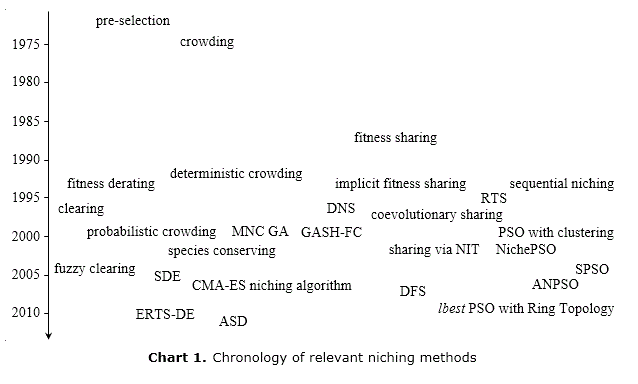
<body><![CDATA[<P><b><font face="Verdana, Arial, Helvetica, sans-serif" size="3">INTRODUCCI&Oacute;N</font>    </b>     <P><font size="2" face="Verdana, Arial, Helvetica, sans-serif">Population based    algorithms are an efficient alternative for solving hard optimization problems.    Despite they are capable to find high quality solutions these algorithms typically    converge to a single final solution due to their global selection scheme. However,    problems from multiple domains such as structure recognition, economic modeling    and engineering design, are highly multimodal. The main goal of multimodal optimization    is to locate several optimal solutions, may them be global or local, and then    to choose the most appropriate solution considering practical issues. When dealing    with multimodal problems some modifications to standard population based algorithms    are needed, in order to provoke the formation of stable subpopulations (also    known as niches) at all peaks in the search space.</font>      <P><font size="2" face="Verdana, Arial, Helvetica, sans-serif">Niching methods    appear from the analogy with natural ecosystems, which are often composed by    different physical spaces (niches) that allow the formation and the maintenance    of distinct types of life competing to survive (species). A species is then    formed by agents biologically similar, which are able for interbreed, but not    with any from other species. For each niche the physical resources are finite    and must be shared among its individuals (Sareni, 1998).</font>      <P><font size="2" face="Verdana, Arial, Helvetica, sans-serif">By analogy, niching    promotes genetic diversity by emerging different sub-populations (niches), each    corresponding to an optimum (peak) of the domain. The fitness represents the    resources (carrying capacity) of the niche, while species can be defined as    similar individuals in terms of certain measures. Speciation methods have been    introduced in evolutionary algorithms (EA) to save diversity among individuals    by forming and maintaining stable subpopulations (Cede&ntilde;o, 1999). It is    required to conserve highly fit individuals and also those that are different    enough from them to be worth keeping. The result is an algorithm that maintains    solutions in multiple peaks while allowing a subset of individuals to explore    other regions of the search space. Without niching strategies, a population    based algorithm generally concentrates on the best peak found so far (Bird,    2006), while otherwise the algorithm searches for multiple solutions at a time.    Even on problems with a single global solution, this has benefits as reducing    the risk of the method sticking locally; some agent will exploit the optimum,    but others will explore other areas of the search space.</font>      <P><font size="2" face="Verdana, Arial, Helvetica, sans-serif">In the next section    a brief review on niching methods is given. Despite it is focused on the classical    techniques, more recent ones are approached or mentioned as well. Section 3    summarizes main limitations of most niching methods while useful aspects on    their performance analysis are detailed in section 4. Finally, conclusions are    presented. </font>      <p><font size="2" face="Verdana, Arial, Helvetica, sans-serif"><B>Briefly surveying    niching methods</B> </font></p>     <p><font size="2" face="Verdana, Arial, Helvetica, sans-serif">Many niching methods    have been reported in the EA literature. One of the first was Cavicchio&rsquo;s    pre-selection (Mahfoud, 1992), later generalized in crowding (De Jong, 1975).    The sharing concept, introduced in (Holland, 1975), was used (Goldberg, 1987)    to ease the selection pressure caused by the fitness proportionate reproduction    (FPR) rule (Holland, 1975). The deterministic crowding (Mahfoud, 1992) deals    with it by letting agents to mate with any other, while in restricted tournament    selection (RTS) (Harik, 1995) it is done by modifying the selection and replacement    steps of the steady state genetic algorithm (SSGA). Fitness derating (Beasley,    1993) allows unimodal optimization methods deal with multimodality by using    the knowledge gained in a run to avoid re-searching the same area. </font></p>     <p><font size="2" face="Verdana, Arial, Helvetica, sans-serif">Other illustrative    examples are clearing (P&eacute;trowski, 1996) and clustering (Kennedy, 2000).    Niching principles have also been applied to Particle Swarm Optimization (PSO),    such as NichePSO (Brits, 2002) and SPSO (Parrott, 2006), as well as to Differential    Evolution (DE), including the species-based DE (SDE) (Li, 2005) and Differential    Evolution with&nbsp; an ensemble of Restricted Tournament Selection (ERTS-DE)    (Qu, 2010). Furthermore, they have addressed combinatorial optimization problems    (Nagata, 2006 and Yang, 1998) and multi-objective ones as well (Chen, 2006 and    Kowalczuk, 2006). Research community on niching methods has dedicated great    efforts to devise niching techniques in absence of parameters derived from <em>a    priori</em> knowledge about the fitness landscape, like the <em>lbest</em> PSO    niching algorithms using a Ring Topology (Li, 2010) and the Adaptive Species    Discovery (ASD) (Della Cioppa, 2011) as well. Other strategies have been devised    to automatically estimate effective values for such parameters, for instance    the Adaptive Niching PSO (ANPSO) (Bird, 2006) and the CMA-ES niching algorithm    (Shir, 2006). Since their large variety, describing most niching methods is    out of the scope of this work. Instead, basic principles of some of the ones    mentioned above which are classical approaches and other relevant methods are    presented below. </font><font face="Verdana, Arial, Helvetica, sans-serif"><a href="/img/revistas/rcci/v7n2/f0103213.gif"><font size="2">Chart    1</font></a></font></p>     <p><font size="2" face="Verdana, Arial, Helvetica, sans-serif"><B>Crowding</B>    </font></p>     <p><font size="2" face="Verdana, Arial, Helvetica, sans-serif">Crowding was first    designed only to keep population diversity since it inserts new elements in    the population by overwriting similar ones. In the basic scheme only a fraction    of the global population (generation gap) reproduces and dies at each generation.    It is, an offspring is compared to a small random sample taken from the current    population and the most similar individual there is replaced. The crowding factor    (CF) parameter is often used to determine the size of the sample. This CF model    is analyzed in (Mahfoud, 1992) and attributed its inability to maintain more    than two peaks of a multimodal landscape to stochastic errors in replacement    which create genetic drift and fixation. </font></p>     ]]></body>
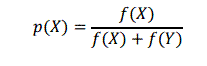
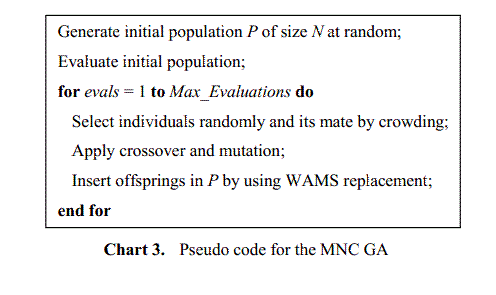
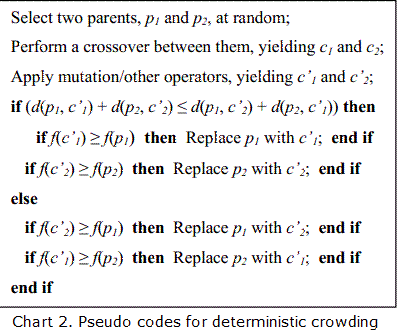
<body><![CDATA[<p><font size="2" face="Verdana, Arial, Helvetica, sans-serif"><B>Deterministic    crowding</B> </font></p>     <p><font size="2" face="Verdana, Arial, Helvetica, sans-serif">Mahfoud made successive    changes to crowding to reduce replacement errors, restore selection pressure    and eliminate the crowding factor, resulting the deterministic crowding (Mahfoud,    1992), which is able to locate and maintain multiple peaks by competition between    children and parents of equal niches. After crossover and mutation, each child    replaces its nearest parent if it has a higher fitness. The procedure in <a href="#2">Chart    2</a> is to be performed <em>N/2</em> times (<em>N</em> is the population size)    and the overall process is to be repeated <em>g</em> generations. <em>d</em>    is the phenotypic distance between agents.</font></p>     <p align="center"><font face="Verdana, Arial, Helvetica, sans-serif"><a name="2"></a><img src="/img/revistas/rcci/v7n2/f0203213.gif" width="399" height="336" border="1">    <br>   </font></p>     <p><font size="2" face="Verdana, Arial, Helvetica, sans-serif"><B>Probabilistic    crowding</B></font></p>     <p><font size="2" face="Verdana, Arial, Helvetica, sans-serif">When a deterministic    tournament is used crowding methods will always prefer higher fitness agents    over lower fitness ones, thus leading to a loss of niches whenever the tournaments    between global and local niches are played. To avoid this deterministic nature    and hence to provide a restorative pressure in such cases, it was proposed the    probabilistic crowding (Mengsheol, 1999). Here, a probabilistic replacement    rule was used to permit higher fitness individuals to win over lower fitness    individuals in proportion to their fitness. The method is essentially the deterministic    crowding with a probabilistic replacement operator. Two similar individuals    <em>X</em> and <em>Y</em> compete, being the probability of <em>X</em> to win:</font></p>     <p><font face="Verdana, Arial, Helvetica, sans-serif"><img src="/img/revistas/rcci/v7n2/fo0103213.gif" width="207" height="66"><font size="2">(1)</font></font></p>     <p><font size="2" face="Verdana, Arial, Helvetica, sans-serif"><B>Multiniche crowding    genetic algorithm</B> </font></p>     <p><font size="2" face="Verdana, Arial, Helvetica, sans-serif">In a further approach,    the multiniche crowding genetic algorithm (MNC GA) illustrated in <a href="/img/revistas/rcci/v7n2/f0303213.gif">Chart    3</a>, both selection and replacement are modified by some kind of crowding    to deal with the selection pressure caused by FPR and allow the population to    keep diversity. No prior knowledge of the problem is needed and no restriction    affects selection neither replacement. The MNC GA uses a replacement policy    called worst among most similar (WAMS). <a href="/img/revistas/rcci/v7n2/f0403213.gif">Chart    4</a> shows a view of this replacement policy (Cede&ntilde;o, 1999).</font></p>     <p><font size="2" face="Verdana, Arial, Helvetica, sans-serif"><B>Fitness sharing</B></font></p>     ]]></body>
<body><![CDATA[<p><font size="2" face="Verdana, Arial, Helvetica, sans-serif">Fitness sharing    (FS) is maybe the most common niching method (Sareni, 1998). It was moved by    nature, where an individual has only limited resources to be shared with other    ones in the same niche. Introduced in (Holland, 1975), it was used in (Goldberg,    1987) to part the population into various subpopulations by the similarity of    the individuals.     <br>   Typically, the shared fitness <em>fsh</em>(<em>i</em>) of an individual <em>i</em>    is its raw fitness <em>f</em>(<em>i</em>) divided by its niche count:</font></p>     <p><font face="Verdana, Arial, Helvetica, sans-serif"><img src="/img/revistas/rcci/v7n2/fo0203213.GIF" width="805" height="118"></font></p>     <p><font size="2" face="Verdana, Arial, Helvetica, sans-serif"><em>N</em> denotes    the population size and <em>d(i,j)</em> &nbsp;is a distance measure between    the individuals <em>i</em> and <em>j</em>. The sharing function (<em>sh</em>)    computes the similarity between two individuals. The most used is described    above, where <em>&sigma;sh</em> (niche radius) is a threshold of dissimilarity    and <em>&alpha;</em> (scaling factor) is a constant that regulates the shape    of <em>sh</em>. Distance is based on a genotypic (Hamming&rsquo;s) similarity    metric or a phenotypic (Euclidean) one. Sharing based on phenotypic one may    give slightly better results (Deb, 1989). Despite its proven value, it has several    difficulties, being the main not to be easy to set proper values for <em>&sigma;sh</em>    and &alpha; without prior knowledge of the problems. </font></p>     <p><font size="2" face="Verdana, Arial, Helvetica, sans-serif"><B>Dynamic niche    sharing</B></font></p>     <p><font size="2" face="Verdana, Arial, Helvetica, sans-serif">Beyond the classic    sharing there are many tries, dynamic niche sharing (DNS) (Miller, 1996), to    self detect niches by using this scheme. DNS adopts a dynamic species identification    and partitions the population by assuming that the number of niches of the fitness    landscape is <em>a priori</em> known. Thus, DNS defines a fixed number of dynamic    niches with radius and centers determined by a full population sort. The individuals    not belonging to any of the previously identified species are grouped into a    unique <em>nonspecies</em> class.</font></p>     <p><font size="2" face="Verdana, Arial, Helvetica, sans-serif">Moreover, the fitness    of the individuals is modified according to two different sharing mechanisms.    The shared fitness of an individual belonging to a species is computed by dividing    its raw fitness by the occupation number of the niche. However, for those individuals    not in a niche, regular fixed sharing is used, in that the standard fitness    sharing formula is used for individuals belonging to the <em>nonspecies</em>    class. The authors motivate this choice in terms of computational cost, as the    occupation number is computed only once for all the individuals of a species,    while the niche count has to be computed for each individual in the population.    It presents certain advantages over other nichers. However, as this method requires    an estimate of the number of peaks in addition to the niche radius, its primary    weakness is the use of fixed sharing outside the dynamic niches (Goldberg, 1997).    </font></p>     <p><font size="2" face="Verdana, Arial, Helvetica, sans-serif"><B>Implicit fitness    sharing</B></font></p>     <p><font size="2" face="Verdana, Arial, Helvetica, sans-serif">In the implicit    fitness sharing (Smith, 1993) each individual&rsquo;s fitness is functionally    dependent on the rest of the population. Sharing is done by inducing competition    for limited and explicit environmental resources. For each resource, a set of    individuals is randomly selected from the population and each one is matched    against the resource.</font></p>     <p><font size="2" face="Verdana, Arial, Helvetica, sans-serif">The individual    with the highest score is then rewarded. Such a procedure is repeated a given    number of times, through which the score of individuals is updated. At each    generation, the discovered niches are obtained by selecting the minimal set    of individuals needed to match all the resources. Therefore, niching is implicit    in that the number of peaks is determined dynamically and there is no specific    limitation on the distance between peaks.</font></p>     ]]></body>
<body><![CDATA[<p><font size="2" face="Verdana, Arial, Helvetica, sans-serif">Hence, it is avoided    the difficulty of appropriately choosing the niche radius and the method may    to deal with problems in which the peaks are not equally spaced. This method    introduces other parameters to be set; it is the size of the sample of individuals    that compete, the number of competition cycles and the definition of a matching    procedure. Moreover, it can be applied, at best, on problems in which explicit    and finite resources are available. </font></p>     <p><font size="2" face="Verdana, Arial, Helvetica, sans-serif"><B>Dynamic fitness    sharing</B> </font></p>     <p><font size="2" face="Verdana, Arial, Helvetica, sans-serif">Dynamic fitness    sharing (DFS) (Della Cioppa, 2007) is another attempt to automatically identify    the niches in the population during the evolution. As shown in <a href="/img/revistas/rcci/v7n2/f0503213.gif">Chart    5</a>, it is based on a dynamic explicit identification of the species</font><font face="Verdana, Arial, Helvetica, sans-serif">.</font></p>     <p><font size="2" face="Verdana, Arial, Helvetica, sans-serif"><B>Coevolutionary    sharing</B></font></p>     <p><font size="2" face="Verdana, Arial, Helvetica, sans-serif">The coevolutionary    sharing model (Goldberg, 1997) attempts to avoid the estimation of niche radius.    It uses two coevolving populations: customers and businessmen. Customers are    served by the nearest businessman. By using a sharing function, customer fitness    is derated in proportion to the total number of other customers served by the    nearest businessman. Thus, there is pressure to find businessmen serving relatively    few customers. </font></p>     <p><font size="2" face="Verdana, Arial, Helvetica, sans-serif">The customer evolves    under a traditional GA. In contrast, the businessmen attempt to maximize the    number of customers served, having more customers yields higher fitness. To    prevent convergence of the businessmen to a single global optimum, they are    separated at least by a distance <em>dmin</em>. This population evolves by a    mechanism that converts the best customers into businessmen. For each businessman,    <em>n</em> customers are randomly selected. The first customer that is both    more fit than it and at <em>dmin</em> away from other businessmen, replaces    the original businessman.</font></p>     <p><font size="2" face="Verdana, Arial, Helvetica, sans-serif"><B>Sharing via    niche identification techniques</B></font></p>     <p><font size="2" face="Verdana, Arial, Helvetica, sans-serif">A sharing scheme    based on niche identification techniques (NIT) is proposed in (Lin, 2002). It    is capable of determining the center location and the radius of each of existing    niches based on fitness topographical information of designs in the population.    Genetic algorithms with NIT were compared to GAs with traditional sharing scheme    and sharing with cluster analysis methods. Results of numerical experiments    showed that the sharing scheme with NIT improved both search stability and effectiveness    of locating multiple optima.</font></p>     <p><font size="2" face="Verdana, Arial, Helvetica, sans-serif"><B>Clearing</B></font></p>     <p><font size="2" face="Verdana, Arial, Helvetica, sans-serif">The clearing procedure    (P&eacute;trowski, 1996) is alike fitness sharing. If an individual belongs    to a given subpopulation, then its dissimilarity with the dominant (individual    with the best fitness) is less than a given threshold <em>&sigma;</em> (the    clearing radius). Instead of evenly sharing the resources among the individuals    of a sub-population as in fitness sharing, clearing attributes them only to    the best members (the <em>winners</em>) of each sub-population. Its reliability    is similar to that of the sharing method with lower complexity but, like sharing,    it requires <em>a priori</em> knowledge of the niche radius.</font></p>     ]]></body>
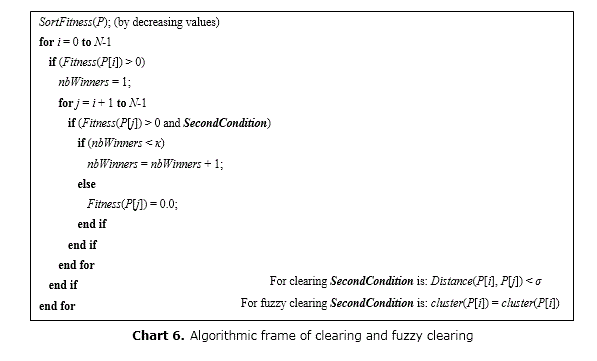
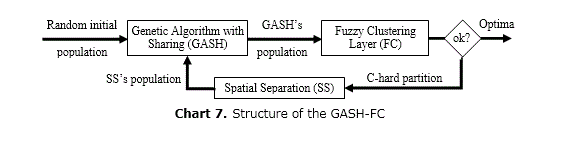
<body><![CDATA[<p><font size="2" face="Verdana, Arial, Helvetica, sans-serif">Pseudo code of    a simplified version of the clearing procedure is presented in <a href="/img/revistas/rcci/v7n2/f0603213.gif">Chart    6</a>, where population <em>P</em> is seen as an array of <em>N</em> agents,    the capacity (<em>&kappa;</em>) is the maximun number of winners that a niche    can accept, while <em>nbWinners</em> is the number of winners of the subpopulation    associated with the current niche. Clearing allows dosing the niching effect    between the maximum capacity (<em>&kappa;</em> = 1) and its absence (<em>&kappa;</em>    = <em>N</em>). Its major weakness is the need for estimate <em>&sigma;</em>    (Sareni, 1998), while a great assets is that its complexity is <em>O</em>(<em>C    N</em>) (being <em>C</em> the number of peaks) instead of sharing&rsquo;s <em>O</em>(<em>N    </em>2). </font></p>     <p><font size="2" face="Verdana, Arial, Helvetica, sans-serif"><B>Fuzzy clearing</B>    </font></p>     <p><font size="2" face="Verdana, Arial, Helvetica, sans-serif">While in standard    clearing an individual dominates those within a range <em>&sigma;</em>, in a    further approach (Sacco, 2004) the individuals were clusterized before submitting    them to clearing, dominance is seen within a cluster. Each individual is allotted    solely to a single cluster by the KMEAN adaptive algorithm. Since it classifies    in a deterministic way, being far from ideal in functions with unknown behavior    or several nearby optima, in real world problems it has a high degree of uncertainty.    The use of fuzzy logic to clusterize the individuals naturally appears. Thus,    they used as fuzzy class separation algorithm the fuzzy clustering means (FCM).    It uses the concept of pertinence that denotes the degree of association of    an individual to a given class. Authors made a combination of an efficient niching    technique with a clustering method free of previous knowledge of the problem.    A pseudo code to be applied after clustering is shown in <a href="/img/revistas/rcci/v7n2/f0603213.gif">Chart    6</a>.</font></p>     <p><font size="2" face="Verdana, Arial, Helvetica, sans-serif"><B>Genetic Algorithm    with Sharing and Fuzzy Clustering</B></font></p>     <p><font size="2" face="Verdana, Arial, Helvetica, sans-serif">With fuzzy clustering,    in the Genetic Algorithm with Sharing and Fuzzy Clustering (GASH-FC) (El Imrani,    2000), the number of niches is automatically determine by continuously updating    the radius of each niche until finding an optimal solution. It is a three-layer    strategy (<a href="/img/revistas/rcci/v7n2/f0703213.gif">Chart 7</a>) that can    be seen as a generalization of hard clustering, with the gain of efficiently    dealing with overlapping clusters. Each cluster represents a niche while their    centers correspond to the desired optima. As this method uses a self-learning    procedure, the number of clusters (C) is computed by itself. Niches merge by    using the center and the radius of each cluster while a GASH handles the evolution    of each sub-population to identify a non-found niche in the previous iteration.</font></p>     <p><font size="2" face="Verdana, Arial, Helvetica, sans-serif"><B>Sequential niching</B></font></p>     <p><font size="2" face="Verdana, Arial, Helvetica, sans-serif">Sequential niching    (Beasley, 1993) works by iterating a simple GA and maintaining the best solution    of each run off-line. To avoid converging to the same area of the search space    multiple times whenever a solution is located it depresses the fitness landscape    at all points within some radius of that solution. This ensures that on subsequent    runs the same peak will not be rediscovered. This technique has many similarities    with fitness sharing. However, instead of the fitness of an individual being    reduced because of its proximity to other members of population (sharing), individuals    have their fitness reduced because their proximity to peaks located in previous    runs. This approach suffers similar limitations about choosing appropriate values    for the niche parameters.</font></p>     <p><font size="2" face="Verdana, Arial, Helvetica, sans-serif"><B>Species conserving    genetic algorithms</B></font></p>     <p><font size="2" face="Verdana, Arial, Helvetica, sans-serif">The species conserving    genetic algorithms (SCGA) (Li, 2002) evolve parallel subpopulations by using    species conservation. According to their similarity, population is divided into    several species, each of which is built around a dominating individual (the    species seed). Species seeds found in the current generation are saved to the    next one. </font></p>     <p><font size="2" face="Verdana, Arial, Helvetica, sans-serif">The definition    of a species and the operation of the SCGA depend on the species distance (&sigma;s),    the upper bound on the distance between two individuals for which they are considered    to be similar. This parameter determines which individuals are worth preserving    from one generation to the next. The distance between any two individuals in    a species is less than &sigma;s while any two individuals within a distance    less than &sigma;s are not forced to be in the same species.</font></p>     ]]></body>
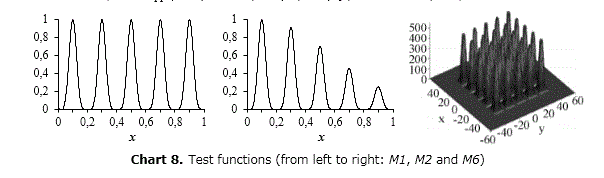
<body><![CDATA[<p><font size="2" face="Verdana, Arial, Helvetica, sans-serif">The algorithm builds    <em>Xs</em> (the set of species found in generation <em>t</em>) by successively    considering each individual in <em>t</em>, in decreasing order of fitness. Considering    an individual means it is compared to the current species seeds. If <em>Xs</em>    does not contain any seed that is closer than half the species distance (<em>&sigma;s</em>/<em>2</em>)    to the individual considered, then the individual will be added to <em>Xs</em>.    Once all the species are found the new population is constructed by applying    the typical genetic operators. Since some species might not survive after such    operations, they are directly saved to the new population.</font></p>     <p><font size="2" face="Verdana, Arial, Helvetica, sans-serif"><B>Relevant drawbacks    of niching algorthims</B> </font></p>     <p><font size="2" face="Verdana, Arial, Helvetica, sans-serif">Near all these    methods depend on parameters usually hard to set as such prior knowledge is    often unavailable in real-world problems. Many tries to deal with such drawback    are reported (Bird, 2006 and Shir, 2006). In addition, most niching methods    perform poorly when the dimensionality of the problem or the number of optima    increases, while for some ones it is hard to maintain found solutions. Also,    some niching techniques only play to find all global optima, while ignoring    local ones. </font></p>     <p><font size="2" face="Verdana, Arial, Helvetica, sans-serif">Furthermore, a    regular drawback is the high computational complexity. As regards this, sharing    has a complexity of <em>O</em>(<em>N </em>2), being <em>N</em> the population    size. Clearing has a complexity of <em>C </em>x <em>N</em>, where <em>C</em>    is the number of subpopulations. For RTS it is <em>w </em>x <em>N</em>,being    <em>w </em>the window size (its niching parameter) and for DFS it is between    <em>O</em>(<em>N</em>) and <em>O</em>(<em>N </em>2). With <em>O</em>(<em>N</em>),    both deterministic and probabilistic crowding are the less complex among methods    included in this work.</font></p>     <p><font size="2" face="Verdana, Arial, Helvetica, sans-serif"><B>On the performance    evaluation of niching methods</B> </font></p>     <p><font size="2" face="Verdana, Arial, Helvetica, sans-serif">The behavior of    niching methods is assessed by analyzing specific measures over the optimization    process of well known benchmark multimodal functions. Some topics on both functions    and measures are presented next.</font></p>     <p><font size="2" face="Verdana, Arial, Helvetica, sans-serif"><B>Test functions</B></font></p>     <p><font size="2" face="Verdana, Arial, Helvetica, sans-serif">While illustrative    multimodal benchmark problems widely studied as <em>M1</em>, <em>M2</em> and    <em>M6</em> are presented, further examples can be found in (Della Cioppa, 2011;    El Imrani, 2000; Li, 2005; Qu, 2010 and Sareni, 1998).</font> <font face="Verdana, Arial, Helvetica, sans-serif"><a href="/img/revistas/rcci/v7n2/f0803213.gif"><font size="2">Chart    8</font></a></font></p>     <p><font size="2" face="Verdana, Arial, Helvetica, sans-serif"><em>M1</em> and    <em>M2</em> were firstly proposed in (Goldberg, 1995) and are the simplest among    the ones proposed in the literature for studying the behavior of a niching method.    The aim in using such functions is particularly devoted to analyze the ability    of the method to maintain the discovered niches rather than its searching ability.    <em>M1</em> is defined as follows:</font></p>     <p><font face="Verdana, Arial, Helvetica, sans-serif"><img src="/img/revistas/rcci/v7n2/fo0303213.gif" width="361" height="42"></font></p>     ]]></body>
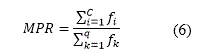
<body><![CDATA[<p><font face="Verdana, Arial, Helvetica, sans-serif" size="2">It has five peaks    at x=0.1, 0.3, 0.5, 0.7 and 0.9 all with a height equal to 1.0. M2 is the same    than M1 regarding the optima values but the heights of the peaks are x=1.0,    0.917, 0.707, 0.459 and 0.250 respectively. It is defined as:</font></p>     <p><font face="Verdana, Arial, Helvetica, sans-serif"><img src="/img/revistas/rcci/v7n2/fo0403213.gif" width="467" height="39"></font></p>     <p><font face="Verdana, Arial, Helvetica, sans-serif" size="2">M6 (Shekel's Foxholes)    was firstly introduced in (De Jong, 1975). Although not deceptive, it is more    complex than the previous. The independent variables range in [-65.536,65.535]    and its 25 equidistant peaks are located in correspondence of the coordinates    [16i,16j], where i and j are integer variables ranging in the interval [-2,2].    The peaks heights range in [476.191,499.002] and the highest peak is located    at (-32,32). Its analytical form is:</font></p>     <p><font face="Verdana, Arial, Helvetica, sans-serif"><img src="/img/revistas/rcci/v7n2/fo0503213.gif" width="544" height="94"></font></p>     <p><font face="Verdana, Arial, Helvetica, sans-serif" size="2"><b>Performance    criteria</b></font></p>     <p><font face="Verdana, Arial, Helvetica, sans-serif" size="2">When assessing    niching methods, different criteria concerning with their ability to identify    the optima might be used. Perhaps the most widely used criteria is the effective    number of peaks maintained (in literature ENPM or EPM), that means the ability    of a method to locate and maintain individuals at peaks for long periods of    time. It is often just tracked the number of peaks maintained as a function    of the number of evaluations run (Sareni, 1998). The maximum peaks ratio (MPR)    is also commonly used. It gives both the quality and the number of the optima    reached:</font></p>     <p><font face="Verdana, Arial, Helvetica, sans-serif" size="2"><img src="/img/revistas/rcci/v7n2/fo0603213.gif" width="205" height="56"></font>  </p>     <p><font size="2" face="Verdana, Arial, Helvetica, sans-serif">where <em>Fi</em>    is the fitness of identified optimum <em>i</em> and <em>fk</em> is the fitness    of the actual optimum <em>k</em>. <em>C</em> is the number of reached peaks,    which contain the identified optima, and <em>q</em> is the number of real optima.    An optimum is as detected if its fitness value is at least 80% of the actual.    Besides, some authors (Sareni, 1998) also check that the optimum is within a    niche radius of the real optimum. If not found, the local optimum value is set    to zero. Hence, the top value for the MPR is 1.</font></p>     <p><font size="2" face="Verdana, Arial, Helvetica, sans-serif">Other criteria    (Della Cioppa, 2011; El Imrani, 2000; Li, 2005 and Sareni, 1998) are the <em>ENPM    and MPR saturation values</em> (<em>GE</em> and <em>GM</em> respectively), that    reveal the generations after which the 99% of such saturation values are reached;    the <em>number of fitness function evaluations (NFE)</em> required for the population    convergence; the <em>accuracy</em>, which gives the proximity of fittest solutions    to all actual optima; the <em>convergence speed</em>, that measures the number    of evaluations needed to reach certain accuracy; the <em>success rate</em>,    meaning the percentage of runs in which all optima are successfully located    and the <em>chi-square-like deviation</em>, that reveals the method&rsquo;s    ability to evenly populate the niches.</font></p>     <p>&nbsp;</p>     ]]></body>
<body><![CDATA[<P><font face="Verdana, Arial, Helvetica, sans-serif" size="3"><B>CONCLUSIONES</B></font>      <P><font size="2" face="Verdana, Arial, Helvetica, sans-serif">Since the large    the number of niching techniques is, after presented some relevant issues about    basics of multimodal optimization, niching methods are briefly surveyed. It    regards classical ones, including fitness sharing, crowding, clearing and clustering;    extensions to previous methods are presented as well. It must be noted that    there is still a need for devise methods out of niching parameters, which is    maybe the most regular difficulty in such methods.</font>      <P><font size="2" face="Verdana, Arial, Helvetica, sans-serif">Moreover, nearly    all niching techniques have a low performance when either the dimensionality    of the search space or number of the optima increases. Besides, it is often    hard to maintain found solutions along generations; whereas some niching approaches    only search for locating all global optima, while ignoring local optima.</font>      <P><font size="2" face="Verdana, Arial, Helvetica, sans-serif">Conversely, some    real domains demands to obtain both global and local optima at a time. Also,    the frequent estimation of information from the whole population requires around    <em>O</em>(<em>N</em> 2) computational complexity. All reported drawbacks define    the current and future research lines on niching methods. Finally, they are    presented some benchmark functions from multimodal problems test suite while    main criteria used when assessing the performance of niching methods are also    depicted.</font>      <P>&nbsp;</p>     <p><font face="Verdana, Arial, Helvetica, sans-serif" size="3"><B>REFERENCIAS    BIBLIOGR&Aacute;FICAS</B></font></p>     <!-- ref --><p><font size="2" face="Verdana, Arial, Helvetica, sans-serif">BEASLEY D., BULL    D. R. and MARTIN R. R. A Sequential Technique for Multimodal Function Optimization.    Evolutionary Computation, 1993, 1(2), 101-125.    </font></p>     <p> <font size="2" face="Verdana, Arial, Helvetica, sans-serif"> BIRD S. and LI    X. Adaptively Choosing Niching Parameters in a PSO. In Proceedings of the 8th    Genetic and Evolutionary Computation Conference (GECCO&rsquo;06). Seattle, Washington:    2006, p. 3-9.</font></p>     <p><font size="2" face="Verdana, Arial, Helvetica, sans-serif"> BRITS R. and VAN    DEN BERGH F. A Niching Particle Swarm Optimizer. In Proceedings of the 4th Asia-Pacific    Conference on Simulated Evolution And Learning (SEAL&rsquo;2002). Singapore:    2002, p. 692-696.</font></p>     ]]></body>
<body><![CDATA[<p><font size="2" face="Verdana, Arial, Helvetica, sans-serif"> CEDE&Ntilde;O    W. and VEMURI V. R. Analysis of Speciation and Niching in the Multi-Niche Crowding    GA. Theoretical Computer Science, 1999, 229, p. 177-197.</font></p>     <p><font size="2" face="Verdana, Arial, Helvetica, sans-serif">CHEN T. Y. and    HSU Y. S. A Multiobjective Optimization Solver Using Rank-Niche Evolution Strategy.    Advances in Engineering Software, 2006, 37, p. 68-699.</font></p>     <!-- ref --><p><font size="2" face="Verdana, Arial, Helvetica, sans-serif">EB K. and GOLDBERG    D. E. An Investigation of Niche and Species Formation in Genetic Function optimization.    In Proceedings of the 3rd Internationl Conference on Genetic Algorithms. Ed.    Morgan Kaufmann, 1989, p. 42-50.    </font></p>     <!-- ref --><p><font size="2" face="Verdana, Arial, Helvetica, sans-serif">DE JONG K.A. An    Analysis of the Behaviour of a Class of Genetic Adaptive Systems. Doctoral dissertation,    University of Michigan, Ann Arbor, MI, 1975.    </font></p>     <!-- ref --><p><font size="2" face="Verdana, Arial, Helvetica, sans-serif">DELLA CIOPPA A.,    DE STEFANO C. and MARCELLi, A. Where Are the Niches? Dynamic Fitness Sharing.    IEEE Transactions on Evolutionary Computation, 2007, 11(4), p. 453-465.     </font></p>     <p><font size="2" face="Verdana, Arial, Helvetica, sans-serif">DELLA CIOPPA A.,    MARCELLI A. and NAPOLI P. Speciation in Evolutionary Algorithms: Adaptive Species    Discovery. In Proceedings of the 13th Genetic and Evolutionary Computation Conference    (GECCO&rsquo;11). Dublin, Ireland: 2011.</font></p>     <!-- ref --><p><font size="2" face="Verdana, Arial, Helvetica, sans-serif"> EL IMRANI A.,    BOUROUMI A., ZINE EL ABIDINE H., LIMOURI M. and ESSA&Iuml;D A. A Fuzzy Clustering-Based    Niching Approach to Multimodal Function Optimization. Journal of Cognitive Systems    Research, 2000, 1, p. 119-133.    </font></p>     <!-- ref --><p><font size="2" face="Verdana, Arial, Helvetica, sans-serif"> GOLDBERG D. E.    and RICHARDSON J. Genetic Algorithms With Sharing for Multimodal Function Optimization.    In Proceedings of the 2nd International Conference on Genetic Algorithms. Hillsdale,    NJ: L. Erlbaum Associates Inc., 1987, p. 41-49.    </font></p>     <!-- ref --><p><font size="2" face="Verdana, Arial, Helvetica, sans-serif">GOLDBERG D. E.    and WANG L. Adaptative Niching via Coevolutionary Sharing. In Genetic Algorithms    in Engineering and Computer Science. New York: Wiley, 1997, p. 21-38.    </font></p>     <p><font size="2" face="Verdana, Arial, Helvetica, sans-serif">HARIK G. R. Finding    Multimodal Solutions Using Restricted Tournament Selection. In Proceedings of    the 6th International Conference on Genetic Algorithms. Eshelman L.J., Ed. Morgan    Kaufmann, 1995, p. 24-31.</font></p>     <!-- ref --><p><font size="2" face="Verdana, Arial, Helvetica, sans-serif">HOLLAND J. H. Adaptation    in Natural and Artificial Systems. The University of Michigan Press, Ann Arbor,    MI, 1975.    </font></p>     <!-- ref --><p><font size="2" face="Verdana, Arial, Helvetica, sans-serif"> KENNEDY J. Stereotyping:    Improving Particle Swarm Performance with Cluster Analysis. In Proceedings of    the IEEE International Conference on Evolutionary Computation. 2000, p. 303-308.    </font></p>     ]]></body>
<body><![CDATA[<!-- ref --><p><font size="2" face="Verdana, Arial, Helvetica, sans-serif"> KOWALCZUK Z. and    BIA&#321;ASZEWSKI T. Niching Mechanisms in Evolutionary Computations. International    Journal of Applied Mathemathics and Computater Science, 2006, 16(1), p.59-84.    </font></p>     <!-- ref --><p><font size="2" face="Verdana, Arial, Helvetica, sans-serif"> LI J. P., BALAZS    M. E., PARKS G.T and CLARKSON P. J. A Species Conserving Genetic Algorithm for    Multimodal Function Optimization. Evolutionary Computation, 2002, 10(3), p.    207-234.    </font></p>     <p><font size="2" face="Verdana, Arial, Helvetica, sans-serif"> LI X. Adaptively    Choosing Neighbourhood Bests Using Species in a Particle Swarm optimizer for    Multimodal Function Optimization. In Proceedings of 6th Genetic and Evolutionary    Computation Conference (GECCO&rsquo;04). 2004, p. 105-116.</font></p>     <p><font size="2" face="Verdana, Arial, Helvetica, sans-serif"> LI X. Efficient    Differential Evolution using Speciation for Multimodal Function Optimization.    In Proceedings of 7th Genetic and Evolutionary Computation Conference (GECCO&rsquo;05).    Washington, DC: 2005, p. 873-880.</font></p>     <!-- ref --><p><font size="2" face="Verdana, Arial, Helvetica, sans-serif"> LI X. Niching    Without Niching Parameters: Particle Swarm Optimization using a Ring Topology.    IEEE Transactions on Evolutionary Computation, 2010, 14, p. 150-169.    </font></p>     <!-- ref --><p><font size="2" face="Verdana, Arial, Helvetica, sans-serif">LIN C.Y and WU    W. H. Niche Identification Techniques in Multimodal Genetic Search with Sharing    Scheme. Advances in Engineering Software, 2002, 33, p. 779-791.    </font></p>     ]]></body>
<body><![CDATA[<!-- ref --><p><font size="2" face="Verdana, Arial, Helvetica, sans-serif"> MAHFOUD S. W.    Crowding and Preselection Revisited. In Proceedings of the 2nd International    Conference on Parallel Problems Solved form Nature. North-Holland, Amsterdam:    1992, p. 27-36.    </font></p>     <p><font size="2" face="Verdana, Arial, Helvetica, sans-serif">MENGSHEOL O. and    GOLDBERG D. Probabilistic Crowding: Deterministic Crowding with Probabilistic    Replacement. In Proceedings of the 1st Genetic and Evolutionary Computation    Conference (GECCO&rsquo;99). 1999, p. 409-416.</font></p>     <!-- ref --><p><font size="2" face="Verdana, Arial, Helvetica, sans-serif"> MILLER B. L. and    SHAW M. J. Genetic Algorithms with Dynamic Niche Sharing for Multimodal Function    Optimization. In Proceedings of the IEEE International Conference on Evolutionary    Computation. Piscataway, NJ: IEEE Press, 1996, p. 786-791.    </font></p>     <!-- ref --><p><font size="2" face="Verdana, Arial, Helvetica, sans-serif"> NAGATA Y. Niching    Method for Combinatorial Optimization Problems and Application to JSP. In Proceedings    of the IEEE Congress on Evolutionary Computation. Vancouver, BC, Canada: 2006.    </font></p>     <!-- ref --><p><font size="2" face="Verdana, Arial, Helvetica, sans-serif"> P&Eacute;TROWSKI    A. A clearing procedure as a niching method for genetic algorithms. In Proceedings    of the 3rd IEEE International Conference on Evolutionary Computation. Nagoya,    Japan:1996, p. 798-803.    </font></p>     <!-- ref --><p><font size="2" face="Verdana, Arial, Helvetica, sans-serif"> QU B.Y. and SUGANTHAN    P. N. Novel Multimodal Problems and Differential Evolution with Ensemble of    Restricted Tournament Selection. In Proceedings of the IEEE Congress on Evolutionary    Computation. Barcelona, Spain: 2010, p. 3480-3486.    </font></p>     <!-- ref --><p><font size="2" face="Verdana, Arial, Helvetica, sans-serif"> SACCO W. F., MACHADO    M. D., PEREIRA C.M. and SCHIRRU R. The fuzzy clearing approach for a niching    genetic algorithm applied to a nuclear reactor core design optimization problem.    Annals of Nuclear Energy, 2004, 31, p. 55-69.    </font></p>     <!-- ref --><p><font size="2" face="Verdana, Arial, Helvetica, sans-serif"> SARENI B. and    KR&Auml;HENB&Uuml;HL L. Fitness sharing and niching methods revisited. IEEE    Transactions on Evolutionary Computation, 1998, 2(3), p. 97-106.    </font></p>     <!-- ref --><p><font size="2" face="Verdana, Arial, Helvetica, sans-serif">SHIR O.M. and B&Auml;CK    T. Niche radius adaptation in the cma-es niching algorithm. In Proceedings of    the 9th International Conference on Parallel Problems Solved form Nature. Reykjavik:    2006, p. 142-151.    </font></p>     <!-- ref --><p><font size="2" face="Verdana, Arial, Helvetica, sans-serif"> SMITH R., FORREST    S. and PERELSON A. S. Searching for diverse, cooperative populations with genetic    algorithms. Evolutionary Computation, 1993, 1(2), pp. 127-149.    </font></p>     <!-- ref --><p><font size="2" face="Verdana, Arial, Helvetica, sans-serif"> YANG R. Line-breeding    Schemes for Combinatorial Optimization. Lectures Notes in Computer Science 1498,    Springer- Verlag Berlin, 1998, p. 448-457.    </font></p>     <p>&nbsp;</p>     <p>&nbsp;</p>     <P><font face="Verdana, Arial, Helvetica, sans-serif" size="2">Recibido:22/04/2013    <br>   Aceptado:9/06/2013</font>       ]]></body><back>
<ref-list>
<ref id="B1">
<nlm-citation citation-type="journal">
<person-group person-group-type="author">
<name>
<surname><![CDATA[BEASLEY]]></surname>
<given-names><![CDATA[D.]]></given-names>
</name>
<name>
<surname><![CDATA[BULL]]></surname>
<given-names><![CDATA[D. R.]]></given-names>
</name>
<name>
<surname><![CDATA[MARTIN]]></surname>
<given-names><![CDATA[R. R.]]></given-names>
</name>
</person-group>
<source><![CDATA[Evolutionary ComputationA Sequential Technique for Multimodal Function Optimization]]></source>
<year>1993</year>
<volume>1</volume>
<numero>2</numero>
<issue>2</issue>
<page-range>101-125</page-range></nlm-citation>
</ref>
<ref id="B2">
<nlm-citation citation-type="">
<person-group person-group-type="author">
<name>
<surname><![CDATA[BIRD]]></surname>
<given-names><![CDATA[S.]]></given-names>
</name>
<name>
<surname><![CDATA[LI]]></surname>
<given-names><![CDATA[X.]]></given-names>
</name>
</person-group>
<source><![CDATA[Adaptively Choosing Niching Parameters in a PSO]]></source>
<year>2006</year>
<page-range>3-9</page-range><publisher-loc><![CDATA[Washington ]]></publisher-loc>
</nlm-citation>
</ref>
<ref id="B3">
<nlm-citation citation-type="">
<person-group person-group-type="author">
<name>
<surname><![CDATA[BRITS]]></surname>
<given-names><![CDATA[R.]]></given-names>
</name>
<name>
<surname><![CDATA[VAN DEN BERGH]]></surname>
<given-names><![CDATA[F.]]></given-names>
</name>
</person-group>
<source><![CDATA[A Niching Particle Swarm Optimizer]]></source>
<year>2002</year>
<page-range>692-696</page-range><publisher-loc><![CDATA[Singapore ]]></publisher-loc>
</nlm-citation>
</ref>
<ref id="B4">
<nlm-citation citation-type="book">
<person-group person-group-type="author">
<name>
<surname><![CDATA[CEDEÑO]]></surname>
<given-names><![CDATA[W.]]></given-names>
</name>
<name>
<surname><![CDATA[VEMURI]]></surname>
<given-names><![CDATA[V. R.]]></given-names>
</name>
</person-group>
<source><![CDATA[Analysis of Speciation and Niching in the Multi-Niche Crowding GA]]></source>
<year>1999</year>
<page-range>177-197</page-range><publisher-name><![CDATA[Theoretical Computer Science]]></publisher-name>
</nlm-citation>
</ref>
<ref id="B5">
<nlm-citation citation-type="book">
<person-group person-group-type="author">
<name>
<surname><![CDATA[CHEN]]></surname>
<given-names><![CDATA[T. Y.]]></given-names>
</name>
<name>
<surname><![CDATA[HSU]]></surname>
<given-names><![CDATA[Y. S.]]></given-names>
</name>
</person-group>
<source><![CDATA[A Multiobjective Optimization Solver Using Rank-Niche Evolution Strategy]]></source>
<year>2006</year>
<page-range>68-699</page-range><publisher-name><![CDATA[Advances in Engineering Software]]></publisher-name>
</nlm-citation>
</ref>
<ref id="B6">
<nlm-citation citation-type="book">
<person-group person-group-type="author">
<name>
<surname><![CDATA[EB]]></surname>
<given-names><![CDATA[K.]]></given-names>
</name>
<name>
<surname><![CDATA[GOLDBERG]]></surname>
<given-names><![CDATA[D. E.]]></given-names>
</name>
</person-group>
<source><![CDATA[An Investigation of Niche and Species Formation in Genetic Function optimization]]></source>
<year>1989</year>
<page-range>42-50</page-range><publisher-name><![CDATA[Morgan Kaufmann]]></publisher-name>
</nlm-citation>
</ref>
<ref id="B7">
<nlm-citation citation-type="">
<person-group person-group-type="author">
<name>
<surname><![CDATA[DE JONG]]></surname>
<given-names><![CDATA[K. A.]]></given-names>
</name>
</person-group>
<source><![CDATA[An Analysis of the Behaviour of a Class of Genetic Adaptive Systems]]></source>
<year>1975</year>
</nlm-citation>
</ref>
<ref id="B8">
<nlm-citation citation-type="journal">
<person-group person-group-type="author">
<name>
<surname><![CDATA[DELLA CIOPPA]]></surname>
<given-names><![CDATA[A.]]></given-names>
</name>
<name>
<surname><![CDATA[DE STEFANO]]></surname>
<given-names><![CDATA[C.]]></given-names>
</name>
<name>
<surname><![CDATA[MARCELLi]]></surname>
<given-names><![CDATA[A.]]></given-names>
</name>
</person-group>
<source><![CDATA[IEEE Transactions on Evolutionary ComputationWhere Are the Niches? Dynamic Fitness Sharing]]></source>
<year>2007</year>
<volume>11</volume>
<numero>4</numero>
<issue>4</issue>
<page-range>453-465</page-range></nlm-citation>
</ref>
<ref id="B9">
<nlm-citation citation-type="">
<person-group person-group-type="author">
<name>
<surname><![CDATA[DELLA CIOPPA]]></surname>
<given-names><![CDATA[A.]]></given-names>
</name>
<name>
<surname><![CDATA[MARCELLI]]></surname>
<given-names><![CDATA[A.]]></given-names>
</name>
<name>
<surname><![CDATA[NAPOLI]]></surname>
<given-names><![CDATA[P.]]></given-names>
</name>
</person-group>
<source><![CDATA[Speciation in Evolutionary Algorithms: Adaptive Species Discovery]]></source>
<year>2011</year>
<publisher-loc><![CDATA[Dublin ]]></publisher-loc>
</nlm-citation>
</ref>
<ref id="B10">
<nlm-citation citation-type="journal">
<person-group person-group-type="author">
<name>
<surname><![CDATA[EL IMRANI]]></surname>
<given-names><![CDATA[A.]]></given-names>
</name>
<name>
<surname><![CDATA[BOUROUMI]]></surname>
<given-names><![CDATA[A.]]></given-names>
</name>
<name>
<surname><![CDATA[ZINE EL ABIDINE]]></surname>
<given-names><![CDATA[H.]]></given-names>
</name>
<name>
<surname><![CDATA[LIMOURI]]></surname>
<given-names><![CDATA[M.]]></given-names>
</name>
<name>
<surname><![CDATA[ESSAÏD]]></surname>
<given-names><![CDATA[A.]]></given-names>
</name>
</person-group>
<source><![CDATA[Journal of Cognitive Systems ResearchA Fuzzy Clustering-Based Niching Approach to Multimodal Function Optimization]]></source>
<year>2000</year>
<volume>1</volume>
<page-range>119-133</page-range></nlm-citation>
</ref>
<ref id="B11">
<nlm-citation citation-type="book">
<person-group person-group-type="author">
<name>
<surname><![CDATA[GOLDBERG]]></surname>
<given-names><![CDATA[D. E.]]></given-names>
</name>
<name>
<surname><![CDATA[RICHARDSON]]></surname>
<given-names><![CDATA[J.]]></given-names>
</name>
</person-group>
<source><![CDATA[Genetic Algorithms With Sharing for Multimodal Function Optimization]]></source>
<year>1987</year>
<page-range>41-49</page-range><publisher-name><![CDATA[L. Erlbaum Associates Inc]]></publisher-name>
</nlm-citation>
</ref>
<ref id="B12">
<nlm-citation citation-type="book">
<person-group person-group-type="author">
<name>
<surname><![CDATA[GOLDBERG]]></surname>
<given-names><![CDATA[D. E.]]></given-names>
</name>
<name>
<surname><![CDATA[WANG]]></surname>
<given-names><![CDATA[L.]]></given-names>
</name>
</person-group>
<source><![CDATA[Adaptative Niching via Coevolutionary Sharing]]></source>
<year>1997</year>
<page-range>21-38</page-range><publisher-loc><![CDATA[New York ]]></publisher-loc>
<publisher-name><![CDATA[Wiley]]></publisher-name>
</nlm-citation>
</ref>
<ref id="B13">
<nlm-citation citation-type="book">
<person-group person-group-type="author">
<name>
<surname><![CDATA[HARIK]]></surname>
<given-names><![CDATA[G. R.]]></given-names>
</name>
</person-group>
<source><![CDATA[Finding Multimodal Solutions Using Restricted Tournament Selection.]]></source>
<year>1995</year>
<page-range>24-31</page-range><publisher-name><![CDATA[Morgan Kaufmann]]></publisher-name>
</nlm-citation>
</ref>
<ref id="B14">
<nlm-citation citation-type="">
<person-group person-group-type="author">
<name>
<surname><![CDATA[HOLLAND]]></surname>
<given-names><![CDATA[J. H.]]></given-names>
</name>
</person-group>
<source><![CDATA[Adaptation in Natural and Artificial Systems]]></source>
<year>1975</year>
</nlm-citation>
</ref>
<ref id="B15">
<nlm-citation citation-type="">
<person-group person-group-type="author">
<name>
<surname><![CDATA[KENNEDY]]></surname>
<given-names><![CDATA[J.]]></given-names>
</name>
</person-group>
<source><![CDATA[Stereotyping: Improving Particle Swarm Performance with Cluster Analysis]]></source>
<year>2000</year>
<page-range>303-308</page-range></nlm-citation>
</ref>
<ref id="B16">
<nlm-citation citation-type="journal">
<person-group person-group-type="author">
<name>
<surname><![CDATA[KOWALCZUK]]></surname>
<given-names><![CDATA[Z.]]></given-names>
</name>
<name>
<surname><![CDATA[BIA&#321;ASZEWSKI]]></surname>
<given-names><![CDATA[T.]]></given-names>
</name>
</person-group>
<source><![CDATA[International Journal of Applied Mathemathics and Computater ScienceNiching Mechanisms in Evolutionary Computations]]></source>
<year>2006</year>
<volume>16</volume>
<numero>1</numero>
<issue>1</issue>
<page-range>59-84</page-range></nlm-citation>
</ref>
<ref id="B17">
<nlm-citation citation-type="journal">
<person-group person-group-type="author">
<name>
<surname><![CDATA[LI]]></surname>
<given-names><![CDATA[J. P.]]></given-names>
</name>
<name>
<surname><![CDATA[BALAZS]]></surname>
<given-names><![CDATA[M. E.]]></given-names>
</name>
<name>
<surname><![CDATA[PARKS]]></surname>
<given-names><![CDATA[G. T.]]></given-names>
</name>
<name>
<surname><![CDATA[CLARKSON]]></surname>
<given-names><![CDATA[P. J.]]></given-names>
</name>
</person-group>
<source><![CDATA[Evolutionary ComputationA Species Conserving Genetic Algorithm for Multimodal Function Optimization]]></source>
<year>2002</year>
<volume>10</volume>
<numero>3</numero>
<issue>3</issue>
<page-range>207-234</page-range></nlm-citation>
</ref>
<ref id="B18">
<nlm-citation citation-type="">
<person-group person-group-type="author">
<name>
<surname><![CDATA[LI]]></surname>
<given-names><![CDATA[X.]]></given-names>
</name>
</person-group>
<source><![CDATA[Adaptively Choosing Neighbourhood Bests Using Species in a Particle Swarm optimizer for Multimodal Function Optimization]]></source>
<year>2004</year>
<page-range>105-116</page-range></nlm-citation>
</ref>
<ref id="B19">
<nlm-citation citation-type="">
<person-group person-group-type="author">
<name>
<surname><![CDATA[LI]]></surname>
<given-names><![CDATA[X.]]></given-names>
</name>
</person-group>
<source><![CDATA[Efficient Differential Evolution using Speciation for Multimodal Function Optimization]]></source>
<year>2005</year>
<page-range>873-880</page-range><publisher-loc><![CDATA[Washington ]]></publisher-loc>
</nlm-citation>
</ref>
<ref id="B20">
<nlm-citation citation-type="book">
<person-group person-group-type="author">
<name>
<surname><![CDATA[LI]]></surname>
<given-names><![CDATA[X.]]></given-names>
</name>
</person-group>
<source><![CDATA[Niching Without Niching Parameters: Particle Swarm Optimization using a Ring Topology]]></source>
<year>2010</year>
<volume>14</volume>
<page-range>150-169</page-range><publisher-name><![CDATA[IEEE Transactions on Evolutionary Computation]]></publisher-name>
</nlm-citation>
</ref>
<ref id="B21">
<nlm-citation citation-type="book">
<person-group person-group-type="author">
<name>
<surname><![CDATA[LIN]]></surname>
<given-names><![CDATA[C. Y.]]></given-names>
</name>
<name>
<surname><![CDATA[WU]]></surname>
<given-names><![CDATA[W. H.]]></given-names>
</name>
</person-group>
<source><![CDATA[Niche Identification Techniques in Multimodal Genetic Search with Sharing Scheme]]></source>
<year>2002</year>
<volume>33</volume>
<page-range>779-791</page-range><publisher-name><![CDATA[Advances in Engineering Software]]></publisher-name>
</nlm-citation>
</ref>
<ref id="B22">
<nlm-citation citation-type="">
<person-group person-group-type="author">
<name>
<surname><![CDATA[MAHFOUD]]></surname>
<given-names><![CDATA[S. W.]]></given-names>
</name>
</person-group>
<source><![CDATA[Crowding and Preselection Revisited]]></source>
<year>1992</year>
<page-range>27-36</page-range><publisher-loc><![CDATA[Amsterdam^eNorth-Holland North-Holland]]></publisher-loc>
</nlm-citation>
</ref>
<ref id="B23">
<nlm-citation citation-type="">
<person-group person-group-type="author">
<name>
<surname><![CDATA[MENGSHEOL]]></surname>
<given-names><![CDATA[O.]]></given-names>
</name>
<name>
<surname><![CDATA[GOLDBERG]]></surname>
<given-names><![CDATA[D.]]></given-names>
</name>
</person-group>
<source><![CDATA[Probabilistic Crowding: Deterministic Crowding with Probabilistic Replacement]]></source>
<year>1999</year>
<page-range>409-416</page-range></nlm-citation>
</ref>
<ref id="B24">
<nlm-citation citation-type="book">
<person-group person-group-type="author">
<name>
<surname><![CDATA[MILLER]]></surname>
<given-names><![CDATA[B. L.]]></given-names>
</name>
<name>
<surname><![CDATA[SHAW]]></surname>
<given-names><![CDATA[M. J.]]></given-names>
</name>
</person-group>
<source><![CDATA[Genetic Algorithms with Dynamic Niche Sharing for Multimodal Function Optimization]]></source>
<year>1996</year>
<page-range>786-791</page-range><publisher-name><![CDATA[IEEE Press]]></publisher-name>
</nlm-citation>
</ref>
<ref id="B25">
<nlm-citation citation-type="">
<person-group person-group-type="author">
<name>
<surname><![CDATA[NAGATA]]></surname>
<given-names><![CDATA[Y.]]></given-names>
</name>
</person-group>
<source><![CDATA[Niching Method for Combinatorial Optimization Problems and Application to JSP]]></source>
<year>2006</year>
<publisher-loc><![CDATA[Vancouver ]]></publisher-loc>
</nlm-citation>
</ref>
<ref id="B26">
<nlm-citation citation-type="">
<person-group person-group-type="author">
<name>
<surname><![CDATA[PÉTROWSKI]]></surname>
<given-names><![CDATA[A.]]></given-names>
</name>
</person-group>
<source><![CDATA[A clearing procedure as a niching method for genetic algorithms]]></source>
<year>1996</year>
<page-range>798-803</page-range><publisher-loc><![CDATA[Nagoya ]]></publisher-loc>
</nlm-citation>
</ref>
<ref id="B27">
<nlm-citation citation-type="">
<person-group person-group-type="author">
<name>
<surname><![CDATA[QU]]></surname>
<given-names><![CDATA[B. Y.]]></given-names>
</name>
<name>
<surname><![CDATA[SUGANTHAN]]></surname>
<given-names><![CDATA[P. N.]]></given-names>
</name>
</person-group>
<source><![CDATA[Novel Multimodal Problems and Differential Evolution with Ensemble of Restricted Tournament Selection]]></source>
<year>2010</year>
<page-range>3480-3486</page-range><publisher-loc><![CDATA[Barcelona ]]></publisher-loc>
</nlm-citation>
</ref>
<ref id="B28">
<nlm-citation citation-type="">
<person-group person-group-type="author">
<name>
<surname><![CDATA[SACCO]]></surname>
<given-names><![CDATA[W. F.]]></given-names>
</name>
<name>
<surname><![CDATA[MACHADO]]></surname>
<given-names><![CDATA[M. D.]]></given-names>
</name>
<name>
<surname><![CDATA[PEREIRA]]></surname>
<given-names><![CDATA[C. M.]]></given-names>
</name>
<name>
<surname><![CDATA[SCHIRRU]]></surname>
<given-names><![CDATA[R.]]></given-names>
</name>
</person-group>
<source><![CDATA[The fuzzy clearing approach for a niching genetic algorithm applied to a nuclear reactor core design optimization problem]]></source>
<year>2004</year>
<volume>31</volume>
<page-range>55-69</page-range></nlm-citation>
</ref>
<ref id="B29">
<nlm-citation citation-type="journal">
<person-group person-group-type="author">
<name>
<surname><![CDATA[SARENI]]></surname>
<given-names><![CDATA[B.]]></given-names>
</name>
<name>
<surname><![CDATA[KRÄHENBÜHL]]></surname>
<given-names><![CDATA[L.]]></given-names>
</name>
</person-group>
<source><![CDATA[IEEE Transactions on Evolutionary ComputationFitness sharing and niching methods revisited]]></source>
<year>1998</year>
<volume>2</volume>
<numero>3</numero>
<issue>3</issue>
<page-range>97-106</page-range></nlm-citation>
</ref>
<ref id="B30">
<nlm-citation citation-type="book">
<person-group person-group-type="author">
<name>
<surname><![CDATA[SHIR]]></surname>
<given-names><![CDATA[O. M.]]></given-names>
</name>
<name>
<surname><![CDATA[BÄCK]]></surname>
<given-names><![CDATA[T.]]></given-names>
</name>
</person-group>
<source><![CDATA[Niche radius adaptation in the cma-es niching algorithm]]></source>
<year>2006</year>
<page-range>142-151</page-range><publisher-name><![CDATA[Reykjavik]]></publisher-name>
</nlm-citation>
</ref>
<ref id="B31">
<nlm-citation citation-type="journal">
<person-group person-group-type="author">
<name>
<surname><![CDATA[SMITH]]></surname>
<given-names><![CDATA[R.]]></given-names>
</name>
<name>
<surname><![CDATA[FORREST]]></surname>
<given-names><![CDATA[S.]]></given-names>
</name>
<name>
<surname><![CDATA[PERELSON]]></surname>
<given-names><![CDATA[A. S.]]></given-names>
</name>
</person-group>
<source><![CDATA[Evolutionary ComputationSearching for diverse, cooperative populations with genetic algorithms]]></source>
<year>1993</year>
<volume>1</volume>
<numero>2</numero>
<issue>2</issue>
<page-range>127-149</page-range></nlm-citation>
</ref>
<ref id="B32">
<nlm-citation citation-type="book">
<person-group person-group-type="author">
<name>
<surname><![CDATA[YANG]]></surname>
<given-names><![CDATA[R.]]></given-names>
</name>
</person-group>
<source><![CDATA[Line-breeding Schemes for Combinatorial Optimization]]></source>
<year>1998</year>
<page-range>448-457</page-range><publisher-loc><![CDATA[Berlin ]]></publisher-loc>
<publisher-name><![CDATA[Springer]]></publisher-name>
</nlm-citation>
</ref>
</ref-list>
</back>
</article>