<?xml version="1.0" encoding="ISO-8859-1"?><article xmlns:mml="http://www.w3.org/1998/Math/MathML" xmlns:xlink="http://www.w3.org/1999/xlink" xmlns:xsi="http://www.w3.org/2001/XMLSchema-instance">
<front>
<journal-meta>
<journal-id>2227-1899</journal-id>
<journal-title><![CDATA[Revista Cubana de Ciencias Informáticas]]></journal-title>
<abbrev-journal-title><![CDATA[Rev cuba cienc informat]]></abbrev-journal-title>
<issn>2227-1899</issn>
<publisher>
<publisher-name><![CDATA[Editorial Ediciones Futuro]]></publisher-name>
</publisher>
</journal-meta>
<article-meta>
<article-id>S2227-18992014000500001</article-id>
<title-group>
<article-title xml:lang="en"><![CDATA[A Comparative Study of Three Test Effort Estimation Methods]]></article-title>
<article-title xml:lang="es"><![CDATA[Un estudio comparativo de tres métodos de estimación de esfuerzo de pruebas]]></article-title>
</title-group>
<contrib-group>
<contrib contrib-type="author">
<name>
<surname><![CDATA[Paula Filho]]></surname>
<given-names><![CDATA[Wilson de Pádua]]></given-names>
</name>
<xref ref-type="aff" rid="A01"/>
</contrib>
<contrib contrib-type="author">
<name>
<surname><![CDATA[França Felipe]]></surname>
<given-names><![CDATA[Natália]]></given-names>
</name>
<xref ref-type="aff" rid="A01"/>
</contrib>
<contrib contrib-type="author">
<name>
<surname><![CDATA[Pena Cavalcanti]]></surname>
<given-names><![CDATA[Raphael]]></given-names>
</name>
<xref ref-type="aff" rid="A01"/>
</contrib>
<contrib contrib-type="author">
<name>
<surname><![CDATA[Bechelane Maia]]></surname>
<given-names><![CDATA[Eduardo Habib]]></given-names>
</name>
<xref ref-type="aff" rid="A01"/>
</contrib>
<contrib contrib-type="author">
<name>
<surname><![CDATA[Porto Amaral]]></surname>
<given-names><![CDATA[Weber]]></given-names>
</name>
<xref ref-type="aff" rid="A01"/>
</contrib>
<contrib contrib-type="author">
<name>
<surname><![CDATA[Campos Farnese]]></surname>
<given-names><![CDATA[Augusto]]></given-names>
</name>
<xref ref-type="aff" rid="A01"/>
</contrib>
<contrib contrib-type="author">
<name>
<surname><![CDATA[Daniel Tavares]]></surname>
<given-names><![CDATA[Leonardo]]></given-names>
</name>
<xref ref-type="aff" rid="A01"/>
</contrib>
<contrib contrib-type="author">
<name>
<surname><![CDATA[Pereira da Silva e Padua]]></surname>
<given-names><![CDATA[Clarindo Isaias]]></given-names>
</name>
<xref ref-type="aff" rid="A01"/>
</contrib>
<contrib contrib-type="author">
<name>
<surname><![CDATA[São José de Faria]]></surname>
<given-names><![CDATA[Eustáquio]]></given-names>
</name>
<xref ref-type="aff" rid="A02"/>
</contrib>
</contrib-group>
<aff id="A01">
<institution><![CDATA[,Universidade Federal de Minas Gerais  ]]></institution>
<addr-line><![CDATA[ ]]></addr-line>
<country>Brazil</country>
</aff>
<aff id="A02">
<institution><![CDATA[,Pontifícia Universidade Católica de Minas Gerais  ]]></institution>
<addr-line><![CDATA[ ]]></addr-line>
</aff>
<pub-date pub-type="pub">
<day>00</day>
<month>12</month>
<year>2014</year>
</pub-date>
<pub-date pub-type="epub">
<day>00</day>
<month>12</month>
<year>2014</year>
</pub-date>
<volume>8</volume>
<fpage>1</fpage>
<lpage>13</lpage>
<copyright-statement/>
<copyright-year/>
<self-uri xlink:href="http://scielo.sld.cu/scielo.php?script=sci_arttext&amp;pid=S2227-18992014000500001&amp;lng=en&amp;nrm=iso"></self-uri><self-uri xlink:href="http://scielo.sld.cu/scielo.php?script=sci_abstract&amp;pid=S2227-18992014000500001&amp;lng=en&amp;nrm=iso"></self-uri><self-uri xlink:href="http://scielo.sld.cu/scielo.php?script=sci_pdf&amp;pid=S2227-18992014000500001&amp;lng=en&amp;nrm=iso"></self-uri><abstract abstract-type="short" xml:lang="en"><p><![CDATA[Effort estimation is a big challenge for those trying to manage a project. In a software development project, testing is essential to assure product quality. However, it is a time consuming activity, and its work must be estimated for successful project execution. In our research, we concentrate our efforts on comparing some known methods of test effort estimation. So, this paper aims to analyze three different test effort estimation methods and compare them with the effort spent on real projects. Firstly we compare two widely used effort estimation methods: Test Point Analysis (TPA) and Use Case Points (UCP). Thereafter, we create an artificial neural network (ANN) based on the TPA, trained to estimate the testing work in software development projects, and compare it with pure TPA, to check which of them results in better estimates. Analyzing the experiment results, we concluded that the neural networks gave the best results, followed by TPA and then UCP.]]></p></abstract>
<abstract abstract-type="short" xml:lang="es"><p><![CDATA[La estimación de esfuerzo es un gran reto para los que gestionan proyectos de desarrollo de software. Estos proyectos deben hacer pruebas para asegurar la calidad del producto. A pesar de la importancia de las pruebas, esa es una actividad costosa en tiempo, así que el esfuerzo debe estar bien planeado para la ejecución exitosa de un proyecto. Este trabajo tiene como objetivo comparar tres métodos de estimación de esfuerzo de pruebas, y compararlos a su vez con el esfuerzo invertido en proyectos reales. En primer lugar comparamos dos métodos de estimación de esfuerzo ampliamente usados: Test Point Analysis (TPA) y Use Case Points (UCP). Después de eso, creamos una red neuronal artificial (RNA) basada en la TPA, entrenada para estimar el esfuerzo en pruebas de proyectos de desarrollo de software. Se comparó con TPA para comprobar cuál de ellos resultaba en estimativa más cercana de la realidad. Con base en los experimentos, se concluyó que las redes neuronales dieron los mejores resultados, seguidas por TPA y luego UCP.]]></p></abstract>
<kwd-group>
<kwd lng="en"><![CDATA[Software Engineering]]></kwd>
<kwd lng="en"><![CDATA[Test Effort Estimation]]></kwd>
<kwd lng="en"><![CDATA[Test Point Analysis]]></kwd>
<kwd lng="en"><![CDATA[Testing]]></kwd>
<kwd lng="en"><![CDATA[TPA]]></kwd>
<kwd lng="en"><![CDATA[UCP]]></kwd>
<kwd lng="en"><![CDATA[Use Case Points]]></kwd>
<kwd lng="es"><![CDATA[Estimación de Esfuerzo de Pruebas]]></kwd>
<kwd lng="es"><![CDATA[Ingeniería de Software]]></kwd>
<kwd lng="es"><![CDATA[Pruebas de software]]></kwd>
<kwd lng="es"><![CDATA[Test Point Analysis]]></kwd>
<kwd lng="es"><![CDATA[TPA]]></kwd>
<kwd lng="es"><![CDATA[UCP]]></kwd>
<kwd lng="es"><![CDATA[Use Case Points]]></kwd>
</kwd-group>
</article-meta>
</front><body><![CDATA[ <p align="right"><font face="Verdana, Arial, Helvetica, sans-serif" size="2"><B>ART&Iacute;CULO    ORIGINAL</B></font></p>     <p>&nbsp;</p>     <p><font face="Verdana, Arial, Helvetica, sans-serif"><strong><font size="4">A Comparative Study  of Three Test Effort Estimation Methods</font></strong></font></p>     <p>&nbsp;</p>     <p><font size="3" face="Verdana, Arial, Helvetica, sans-serif"><strong>Un estudio comparativo de tres m&eacute;todos de estimaci&oacute;n de  esfuerzo de pruebas</strong></font></p>     <p>&nbsp;</p>     <p>&nbsp;</p>     <P><font size="2" face="Verdana, Arial, Helvetica, sans-serif"><strong>Wilson de P&aacute;dua Paula Filho<sup>1*</sup>, Nat&aacute;lia Fran&ccedil;a Felipe<sup>1</sup>, Raphael Pena  Cavalcanti<sup>1</sup>, Eduardo Habib Bechelane Maia<sup>1</sup>,     <br> Weber Porto Amaral<sup>1</sup>, Augusto Campos Farnese<sup>1</sup>, Leonardo Daniel  Tavares<sup>1</sup>, Clarindo Isaias  Pereira da Silva e Padua<sup>1</sup>, Eust&aacute;quio S&atilde;o Jos&eacute; de Faria<sup>2</sup> </strong></font></p>     <p><font size="2" face="Verdana, Arial, Helvetica, sans-serif"><sup>1</sup></font> <font size="2" face="Verdana, Arial, Helvetica, sans-serif">Universidade Federal de Minas Gerais (UFMG) &ndash; Belo Horizonte, MG &ndash;  Brazil. E-mail: {natf, raphaelp, habib, weber, farnese, tavares, clarindo}@dcc.ufmg.br    ]]></body>
<body><![CDATA[<br>     <sup>2 </sup>Pontif&iacute;cia Universidade  Cat&oacute;lica de Minas Gerais (PUC-MG) &ndash; Betim, MG &ndash; Brazil. E-mail: eustaquio@pucminas.br</font></p>     <P><font face="Verdana, Arial, Helvetica, sans-serif"><span class="class"><font size="2">*Autor para la correspondencia: </font></span><a href="mailto:wppf@ieee.org"><font size="2">wppf@ieee.org</font></a> </font>     <p>&nbsp;</p>     <p>&nbsp;</p> <hr>     <P><font size="2" face="Verdana, Arial, Helvetica, sans-serif"><b>ABSTRACT</b></font>     <P><font size="2" face="Verdana, Arial, Helvetica, sans-serif">Effort estimation is a big challenge for  those trying to manage a project. In a software development project, testing is  essential to assure product quality. However, it is a time consuming activity,  and its work must be estimated for successful project execution.&nbsp; In our research, we concentrate our efforts  on comparing some known methods of test effort estimation. So, this paper aims  to analyze three different test effort estimation methods and compare them with  the effort spent on real projects. Firstly we compare two widely used effort  estimation methods: Test Point Analysis (TPA) and Use Case Points (UCP).  Thereafter, we create an artificial neural network (ANN) based on the TPA,  trained to estimate the testing work in software development projects, and  compare it with pure TPA, to check which of them results in better estimates. Analyzing  the experiment results, we concluded that the neural networks gave the best  results, followed by TPA and then UCP.    <br> </font><font face="Verdana, Arial, Helvetica, sans-serif">    <br>   <font size="2"><strong>Keywords: </strong>Software Engineering,  Test Effort Estimation, Test Point Analysis, Testing, TPA, UCP, Use Case Points.</font></font> <hr>     <p><font face="Verdana, Arial, Helvetica, sans-serif"><strong><font size="2">RESUMEN</font></strong></font></p>     <p><font size="2" face="Verdana, Arial, Helvetica, sans-serif">La estimaci&oacute;n de esfuerzo es un gran reto para los  que gestionan proyectos de desarrollo de software. Estos proyectos deben hacer  pruebas para asegurar la calidad del producto. A pesar de la importancia de las  pruebas, esa es una actividad costosa en&nbsp;  tiempo, as&iacute; que el esfuerzo debe estar bien planeado para la ejecuci&oacute;n  exitosa de un proyecto. Este trabajo tiene como objetivo comparar tres m&eacute;todos  de estimaci&oacute;n de esfuerzo de pruebas, y compararlos a su vez con el esfuerzo  invertido en proyectos reales. En primer lugar comparamos dos m&eacute;todos de  estimaci&oacute;n de esfuerzo ampliamente usados: Test Point Analysis (TPA) y Use Case  Points (UCP). Despu&eacute;s de eso, creamos una red neuronal artificial (RNA) basada  en la TPA, entrenada para estimar el esfuerzo en pruebas de proyectos de  desarrollo de software. Se compar&oacute; con TPA para comprobar cu&aacute;l de ellos  resultaba en estimativa m&aacute;s cercana de la realidad. Con base en los  experimentos, se concluy&oacute; que las redes neuronales dieron los mejores  resultados, seguidas por TPA y luego UCP.</font></p>     ]]></body>
<body><![CDATA[<p><font size="2" face="Verdana, Arial, Helvetica, sans-serif"><b><span lang=EN-GB>Palabras clave: </span></b>Estimaci&oacute;n de Esfuerzo de Pruebas, Ingenier&iacute;a de  Software, Pruebas de software, Test Point Analysis, TPA, UCP, Use Case Points.</font></p> <hr>     <p>&nbsp;</p>     <p>&nbsp;</p>     <p><font size="3" face="Verdana, Arial, Helvetica, sans-serif"><strong>INTRODUCTION</strong></font></p>     <p><font size="2" face="Verdana, Arial, Helvetica, sans-serif">Every software  development company focuses on product quality assurance. Clients demand  reliable software that meets their needs and expectations, with a minimum bug  count. Software testing has being widely used as an activity to help developers  achieve software qualityMoreover, a successful software development project must be delivered  on time within budget and high quality software, while meeting customer  expectations. Testing is a crucial and time consuming activity in every  software development project; therefore, it must be planned, and its execution  must be monitored.    <br>       <br> A study with 65  companies showed that 44 of them have an independent testing team (Zhu 2008). Those teams need  independent resources and must follow a specific test management plan. This  plan must consider the work needed to perform the software testing process.  That requires techniques for estimating the effort spent on testing.     <br>     <br> Software testing is  defined as the activity conducted to verify the software implementation results  through test planning, design and execution (P&aacute;dua 2009). Without consistent  effort estimation the test manager will not be able to plan the resources to be  used on that activity (Sharma 2012).  According to Black (2012) there is a set of characteristics of good test effort  estimations, based on the most probable cost and effort of each task, as listed  below: </font></p> <ul>    <li><font size="2" face="Verdana, Arial, Helvetica, sans-serif">It is based on the knowledge and wisdom of experienced practitioners.</font></li>       ]]></body>
<body><![CDATA[<li><font size="2" face="Verdana, Arial, Helvetica, sans-serif">It is supported by those who will do the work.</font></li>       <li><font size="2" face="Verdana, Arial, Helvetica, sans-serif">It is specific and detailed about costs, resources, tasks, and people.</font></li>       <li><font size="2" face="Verdana, Arial, Helvetica, sans-serif">It is based on the most likely cost, effort, and duration for each task.</font></li>     </ul> <h1><font size="2" face="Verdana, Arial, Helvetica, sans-serif">Test Effort Estimation: An Overview</font></h1>     <p><font size="2" face="Verdana, Arial, Helvetica, sans-serif">In a software  development project, the project work must be estimated in order to plan time  and cost (Sommerville 2003). Test estimation tries to determine how  much effort will be needed execute the planned tests for a given project, and  is essential to forecast the cost of a project (Lopes 2008).  Estimation enables the project manager to predict how long will take to test a  system, how many workers will need to be allocated, and how much will it cost  to perform the tests. &nbsp;To achieve high  accuracy on estimation, it is not enough to have historical data: we need to  use metrics and techniques.    <br>       <br>   The test effort is usually estimated within  the software development effort estimation, not as an individual task.  According to (Nageswaran 2001) the most common methods for estimating  test effort are:</font></p> <ul>       <li><font size="2" face="Verdana, Arial, Helvetica, sans-serif"><strong>Ad-hoc methods</strong>: tests are performed  until the project manager decides otherwise, or the test budget is over;</font></li>       <li><font size="2" face="Verdana, Arial, Helvetica, sans-serif"><strong>Percentage of software development effort</strong>: it is assumed that the effort needed for testing is some fixed  fraction of the development work;</font></li>       <li><font size="2" face="Verdana, Arial, Helvetica, sans-serif"><strong>Function Points Estimation</strong>: test effort  is based on the functional size of the functions being tested (in function  points).</font></li>     ]]></body>
<body><![CDATA[</ul>     <p><font size="2" face="Verdana, Arial, Helvetica, sans-serif">Besides the methods  cited above, there are other three important methods &ndash; not so widely used &ndash;  that are the main subjects of this paper. <strong>1)</strong> Use Case Points (Nageswaran 2001); <strong>2)</strong> Test Point Analysis (Van Veenendaal 1999); <strong>3)</strong> Neural Networks Based Estimations.</font></p> <h3><font size="2" face="Verdana, Arial, Helvetica, sans-serif">Use Case Points Based Test Effort  Estimation</font></h3>     <p><font size="2" face="Verdana, Arial, Helvetica, sans-serif">The Use Case Point  (UCP) was created in 1993 by Gustav Karner (Belgamo e Fabbri 2004).</font></p>     <p>     <p><font size="2" face="Verdana, Arial, Helvetica, sans-serif"><font size="2" face="Verdana, Arial, Helvetica, sans-serif">&ldquo;A use case  captures a contract between the stakeholders of a system about its behavior.  The use case describes the system&rsquo;s behavior under various conditions as it  responds to a request from one of the stakeholders, called the primary actor.  The primary actor initiates an interaction with the system to accomplish some  goal. The system responds, protecting the interests of all the stakeholders. Different  sequences of behavior, or scenarios, can unfold, depending on the particular  requests made and conditions surrounding the requests. The use case collects  together those different scenarios.&rdquo; (Cockburn 2001) The UCP technique allows estimation on  the project initial phase, if it based on use cases. The steps to estimate the  project&rsquo;s effort based on the UCP are: (1) Actors evaluation; (2) Use cases  evaluation; (3) Adjust factors calculation; (4) Final UCP calculation; (5) Final  effort calculation.    <br>         <br>   In order to  estimate test effort, some changes on those steps may be needed. Some changes,  proposed by (Nageswaran 2001), adapt the steps to estimate test tasks  effort. The author detailed those steps as: (1) Set the weight for each actor;  (2) Set the weight of each use case; (3) Set the UCP; (4) Set the technical and  environmental factors; (5) Set the UCP adjusted; (6) Calculate the final  effort; (7) Add some percentage for complexity and management;</font>    </font></p><font size="2" face="Verdana, Arial, Helvetica, sans-serif">     <p><font size="2" face="Verdana, Arial, Helvetica, sans-serif">The UCP technique  has 2 main problems:</font> </p>     <li><font size="2" face="Verdana, Arial, Helvetica, sans-serif">There is a lack of standardized  definition of the parameter used by technique. Therefore, estimates made &#8203;&#8203;by  different people can get very different results.</font></li>         <li><font size="2" face="Verdana, Arial, Helvetica, sans-serif">The complexity of a use case  can vary greatly, depending on which design is used.</font></li>  <h2><font size="2" face="Verdana, Arial, Helvetica, sans-serif">Test Point Analysis Method</font></h2>     ]]></body>
<body><![CDATA[<p><font size="2" face="Verdana, Arial, Helvetica, sans-serif">The Test Point  Analysis (TPA) is based on Function Point Analysis and considers the system&rsquo;s  size &ndash; calculated in Function Points &ndash; as the basis for estimating. The steps  to be taken to execute the TPA are shown in <a href="#f01">figure 1</a>.</font></p>     <p align="center"><font face="Verdana, Arial, Helvetica, sans-serif"><a name="f01"></a><img src="/img/revistas/rcci/v8s1/f0101514.jpg" width="427" height="280"></font></p>     <p><font size="2" face="Verdana, Arial, Helvetica, sans-serif">In the first step  for the TPA the total count of test points is calculated. It is given by the  sum of the dynamic test points &ndash; which is the sum of the test points assigned  to the individual functions &ndash; and static test points &ndash; which is the count of  test points necessary for testing the static measurable quality  characteristics.     <br>       <br> After that, the  primary test work (in person-hours) is calculated by multiplying the total  count of test points by the calculated environmental factor and the applicable  productivity factor. The result represents the volume of work involved in the  primary testing activities. </font></p> <h2><font size="2" face="Verdana, Arial, Helvetica, sans-serif">Neural Networks Based Estimation</font></h2>     <p><font size="2" face="Verdana, Arial, Helvetica, sans-serif">The third  estimation technique used in this paper is based on artificial neural networks  (ANN). ANN is a mathematical model inspired on the capability of the human  brain to perform very high complexity tasks. It can handle with three main  purposes (but not limited to): (i) nonlinear function regression, (ii) data  classification and (iii) time series forecast (Haykin 1994).  In the context of regression and time series forecast, it can be used as an aid  in decision making in project management (Pe&ntilde;a, et al. 2013).    <br>       <br>   As a human brain,  an ANN has simple calculation units called &quot;neurons&quot; or  &quot;perceptron&quot;. The name &quot;perceptron&quot; comes from the pioneer  McCulloch and Pitts work, where one simple neuron could solve classification  problems in a linearly separable space (McCulloch e Pitts 1943).     <br>       <br>   Mathematically  speaking, the perceptron is modeled as (Freeman e Skapura 1991):</font></p>     ]]></body>
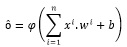
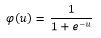
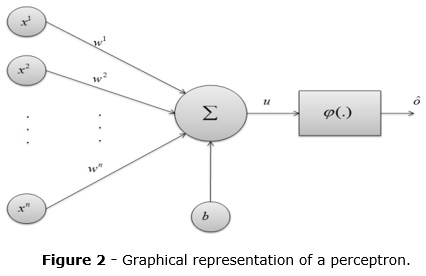
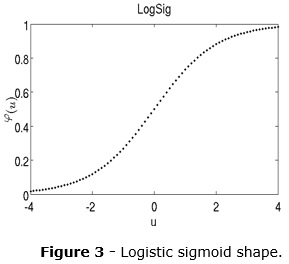
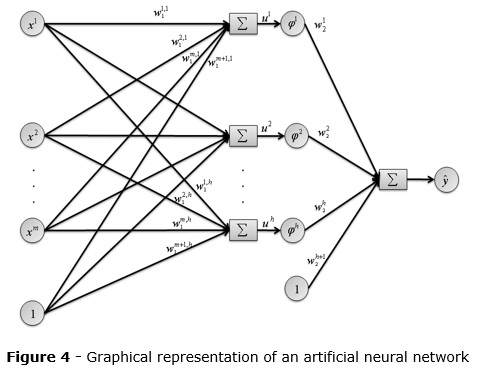
<body><![CDATA[<p align="center"><font face="Verdana, Arial, Helvetica, sans-serif"><img src="/img/revistas/rcci/v8s1/fo0101514.jpg" width="127" height="47"></font></p>     <p align="left"><font size="2" face="Verdana, Arial, Helvetica, sans-serif">Where <em>n</em>&nbsp;is the input dimension, <em>x<sup>i</sup></em>&nbsp;is the <em>i</em>-th  input dimension, <em>w<sup>i</sup></em>&nbsp;is the <em>i</em>-th  neuron weight parameter, b&nbsp;is the neuron bias, &Ocirc;&nbsp;is the neuron output and</font> <font size="2" face="Verdana, Arial, Helvetica, sans-serif">&phi;(.)</font> <font size="2" face="Verdana, Arial, Helvetica, sans-serif">is the neuron  activation function. A graphical representation of neuron and logistic sigmoid  shape are shown in the <a href="#f02">figure 2</a> and <a href="#f03">figure 3</a>&nbsp;(B. e van der Smagt 1996).  Several activation functions can be used. The most common, mainly in the hidden  layers, is the logistic sigmoid, on the form:</font></p>     <p align="center"><font face="Verdana, Arial, Helvetica, sans-serif"><img src="/img/revistas/rcci/v8s1/fo0201514.jpg" width="101" height="38"></font></p>     <p align="center"><font face="Verdana, Arial, Helvetica, sans-serif"><a name="f02"></a><img src="/img/revistas/rcci/v8s1/f0201514.jpg" width="426" height="276"> </font></p>     <p align="center">&nbsp;</p>     <p align="center"><font face="Verdana, Arial, Helvetica, sans-serif"><a name="f03"></a><img src="/img/revistas/rcci/v8s1/f0301514.jpg" width="289" height="264"></font></p>     <p><font size="2" face="Verdana, Arial, Helvetica, sans-serif">Most of real world mathematical  problems are not easy to resolve. They can contain non linear characteristics,  discontinuity, noises, among other difficulties. In order to transpose this  situation, it is possible to organize the neurons in layers, increasing significantly  the processing capacity, so that the problem becomes easily resolvable&nbsp;(Haykin 1994).    <br>       <br> One of these  approaches is the multilayer perceptron (MLP) neural network. The <a href="#f04">figure 4</a>  shows a graphical representation of an MLP-NN.</font></p>     <p align="center"><font face="Verdana, Arial, Helvetica, sans-serif"><a name="f04"></a><img src="/img/revistas/rcci/v8s1/f0401514.jpg" width="477" height="370"></font></p>     ]]></body>
<body><![CDATA[<p><font size="2" face="Verdana, Arial, Helvetica, sans-serif">In this context,  the neurons belonging to the same layer use the same activation function.  Generally, the hidden layer has a non-linear function, such as the logistic  sigmoid, and an output layer uses an activation function consistent with the  purpose of the network. In this work, the output layer uses linear function&nbsp;(Ludemir,   Braga e Carvalho 2000).    <br>       <br> Once chosen  topology, it is necessary to conduct the training phase. The most commonly used  method for this is the back-propagation. The back-propagation is a supervised  training method based on local search optimization, more specifically, the  gradient decent method.    <br>     <br> The  back-propagation works as follows: all the training data are presented to the  MLP-NN so that they pass through all the layers (from input to output layer).  This is the feed forward step. Then the difference between estimated output and  the desired output is calculated. This difference is called &quot;empirical  risk&quot;. The aim of the method is then to minimize the empirical risk, so  that, the estimated output is as close as possible to the desired output. In  this study the empirical risk chosen is the Root-mean square error (RMSE).    <br>     <br> The error is then  back-propagated (from the output layer to the input layer), and thus adjusting  the associated parameters. Each iteration of the described process is called  'epoch'. The process is repeated until one of the conditions is satisfied: (i)  low error value or (ii) number of time limit reached&nbsp;(Tang, Kay   Chen e Yi 2007).     <br>     <br> The topology used  in this work is the three-layers neural network, being the first the input  layer, composed by 6 neurons, the second as the hidden layer, with 4 neurons  and the last as output layer with 1 neuron. This approach is interesting once  it meets all the requirements of the universal approximation theorem&nbsp;(T.J. 1981)&nbsp;(Hornik,   Stinchcombe e White 1989).    <br>     ]]></body>
<body><![CDATA[<br> To use an ANN for  estimation, a user has to setup the same attributes used in the TPA. Those  attributes will be preprocessed &ndash; based on the TPA &ndash; so the network will only  receive as input data generated as intermediate results from the TPA, listed  below:</font></p> <ul>    <li><font size="2" face="Verdana, Arial, Helvetica, sans-serif"><strong>PF</strong> &ndash; Amount of Function Points of the  Use Cases being tested</font></li>       <li><font size="2" face="Verdana, Arial, Helvetica, sans-serif"><strong>Df</strong> &ndash; Specific factors for  each function</font></li>       <li><font size="2" face="Verdana, Arial, Helvetica, sans-serif"><strong>Qd</strong> &ndash; Dynamic Quality  Characteristics</font></li>       <li><font size="2" face="Verdana, Arial, Helvetica, sans-serif"><strong>E</strong> &ndash; Environment Factor</font></li>       <li><font size="2" face="Verdana, Arial, Helvetica, sans-serif"><strong>P</strong> &ndash; Productivity Factor</font></li>       <li><font size="2" face="Verdana, Arial, Helvetica, sans-serif"><strong>%</strong> &ndash; Plan and control estimation margin </font></li>     </ul>     <p>&nbsp;</p> <h1><font size="3" face="Verdana, Arial, Helvetica, sans-serif"><strong>COMPUTACIONAL METHODOLOGY </strong></font></h1>     <p><font size="2" face="Verdana, Arial, Helvetica, sans-serif">In order to  evaluate the three methodologies for test effort estimation, we used data from  real projects and help from Neural Network Specialist. To estimate the work using  the TPA and the UCP methods, we developed two different applications to  automate the effort estimation, reducing time consumption and probability of error  when estimating. Those applications accepted project data as input (e.g.  actors&rsquo; weights and use cases weights) to output the work estimation. First, we  compared the TPA and the UCP, to find the best between them. Then we compared  Neural Network and the TPA (which went better in the first experiment).     ]]></body>
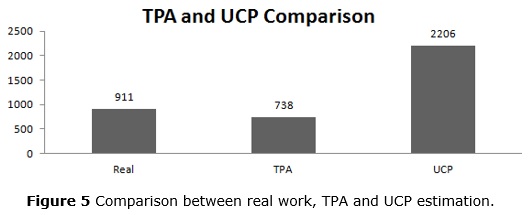
<body><![CDATA[<br>       <br>   Another application  was built to estimate work using neural networks. The application was also able  to be trained using data from past projects of a company. After training the  neural network, the results were closer to the real effort spent by the  company. In other words, after training, the neural network provides better  estimation.    <br>       <br>   The data used to  evaluate and compare the estimation methods were gathered from two real  software development projects, hereinafter called &ldquo;Project A&rdquo; and &ldquo;Project B&rdquo;.  The experiments were conducted using data from both projects to compare the  TPA, UPC and Neural Network estimations.     <br>       <br>   There were ten use  cases from Project A and other ten from Project B, all of them with distinct  characteristics. With the help of a test analyst, the use cases from Project A  were analyzed in order to generate input for the TPA, the UCP and neural  networks, so that the test effort (in person-hours) could be calculated. Data  from Project B was used to re-training the neural network to achieve better  results.</font></p>     <p><font size="2" face="Verdana, Arial, Helvetica, sans-serif">The complexity for each use case and the actors  count grouped by complexity can be seen in <a href="/img/revistas/rcci/v8s1/t0101514.jpg" target="_blank">table 1</a> for Project A and in <a href="/img/revistas/rcci/v8s1/t0201514.jpg" target="_blank">table 2</a>  for Project B. To use the TPA there is a set of aspects that must be  considered, shown in <a href="/img/revistas/rcci/v8s1/t0301514.jpg" target="_blank">table 3</a>.</font></p>     <p>&nbsp;</p>     <p><font size="3" face="Verdana, Arial, Helvetica, sans-serif"><strong>RESULTS AND DISCUSSION</strong></font></p>     <p><font size="2" face="Verdana, Arial, Helvetica, sans-serif">When estimating  using the UCP we verified a high estimation error in the results. The final  results for each project exceed the actual work in about 140%. As a good  estimate should be close to reality, we can conclude that the UCP results were  not good. The comparison chart can be seen below in <a href="#f02">figure 2</a>.    ]]></body>
<body><![CDATA[<br>       <br> The UCP does not  distinguish between normal and alternate flows, but, in fact, alternate flows  usually require less time to be tested then a normal flow (de   Almeida, de Abreu and Moraes 2009). Moreover, in order  to consider technical and environmental factors, the UCP requires data from  many projects. Since we did not have such data, we had to use educated guesses,  in order to choose values to these proprieties to estimate the test effort. </font></p>     <p><font size="2" face="Verdana, Arial, Helvetica, sans-serif">Besides the problems  cited above, another aspect that may have influenced the error on the UCP  estimation is the conversion factor used to find the total work value. On the  UCP description (Nageswaran 2001), it is not shown how to find that  factor; it is only stated that it can be determined by the organization,  according to some other factors. To determine this factor using historical data  would require a long period applying this technique in other projects. So we  used the calculation procedure suggested in (Banerjee 2001). Other studies on the same technique (de Almeida, de Abreu e Moraes 2008)  did not have satisfactory results either. When comparing the results with the  real work, they had an error of about 1300%. In our experiments, we had an  error of about 140% (<a href="#f05">figure 5</a>).</font></p>     <p align="center"><font face="Verdana, Arial, Helvetica, sans-serif"><a name="f05"></a><img src="/img/revistas/rcci/v8s1/f0501514.jpg" width="531" height="215"></font></p>     <p><font size="2" face="Verdana, Arial, Helvetica, sans-serif">Compared to the  UCP, the TPA had better results (<a href="#f05">figure 5</a>). This might be explained by the fact  that the TPA considers more factors than the UCP. Furthermore, the TPA steps to  estimate are better explained than the UCP and much less subjective (Van Veenendaal 1999). The TPA was also  used as the basis of the built neural network.     <br>       <br> At last, we  compared how close to reality are the TPA and Neural Networks. For Neural Network  estimation, we calculated estimates before and after re-training the network  with real data. The re-training is supposed to output estimates closer to  reality, as it is uses actual data from a specific enterprise, in order to  train the network.     <br>     <br> Comparing total  work time for each method, we can see that the neural network, after  re-training, outputs estimates closer to reality. The general error dropped  from 19% on the TPA to 4.85% on neural network after re-training. The error in  individual use cases stills bigger than expected.&nbsp;     <br>     ]]></body>
<body><![CDATA[<br> When analyzing  individual use cases we can see that eight of them had results closer to the  real work spent after re-training with historical data. This demonstrates that  re-training the network leads to significantly better results. </font></p>     <p><font size="2" face="Verdana, Arial, Helvetica, sans-serif">We can also observe that even before re-training  the neural network, its results are very close to TPA&rsquo;s results. It means that  training the network with an efficient method, than re-training it with  historical data from real project is a procedure that works and gives better  results (<a href="/img/revistas/rcci/v8s1/t0401514.jpg" target="_blank">table 4</a>). </font></p>     <p align="left">&nbsp;</p>     <p><font face="Verdana, Arial, Helvetica, sans-serif" size="3"><B>CONCLUSIONS</B></font></p>     <p><font size="2" face="Verdana, Arial, Helvetica, sans-serif">To make this paper  possible we developed two different web applications to calculate the test effort  estimation using the TPA and the UCP. Comparing those methods we concluded that  the TPA resulted in an error of 19%, while the UCP had 142% for the use case  set used. A third command line application was developed to estimate using  neural networks trained with the TPA method.     <br>       <br> Applying those  methods on a real testing environment showed that they can be very effective  and result in accurate effort estimation. After using neural networks for  estimation, they showed to be a promising approach for work estimation, and  become even better when re-trained with historical data from past projects.     <br>     <br> Although we had  good results using neural networks, the error for each use case is still large,  showing that they might not be adequate, when estimating for a single use case.  This was somewhat expected, because none of the methods consider the individual  productivity of the professional responsible for the use case testing. We  consider such extension as a good opportunity for future work. </font></p>     <p>&nbsp;</p>     ]]></body>
<body><![CDATA[<p align="left"><font face="Verdana, Arial, Helvetica, sans-serif" size="3"><B>REFERENCES</B></font>     <!-- ref --><p><font size="2" face="Verdana, Arial, Helvetica, sans-serif">B., Kr&ouml;se, and Patrick van der   Smagt. <em>An Introduction to Neural Networks.</em> University of Amsterdam,   1996.    </font></p>     <!-- ref --><p><font size="2" face="Verdana, Arial, Helvetica, sans-serif">Banerjee,   Gautam. <em>Use Case Points: an estimation approach.</em> Unpublished, 2001.    </font></p>     <!-- ref --><p><font size="2" face="Verdana, Arial, Helvetica, sans-serif">Belgamo,   Anderson, and Sandra Fabbri. &quot;Um estudo sobre a influ&ecirc;ncia da sistematiza&ccedil;&atilde;o   da constru&ccedil;&atilde;o de modelos de casos de uso na contagem dos pontos de caso de   uso.&quot; <em>III Simp&oacute;sio Brasileiro de Qualidade de Software.</em> Bras&iacute;lia,   2004.    </font></p>     <!-- ref --><p><font size="2" face="Verdana, Arial, Helvetica, sans-serif">Black, Rex. <em>Advanced Software Testing-Vol. 2: Guide to the Istqb Advanced   Certification as an Advanced Test Manager.</em> O'Reilly, 2012.    </font></p>     <!-- ref --><p><font size="2" face="Verdana, Arial, Helvetica, sans-serif">Cockburn,   Alistair. <em>Writing effective use cases (Vol. 1).</em> Addison-Wesley, 2001.    </font></p>     <p><font size="2" face="Verdana, Arial, Helvetica, sans-serif">Cybenko,   G. &quot;Approximation by superpositions of a sigmoidal function.&quot; <em>Mathematics of   Control, Signals, and Systems (MCSS)</em> 2, no. 4 (1989): 303-314.</font></p>     <!-- ref --><p><font size="2" face="Verdana, Arial, Helvetica, sans-serif">de Almeida, &Eacute;rica Regina Campos, Bruno Teixeira de Abreu,   and Regina Moraes. &quot;Avalia&ccedil;&atilde;o de um M&eacute;todo para Estimativa de Esfor&ccedil;o   para Testes baseado em Casos de Uso.&quot; <em>SBQS Simp&oacute;sio Brasileira de   Qualidade de Software da SBC.</em> Florian&oacute;polis, 2008. 331-338.    </font></p>     <p><font size="2" face="Verdana, Arial, Helvetica, sans-serif">de Almeida, &Eacute;rika Regina Campos, Bruno Teixeira de Abreu,   and Regina Moraes. &quot;An   alternative approach to test effort estimation based on use cases.&quot; <em>Software   Testing Verification and Validation, 2009. ICST'09. International Conference   on.</em> IEEE, 2009. 279-288.</font></p>     <!-- ref --><p><font size="2" face="Verdana, Arial, Helvetica, sans-serif">de Barcelos Tronto, Iris Fabiana, Jos&eacute; Dem&iacute;sio Sim&otilde;es da   Silva, and Nilson Sant'Anna. &quot;An   investigation of artificial neural networks based prediction systems in   software project management.&quot; <em>Journal of Systems and Software</em>,   2008: 356--367.    </font></p>     <!-- ref --><p><font size="2" face="Verdana, Arial, Helvetica, sans-serif">Freeman,   James A., and David M. Skapura. <em>Neural networks: algorithms, applications,   and programming techniques.</em> Addison-Wesley, 1991.    </font></p>     <!-- ref --><p><font size="2" face="Verdana, Arial, Helvetica, sans-serif">Haykin,   Simon. <em>Neural networks: a comprehensive foundation.</em> Prentice Hall PTR,   1994.    </font></p>     <!-- ref --><p><font size="2" face="Verdana, Arial, Helvetica, sans-serif">Hornik,   Kurt, Maxwell Stinchcombe, and Hallbert White. &quot;Multilayer feedforward   networks are universal approximators.&quot; <em>Neural Networks</em> 2, no. 5 (1989):   359-366.    </font></p>     <p><font size="2" face="Verdana, Arial, Helvetica, sans-serif">Lopes, Fernanda Amorim and Nelson, Maria Augusta Vieira.   &quot;An&aacute;lise das T&eacute;cnicas de Estimativas de Esfor&ccedil;o para o Processo de Teste   de Software.&quot; <em>III Encontro Brasileiro de Testes de Software.</em> Recife, 2008.</font></p>     <!-- ref --><p><font size="2" face="Verdana, Arial, Helvetica, sans-serif">Ludemir, TB, AP Braga, and A Carvalho. <em>Redes Neurais   Artificiais: Teoria e Aplica&ccedil;&otilde;es.</em> Livros T&eacute;cnicos e Cient&iacute;ficos Editora,   2000.    </font></p>     <!-- ref --><p><font size="2" face="Verdana, Arial, Helvetica, sans-serif">McCulloch, WarrenS, and Walter Pitts. &quot;A logical calculus of the ideas   immanent in nervous activity.&quot; <em>The bulletin of mathematical biophysics</em>,   1943: 115-113.    </font></p>     <!-- ref --><p><font size="2" face="Verdana, Arial, Helvetica, sans-serif">Nageswaran,   Suresh. &quot;Test effort estimation using use case points.&quot; <em>Quality Week.</em> 2001. 1-6.    </font></p>     ]]></body>
<body><![CDATA[<!-- ref --><p><font size="2" face="Verdana, Arial, Helvetica, sans-serif">P&aacute;dua, Wilson. <em>Engenharia de Software.</em> Rio de   Janeiro: LCT, 2009.    </font></p>     <p><font size="2" face="Verdana, Arial, Helvetica, sans-serif">Pe&ntilde;a, Ani&eacute; Bermudez, Jos&eacute; Alejandro Lugo Garc&iacute;a, Pedro   Yobanis Pi&ntilde;ero P&eacute;rez, and Iliana P&eacute;rez Pupo. &quot;Optimizaci&oacute;n de reglas borrosas   parael apoyo a la toma de decisiones en la Direcci&oacute;n Integrada de   Proyectos.&quot; 2013.</font></p>     <!-- ref --><p><font size="2" face="Verdana, Arial, Helvetica, sans-serif">Rios, Emerson, and Trayah&uacute; Moreira. <em>Teste de Software.</em> Rio de Janeiro: Alta Books, 2006.    </font></p>     <!-- ref --><p><font size="2" face="Verdana, Arial, Helvetica, sans-serif">Russell,   Stuart J., and Peter Norvig. <em>Artificial Intelligence: A Modern Approach.</em> 2003.    </font></p>     <!-- ref --><p><font size="2" face="Verdana, Arial, Helvetica, sans-serif">Sharma,   Ashish and Kushwaha, Dharmender Singh. &quot;Applying requirement based   complexity for the estimation of software development and testing   effort.&quot; <em>ACM SIGSOFT Software Engineering Notes</em>, 2012: 1-11.    </font></p>     <!-- ref --><p><font size="2" face="Verdana, Arial, Helvetica, sans-serif">Smith,   John. &quot;The estimation of effort based on use cases.&quot; <em>Rational   Software, white paper.</em> 1999.    </font></p>     <!-- ref --><p><font size="2" face="Verdana, Arial, Helvetica, sans-serif">Sommerville,   Ian and Melnikoff, Selma Shin Shimizu and Arakaki, Reginaldo and de Andrade   Barbosa, Edilson. <em>Engenharia de software.</em> Addison Wesley, 2003.    </font></p>     <!-- ref --><p><font size="2" face="Verdana, Arial, Helvetica, sans-serif">T.J.,   Rivlin. <em>An Introduction to the Approximation of Functions.</em> Dover   Publications, 1981.    </font></p>     <!-- ref --><p><font size="2" face="Verdana, Arial, Helvetica, sans-serif">Tang,   Huajin, Tan Kay Chen, and Zhang Yi. <em>Neural Networks: Computational Models   and Applications.</em> Springer, 2007.    </font></p>     <!-- ref --><p><font size="2" face="Verdana, Arial, Helvetica, sans-serif">Van   Veenendaal, EPWM and Dekkers, Ton. &quot;Test Point Analysis: A Method for   Test Estimation.&quot; <em>Project Control For Software Quality: Proceedings Of   The Combined 10th European Software Control And Metrics Conference And The 2nd   SCOPE Conference On Software Product Evaluation.</em> Herstmonceux Castle,   United Kingdom: Shaker Publishing B.V., 1999. 47-59.    </font></p>     <!-- ref --><p><font size="2" face="Verdana, Arial, Helvetica, sans-serif">Werbos,   Paul. &quot;Beyond regression: New tools for prediction and analysis in the   behavioral sciences.&quot; 1974.    </font></p>     <!-- ref --><p><font size="2" face="Verdana, Arial, Helvetica, sans-serif">Zhu,   Xiaochun and Zhou, Bo and Hou, Li and Chen, Junbo and Chen, Lu. &quot;An   experience-based approach for test execution effort estimation.&quot; <em>Young   Computer Scientists, 2008. ICYCS 2008. The 9th International Conference for.</em> IEEE, 2008. 1193--1198.    </font></p>     <p>&nbsp;</p>     <p>&nbsp;</p>     <p><font size="2" face="Verdana, Arial, Helvetica, sans-serif">Recibido: 7/05/2014      <br> Aceptado: 21/05/2014 </font></p> </font>     ]]></body><back>
<ref-list>
<ref id="B1">
<nlm-citation citation-type="book">
<person-group person-group-type="author">
<name>
<surname><![CDATA[Kröse]]></surname>
<given-names><![CDATA[B]]></given-names>
</name>
<name>
<surname><![CDATA[Smagt]]></surname>
<given-names><![CDATA[Patrick van der]]></given-names>
</name>
</person-group>
<source><![CDATA[An Introduction to Neural Networks]]></source>
<year>1996</year>
<publisher-name><![CDATA[University of Amsterdam]]></publisher-name>
</nlm-citation>
</ref>
<ref id="B2">
<nlm-citation citation-type="book">
<person-group person-group-type="author">
<name>
<surname><![CDATA[Banerjee]]></surname>
<given-names><![CDATA[Gautam]]></given-names>
</name>
</person-group>
<source><![CDATA[Use Case Points: an estimation approach]]></source>
<year>2001</year>
<publisher-name><![CDATA[Unpublished]]></publisher-name>
</nlm-citation>
</ref>
<ref id="B3">
<nlm-citation citation-type="book">
<person-group person-group-type="author">
<name>
<surname><![CDATA[Belgamo]]></surname>
<given-names><![CDATA[Anderson]]></given-names>
</name>
<name>
<surname><![CDATA[Fabbri]]></surname>
<given-names><![CDATA[Sandra]]></given-names>
</name>
</person-group>
<source><![CDATA["Um estudo sobre a influência da sistematização da construção de modelos de casos de uso na contagem dos pontos de caso de uso."]]></source>
<year>2004</year>
<publisher-name><![CDATA[III Simpósio Brasileiro de Qualidade de Software.]]></publisher-name>
</nlm-citation>
</ref>
<ref id="B4">
<nlm-citation citation-type="book">
<person-group person-group-type="author">
<name>
<surname><![CDATA[Black]]></surname>
<given-names><![CDATA[Rex]]></given-names>
</name>
</person-group>
<source><![CDATA[Advanced Software Testing-Vol. 2: Guide to the Istqb Advanced Certification as an Advanced Test Manager]]></source>
<year>2012</year>
<publisher-name><![CDATA[O'Reilly]]></publisher-name>
</nlm-citation>
</ref>
<ref id="B5">
<nlm-citation citation-type="book">
<person-group person-group-type="author">
<name>
<surname><![CDATA[Alistair]]></surname>
<given-names><![CDATA[Cockburn]]></given-names>
</name>
</person-group>
<source><![CDATA[Writing effective use cases (Vol. 1)]]></source>
<year>2001</year>
<publisher-name><![CDATA[Addison-Wesley]]></publisher-name>
</nlm-citation>
</ref>
<ref id="B6">
<nlm-citation citation-type="">
<person-group person-group-type="author">
<name>
<surname><![CDATA[Cybenko]]></surname>
<given-names><![CDATA[G]]></given-names>
</name>
</person-group>
<article-title xml:lang="en"><![CDATA["Approximation by superpositions of a sigmoidal function."]]></article-title>
<source><![CDATA[]]></source>
<year>1989</year>
<volume>2</volume>
<numero>4</numero>
<issue>4</issue>
<page-range>303-314</page-range></nlm-citation>
</ref>
<ref id="B7">
<nlm-citation citation-type="book">
<person-group person-group-type="author">
<name>
<surname><![CDATA[de Almeida]]></surname>
<given-names><![CDATA[Érica Regina Campos]]></given-names>
</name>
<name>
<surname><![CDATA[Teixeira de Abreu]]></surname>
<given-names><![CDATA[Bruno]]></given-names>
</name>
<name>
<surname><![CDATA[Moraes]]></surname>
<given-names><![CDATA[Regina]]></given-names>
</name>
</person-group>
<source><![CDATA["Avaliação de um Método para Estimativa de Esforço para Testes baseado em Casos de Uso."]]></source>
<year>2008</year>
<page-range>331-338</page-range><publisher-loc><![CDATA[^eFlorianópolis Florianópolis]]></publisher-loc>
<publisher-name><![CDATA[SBQS Simpósio Brasileira de Qualidade de Software da SBC.]]></publisher-name>
</nlm-citation>
</ref>
<ref id="B8">
<nlm-citation citation-type="book">
<person-group person-group-type="author">
<name>
<surname><![CDATA[de Almeida]]></surname>
<given-names><![CDATA[Érika Regina Campos]]></given-names>
</name>
<name>
<surname><![CDATA[Teixeira de Abreu]]></surname>
<given-names><![CDATA[Bruno]]></given-names>
</name>
<name>
<surname><![CDATA[Moraes]]></surname>
<given-names><![CDATA[Regina]]></given-names>
</name>
</person-group>
<source><![CDATA[An alternative approach to test effort estimation based on use cases]]></source>
<year>2009</year>
<page-range>279-288</page-range><publisher-name><![CDATA[Software Testing Verification and Validation,ICST'09. International Conference on. IEEE]]></publisher-name>
</nlm-citation>
</ref>
<ref id="B9">
<nlm-citation citation-type="book">
<person-group person-group-type="author">
<name>
<surname><![CDATA[de Barcelos Tronto]]></surname>
<given-names><![CDATA[Iris Fabiana]]></given-names>
</name>
<name>
<surname><![CDATA[Simões da Silva]]></surname>
<given-names><![CDATA[José Demísio]]></given-names>
</name>
<name>
<surname><![CDATA[Sant'Anna]]></surname>
<given-names><![CDATA[Nilson]]></given-names>
</name>
</person-group>
<source><![CDATA["An investigation of artificial neural networks based prediction systems in software project management."]]></source>
<year>2008</year>
<page-range>356--367</page-range><publisher-name><![CDATA[Journal of Systems and Software]]></publisher-name>
</nlm-citation>
</ref>
<ref id="B10">
<nlm-citation citation-type="book">
<person-group person-group-type="author">
<name>
<surname><![CDATA[Freeman]]></surname>
<given-names><![CDATA[James A]]></given-names>
</name>
<name>
<surname><![CDATA[Skapura]]></surname>
<given-names><![CDATA[David M]]></given-names>
</name>
</person-group>
<source><![CDATA[Neural networks: algorithms, applications, and programming techniques]]></source>
<year>1991</year>
<publisher-name><![CDATA[Addison-Wesley]]></publisher-name>
</nlm-citation>
</ref>
<ref id="B11">
<nlm-citation citation-type="book">
<person-group person-group-type="author">
<name>
<surname><![CDATA[Haykin]]></surname>
<given-names><![CDATA[Simon]]></given-names>
</name>
</person-group>
<source><![CDATA[Neural networks: a comprehensive foundation]]></source>
<year>1994</year>
<publisher-name><![CDATA[Prentice Hall PTR]]></publisher-name>
</nlm-citation>
</ref>
<ref id="B12">
<nlm-citation citation-type="">
<person-group person-group-type="author">
<name>
<surname><![CDATA[Hornik]]></surname>
<given-names><![CDATA[Kurt]]></given-names>
</name>
<name>
<surname><![CDATA[Stinchcombe]]></surname>
<given-names><![CDATA[Maxwell]]></given-names>
</name>
<name>
<surname><![CDATA[White]]></surname>
<given-names><![CDATA[Hallbert]]></given-names>
</name>
</person-group>
<article-title xml:lang="en"><![CDATA["Multilayer feedforward networks are universal approximators."]]></article-title>
<source><![CDATA[]]></source>
<year>1989</year>
<volume>2</volume>
<numero>5</numero>
<issue>5</issue>
<page-range>359-366</page-range></nlm-citation>
</ref>
<ref id="B13">
<nlm-citation citation-type="book">
<person-group person-group-type="author">
<name>
<surname><![CDATA[Lopes]]></surname>
<given-names><![CDATA[Fernanda]]></given-names>
</name>
<name>
<surname><![CDATA[Amorim]]></surname>
<given-names><![CDATA[Nelson]]></given-names>
</name>
<name>
<surname><![CDATA[Augusta Vieira]]></surname>
<given-names><![CDATA[Maria]]></given-names>
</name>
</person-group>
<source><![CDATA["Análise das Técnicas de Estimativas de Esforço para o Processo de Teste de Software."]]></source>
<year>2008</year>
<publisher-name><![CDATA[III Encontro Brasileiro de Testes de Software. Recife]]></publisher-name>
</nlm-citation>
</ref>
<ref id="B14">
<nlm-citation citation-type="book">
<person-group person-group-type="author">
<name>
<surname><![CDATA[Ludemir]]></surname>
<given-names><![CDATA[TB]]></given-names>
</name>
<name>
<surname><![CDATA[Braga]]></surname>
<given-names><![CDATA[AP]]></given-names>
</name>
<name>
<surname><![CDATA[Carvalho]]></surname>
<given-names><![CDATA[A]]></given-names>
</name>
</person-group>
<source><![CDATA[Redes Neurais Artificiais: Teoria e Aplicações]]></source>
<year>2000</year>
<publisher-name><![CDATA[Livros Técnicos e Científicos Editora]]></publisher-name>
</nlm-citation>
</ref>
<ref id="B15">
<nlm-citation citation-type="book">
<person-group person-group-type="author">
<name>
<surname><![CDATA[McCulloch]]></surname>
<given-names><![CDATA[WarrenS]]></given-names>
</name>
<name>
<surname><![CDATA[Pitts]]></surname>
<given-names><![CDATA[Walter]]></given-names>
</name>
</person-group>
<source><![CDATA["A logical calculus of the ideas immanent in nervous activity."]]></source>
<year>1943</year>
<page-range>115-113</page-range><publisher-name><![CDATA[The bulletin of mathematical biophysics]]></publisher-name>
</nlm-citation>
</ref>
<ref id="B16">
<nlm-citation citation-type="book">
<person-group person-group-type="author">
<name>
<surname><![CDATA[Suresh]]></surname>
<given-names><![CDATA[Nageswaran]]></given-names>
</name>
</person-group>
<source><![CDATA["Test effort estimation using use case points."]]></source>
<year>2001</year>
<page-range>1-6</page-range><publisher-name><![CDATA[Quality Week]]></publisher-name>
</nlm-citation>
</ref>
<ref id="B17">
<nlm-citation citation-type="book">
<person-group person-group-type="author">
<name>
<surname><![CDATA[Pádua]]></surname>
<given-names><![CDATA[Wilson]]></given-names>
</name>
</person-group>
<source><![CDATA[Engenharia de Software]]></source>
<year>2009</year>
<publisher-name><![CDATA[Rio de Janeiro: LCT]]></publisher-name>
</nlm-citation>
</ref>
<ref id="B18">
<nlm-citation citation-type="">
<person-group person-group-type="author">
<name>
<surname><![CDATA[Bermudez Peña]]></surname>
<given-names><![CDATA[Anié]]></given-names>
</name>
<name>
<surname><![CDATA[Lugo García]]></surname>
<given-names><![CDATA[José Alejandro]]></given-names>
</name>
<name>
<surname><![CDATA[Piñero Pérez]]></surname>
<given-names><![CDATA[Pedro Yobanis]]></given-names>
</name>
<name>
<surname><![CDATA[Pérez Pupo]]></surname>
<given-names><![CDATA[Iliana]]></given-names>
</name>
</person-group>
<source><![CDATA["Optimización de reglas borrosas parael apoyo a la toma de decisiones en la Dirección Integrada de Proyectos."]]></source>
<year>2013</year>
</nlm-citation>
</ref>
<ref id="B19">
<nlm-citation citation-type="book">
<person-group person-group-type="author">
<name>
<surname><![CDATA[Rios]]></surname>
<given-names><![CDATA[Emerson]]></given-names>
</name>
<name>
<surname><![CDATA[Moreira]]></surname>
<given-names><![CDATA[Trayahú]]></given-names>
</name>
</person-group>
<source><![CDATA[Teste de Software]]></source>
<year>2006</year>
<publisher-loc><![CDATA[^eRio de Janeiro Rio de Janeiro]]></publisher-loc>
<publisher-name><![CDATA[Alta Books]]></publisher-name>
</nlm-citation>
</ref>
<ref id="B20">
<nlm-citation citation-type="">
<person-group person-group-type="author">
<name>
<surname><![CDATA[Russell]]></surname>
<given-names><![CDATA[Stuart J]]></given-names>
</name>
<name>
<surname><![CDATA[Norvig]]></surname>
<given-names><![CDATA[Peter]]></given-names>
</name>
</person-group>
<source><![CDATA[Artificial Intelligence: A Modern Approach]]></source>
<year>2003</year>
</nlm-citation>
</ref>
<ref id="B21">
<nlm-citation citation-type="book">
<person-group person-group-type="author">
<name>
<surname><![CDATA[Sharma]]></surname>
<given-names><![CDATA[Ashish]]></given-names>
</name>
<name>
<surname><![CDATA[Dharmender Singh]]></surname>
<given-names><![CDATA[Kushwaha]]></given-names>
</name>
</person-group>
<source><![CDATA["Applying requirement based complexity for the estimation of software development and testing effort."]]></source>
<year>2012</year>
<page-range>1-11</page-range><publisher-name><![CDATA[ACM SIGSOFT Software Engineering Notes]]></publisher-name>
</nlm-citation>
</ref>
<ref id="B22">
<nlm-citation citation-type="book">
<person-group person-group-type="author">
<name>
<surname><![CDATA[Smith]]></surname>
<given-names><![CDATA[John]]></given-names>
</name>
</person-group>
<source><![CDATA["The estimation of effort based on use cases."]]></source>
<year>1999</year>
<publisher-name><![CDATA[Rational Software, white paper]]></publisher-name>
</nlm-citation>
</ref>
<ref id="B23">
<nlm-citation citation-type="book">
<person-group person-group-type="author">
<name>
<surname><![CDATA[Sommerville]]></surname>
<given-names><![CDATA[Ian]]></given-names>
</name>
<name>
<surname><![CDATA[Melnikoff, Selma]]></surname>
<given-names><![CDATA[Shin Shimizu]]></given-names>
</name>
<name>
<surname><![CDATA[Arakaki]]></surname>
<given-names><![CDATA[Reginaldo]]></given-names>
</name>
<name>
<surname><![CDATA[de Andrade Barbosa]]></surname>
<given-names><![CDATA[Edilson]]></given-names>
</name>
</person-group>
<source><![CDATA[Engenharia de software]]></source>
<year>2003</year>
<publisher-name><![CDATA[Addison Wesley]]></publisher-name>
</nlm-citation>
</ref>
<ref id="B24">
<nlm-citation citation-type="book">
<person-group person-group-type="author">
<name>
<surname><![CDATA[Rivlin]]></surname>
<given-names><![CDATA[T.J]]></given-names>
</name>
</person-group>
<source><![CDATA[An Introduction to the Approximation of Functions.]]></source>
<year>1981</year>
<publisher-name><![CDATA[Dover Publications]]></publisher-name>
</nlm-citation>
</ref>
<ref id="B25">
<nlm-citation citation-type="book">
<person-group person-group-type="author">
<name>
<surname><![CDATA[Huajin]]></surname>
<given-names><![CDATA[Tang]]></given-names>
</name>
<name>
<surname><![CDATA[Kay Chen]]></surname>
<given-names><![CDATA[Tan]]></given-names>
</name>
<name>
<surname><![CDATA[Yi]]></surname>
<given-names><![CDATA[Zhang]]></given-names>
</name>
</person-group>
<source><![CDATA[Neural Networks: Computational Models and Applications]]></source>
<year>2007</year>
<publisher-name><![CDATA[Springer]]></publisher-name>
</nlm-citation>
</ref>
<ref id="B26">
<nlm-citation citation-type="book">
<person-group person-group-type="author">
<name>
<surname><![CDATA[Van Veenendaal]]></surname>
<given-names><![CDATA[EPWM]]></given-names>
</name>
<name>
<surname><![CDATA[Dekkers]]></surname>
<given-names><![CDATA[Ton]]></given-names>
</name>
</person-group>
<source><![CDATA["Test Point Analysis: A Method for Test Estimation."]]></source>
<year>1999</year>
<page-range>47-59</page-range><publisher-name><![CDATA[Project Control For Software Quality: Proceedings Of The Combined 10th European Software Control And Metrics Conference And The 2nd SCOPE Conference On Software Product Evaluation. Herstmonceux Castle, United Kingdom Shaker Publishing B.V]]></publisher-name>
</nlm-citation>
</ref>
<ref id="B27">
<nlm-citation citation-type="">
<person-group person-group-type="author">
<name>
<surname><![CDATA[Werbos]]></surname>
<given-names><![CDATA[Paul]]></given-names>
</name>
</person-group>
<source><![CDATA["Beyond regression: New tools for prediction and analysis in the behavioral sciences]]></source>
<year>1974</year>
</nlm-citation>
</ref>
<ref id="B28">
<nlm-citation citation-type="book">
<person-group person-group-type="author">
<name>
<surname><![CDATA[Xiaochun]]></surname>
<given-names><![CDATA[Zhu]]></given-names>
</name>
<name>
<surname><![CDATA[Zhou]]></surname>
<given-names><![CDATA[Bo]]></given-names>
</name>
<name>
<surname><![CDATA[Hou]]></surname>
<given-names><![CDATA[Li]]></given-names>
</name>
<name>
<surname><![CDATA[Chen]]></surname>
<given-names><![CDATA[Junbo]]></given-names>
</name>
<name>
<surname><![CDATA[Chen]]></surname>
<given-names><![CDATA[Lu]]></given-names>
</name>
</person-group>
<source><![CDATA["An experience-based approach for test execution effort estimation."]]></source>
<year>2008</year>
<page-range>1193--1198</page-range><publisher-name><![CDATA[Young Computer Scientists, 2008. ICYCS 2008. The 9th International Conference for. IEEE]]></publisher-name>
</nlm-citation>
</ref>
</ref-list>
</back>
</article>