<?xml version="1.0" encoding="ISO-8859-1"?><article xmlns:mml="http://www.w3.org/1998/Math/MathML" xmlns:xlink="http://www.w3.org/1999/xlink" xmlns:xsi="http://www.w3.org/2001/XMLSchema-instance">
<front>
<journal-meta>
<journal-id>2227-1899</journal-id>
<journal-title><![CDATA[Revista Cubana de Ciencias Informáticas]]></journal-title>
<abbrev-journal-title><![CDATA[Rev cuba cienc informat]]></abbrev-journal-title>
<issn>2227-1899</issn>
<publisher>
<publisher-name><![CDATA[Editorial Ediciones Futuro]]></publisher-name>
</publisher>
</journal-meta>
<article-meta>
<article-id>S2227-18992017000100002</article-id>
<title-group>
<article-title xml:lang="en"><![CDATA[Design and Implementation of an Attitude and Heading Reference System (AHRS) using Direction Cosine Matrix]]></article-title>
<article-title xml:lang="es"><![CDATA[Diseño e Implementación de un Sistema de Referencia de Orientación y Rumbo usando Matrices de Cosenos Dirigidos]]></article-title>
</title-group>
<contrib-group>
<contrib contrib-type="author">
<name>
<surname><![CDATA[Hechevarría Junco]]></surname>
<given-names><![CDATA[Antonio]]></given-names>
</name>
<xref ref-type="aff" rid="A01"/>
</contrib>
<contrib contrib-type="author">
<name>
<surname><![CDATA[Machado Fernández]]></surname>
<given-names><![CDATA[José Raúl]]></given-names>
</name>
<xref ref-type="aff" rid="A02"/>
</contrib>
</contrib-group>
<aff id="A01">
<institution><![CDATA[,Ministerio del Interior (MININT) Dirección de Tecnología y Sistemas (DTS) Departamento de Telecomunicaciones]]></institution>
<addr-line><![CDATA[ La Habana]]></addr-line>
<country>Cuba</country>
</aff>
<aff id="A02">
<institution><![CDATA[,Universidad Tecnológica de la Habana José Antonio Echeverría (CUJAE) Facultad de Eléctrica Departamento de Telecomunicaciones y Telemática]]></institution>
<addr-line><![CDATA[ La Habana]]></addr-line>
<country>Cuba</country>
</aff>
<pub-date pub-type="pub">
<day>00</day>
<month>03</month>
<year>2017</year>
</pub-date>
<pub-date pub-type="epub">
<day>00</day>
<month>03</month>
<year>2017</year>
</pub-date>
<volume>11</volume>
<numero>1</numero>
<fpage>14</fpage>
<lpage>28</lpage>
<copyright-statement/>
<copyright-year/>
<self-uri xlink:href="http://scielo.sld.cu/scielo.php?script=sci_arttext&amp;pid=S2227-18992017000100002&amp;lng=en&amp;nrm=iso"></self-uri><self-uri xlink:href="http://scielo.sld.cu/scielo.php?script=sci_abstract&amp;pid=S2227-18992017000100002&amp;lng=en&amp;nrm=iso"></self-uri><self-uri xlink:href="http://scielo.sld.cu/scielo.php?script=sci_pdf&amp;pid=S2227-18992017000100002&amp;lng=en&amp;nrm=iso"></self-uri><abstract abstract-type="short" xml:lang="en"><p><![CDATA[ABSTRACT Attitude and Heading Reference Systems (AHRS) are based on fusion algorithms for Micro-Electro-Mechanical (MEMS) sensors Systems in order to obtain the position and orientation of a given entity. These systems are applied mainly in air navigation services, space exploration and creating interactive software for mobile phones. In an effort for avoiding the high prices of AHRS solutions in the international market, the authors construct a device with individual components using the Direction Cosine Matrix (DCM) alternative as fusion algorithm. As a result, the implementation of a functional architecture is achieved at a reduced cost. Validation&#8217;s tests were executed observing the effective detection of the Pitch and Roll angles after rotating a surface where the device was situated.]]></p></abstract>
<abstract abstract-type="short" xml:lang="es"><p><![CDATA[RESUMEN Los Sistemas de Referencia de Orientación y Rumbo (AHRS, Attitude and Heading Reference System) se basan en el uso de algoritmos de fusión de Sistemas de Sensores Micro-Electro-Mecánicos (MEMS, MicroElectroMechanical Systems) para conocer la posición y orientación de un cuerpo. Encuentran su aplicación fundamentalmente en la navegación aérea, la exploración espacial y la creación de programas informáticos interactivos para teléfonos celulares. Ante los elevados precios de las soluciones AHRS en el mercado internacional, los autores construyen un dispositivo a partir de componentes individuales utilizando algoritmos de Matrices de Cosenos Dirigidos (DCM, Direction Cosine Matrix) en el rol de mecanismo de fusión. Como resultado, se logra implementar una arquitectura funcional a un costo reducido, validada con pruebas donde se midió la detección efectiva de los ángulos de Cabeceo (Pitch) y Alabeo (Roll) colocando la solución sobre una superficie sometida a rotaciones.]]></p></abstract>
<kwd-group>
<kwd lng="en"><![CDATA[Attitude and Heading Reference Systems (AHRS)]]></kwd>
<kwd lng="en"><![CDATA[Micro-Electro-Mechanical Systems (MEMS)]]></kwd>
<kwd lng="en"><![CDATA[Algorithms for Sensors Fusion]]></kwd>
<kwd lng="en"><![CDATA[Direction Cosine Matrix (DCM)]]></kwd>
<kwd lng="es"><![CDATA[Sistema de Referencia de Orientación y Rumbo]]></kwd>
<kwd lng="es"><![CDATA[Sensores Micro-Mecánicos]]></kwd>
<kwd lng="es"><![CDATA[Algoritmos de Fusión de Sensores]]></kwd>
<kwd lng="es"><![CDATA[Matrices de Cosenos Dirigidos]]></kwd>
</kwd-group>
</article-meta>
</front><body><![CDATA[ <p align="right"><font face="Verdana, Arial, Helvetica, sans-serif" size="2"><B>ART&Iacute;CULO  ORIGINAL</B></font></p>     <p>&nbsp;</p>     <p><font size="4"><strong><font face="Verdana, Arial, Helvetica, sans-serif">Design and Implementation of an Attitude and  Heading Reference System (AHRS) using Direction Cosine Matrix</font></strong></font></p>     <p>&nbsp;</p>     <p><font size="3"><strong><font face="Verdana, Arial, Helvetica, sans-serif">Dise&ntilde;o e Implementaci&oacute;n de un Sistema de Referencia  de Orientaci&oacute;n y Rumbo usando Matrices de Cosenos Dirigidos</font></strong></font></p>     <p>&nbsp;</p>     <p>&nbsp;</p>     <P><font size="2"><strong><font face="Verdana, Arial, Helvetica, sans-serif">Antonio  Hechevarr&iacute;a Junco<strong><sup>1</sup></strong>, Jos&eacute; Ra&uacute;l  Machado Fern&aacute;ndez<strong><sup>2</sup></strong><font size="2"><strong><strong><sup>*</sup></strong></strong></font></font></strong></font></p>     <p><font size="2" face="Verdana, Arial, Helvetica, sans-serif"><sup>1 </sup>Especialista en Telecomunicaciones, Departamento de  Telecomunicaciones (DTEL), Direcci&oacute;n de Tecnolog&iacute;a y Sistemas (DTS), Ministerio  del Interior (MININT), La Habana, Cuba.</font> <font size="2" face="Verdana, Arial, Helvetica, sans-serif">    <br>     <sup>2 </sup>Profesor e Investigador, Departamento de  Telecomunicaciones y Telem&aacute;tica, Facultad de El&eacute;ctrica, Universidad Tecnol&oacute;gica  de la Habana Jos&eacute; Antonio Echeverr&iacute;a (CUJAE), La Habana, Cuba.    ]]></body>
<body><![CDATA[<br>       </font></p>     <P><font face="Verdana, Arial, Helvetica, sans-serif"><span class="class"><font size="2">*Autor para la correspondencia: </font></span></font><font size="2" face="Verdana, Arial, Helvetica, sans-serif"> <a href="mailto:m4ch4do@hispavista.com">m4ch4do@hispavista.com</a><a href="mailto:fjsilva@cenatav.co.cu"></a><a href="mailto:jova@uci.cu"></a></font><font face="Verdana, Arial, Helvetica, sans-serif"><a href="mailto:losorio@ismm.edu.cu"></a> </font>     <p>&nbsp;</p>     <p>&nbsp;</p> <hr>     <P><font size="2" face="Verdana, Arial, Helvetica, sans-serif"><b>ABSTRACT</b> </font>     <p><font size="2" face="Verdana, Arial, Helvetica, sans-serif">Attitude and  Heading Reference Systems (AHRS) are based on fusion algorithms for Micro-Electro-Mechanical  (MEMS) sensors Systems in order to obtain the position and orientation of a  given entity. These systems are applied mainly in  air navigation services, space exploration and creating interactive software  for mobile phones. In  an effort for avoiding the high prices of AHRS solutions in the international  market, the authors construct a device with individual components using the  Direction Cosine Matrix (DCM) alternative as fusion algorithm. As a result, the  implementation of a functional architecture is achieved at a reduced cost.  Validation&rsquo;s tests were executed observing the effective detection of the Pitch  and Roll angles after rotating a surface where the device was situated.</font></p>     <p><font size="2" face="Verdana, Arial, Helvetica, sans-serif"><b>Key words:</b></font> <font size="2" face="Verdana, Arial, Helvetica, sans-serif">Attitude and Heading Reference Systems (AHRS),  Micro-Electro-Mechanical Systems (MEMS), Algorithms for Sensors Fusion,  Direction Cosine Matrix (DCM).</font><font size="2"></font></p> <hr>     <p><font size="2" face="Verdana, Arial, Helvetica, sans-serif"><b>RESUMEN</b></font></p>     <p><font size="2" face="Verdana, Arial, Helvetica, sans-serif">Los Sistemas de Referencia de Orientaci&oacute;n y Rumbo  (AHRS, Attitude and Heading Reference System) se basan en el uso de algoritmos de fusi&oacute;n de Sistemas de Sensores  Micro-Electro-Mec&aacute;nicos (MEMS, MicroElectroMechanical Systems) para conocer la  posici&oacute;n y orientaci&oacute;n de un cuerpo. Encuentran su aplicaci&oacute;n fundamentalmente  en la navegaci&oacute;n a&eacute;rea, la exploraci&oacute;n espacial y la creaci&oacute;n de programas  inform&aacute;ticos interactivos para tel&eacute;fonos celulares. Ante los elevados precios  de las soluciones AHRS en el mercado internacional, los autores construyen un  dispositivo a partir de componentes individuales utilizando algoritmos de  Matrices de Cosenos Dirigidos (DCM, Direction Cosine Matrix) en el rol de mecanismo de fusi&oacute;n. Como resultado, se logra implementar  una arquitectura funcional a un costo reducido, validada con pruebas donde se  midi&oacute; la detecci&oacute;n efectiva de los &aacute;ngulos de Cabeceo (Pitch) y Alabeo (Roll) colocando  la soluci&oacute;n sobre una superficie sometida a rotaciones.</font></p>     <p><font size="2" face="Verdana, Arial, Helvetica, sans-serif"><b>Palabras clave:</b></font> <font size="2" face="Verdana, Arial, Helvetica, sans-serif">Sistema de Referencia de  Orientaci&oacute;n y Rumbo, Sensores Micro-Mec&aacute;nicos, Algoritmos de Fusi&oacute;n de  Sensores, Matrices de Cosenos Dirigidos.</font></p> <hr>     ]]></body>
<body><![CDATA[<p>&nbsp;</p>     <p>&nbsp;</p>     <p><font size="3" face="Verdana, Arial, Helvetica, sans-serif"><b>INTRODUCCI&Oacute;N</b></font></p>     <p><font size="2" face="Verdana, Arial, Helvetica, sans-serif">ARHS systems provide information  about the orientation, the heading and the position  of a given body in space <em>(Teixeira Rita 2009)</em>. The orientation is  specified by the prediction of the Roll, Pitch and Yaw angles,  known as Euler angles. Applications of attitude and heading reference systemsare found in the aviation industry for aerial control and  navigation <em>(Nerholm 2011; Sevilla Fern&aacute;ndez 2014)</em>, in the aerospace industry  to develop unmanned robots,  in the movies for performing three-dimensional planes, in the medicine for patient rehabilitation and body biomechanics researches <em>(Dehzangi et al. 2013; Frisoli et al. 2011)</em>, and in video games and cell phones in the form of interactive applications <em>(Castro Pescador 2013)</em>.</font></p>     <p><font size="2" face="Verdana, Arial, Helvetica, sans-serif">The classic form of implementing an ARHS  consist on placing multiple sensors in  order to obtain supplementary information sources that will be integrated using  a fusion algorithm <em>(Almeida Cypriano 2014)</em>. The most popular sensors  are known as MEMS, and are classified as accelerometers, gyroscopes and magnetometers.</font></p>     <p><font size="2" face="Verdana, Arial, Helvetica, sans-serif">An accelerometer is designed to measure acceleration along a predefined axis (Andrejasic 2005). Taking into account the  constant contribution of gravity&rsquo;s acceleration, it can be understood that the sensor provides  a mixture of the acceleration  experienced by the body during a rotation  and the gravitational contribution.</font></p>     <p><font size="2" face="Verdana, Arial, Helvetica, sans-serif">Furthermore, a gyroscope is a device that measures the angular rate experienced by a body along one of the  axes of the coordinate system <em>(Piechocki 2012)</em>. Gyroscopes are sometimes used to correct measurements made by the accelerometers,  or vice versa; both systems are often regarded as complementary.</font></p>     <p><font size="2" face="Verdana, Arial, Helvetica, sans-serif">Accelerometers are sensitive to vibrations experienced  by the body on which they rest  and consequently introduce an error in  measurement caused by the small accelerations that appear in several axes. Therefore, its operation only makes sense in static  conditions.</font></p>     <p><font size="2" face="Verdana, Arial, Helvetica, sans-serif">Gyroscopes, on the other hand, provide an effective response in dynamic conditions.  If the body is in static conditions, the output signal of the sensor suffers a shift which  accumulates as time passes creating errors in the measurements. The shift is a product of the noise that appears in this type of sensor.</font></p>     <p><font size="2" face="Verdana, Arial, Helvetica, sans-serif">The third type of MEMS, the magnetometer,  is a device that measures the strength and the direction of the magnetic  field, either the Earth magnetic field or one artificially created <em>(Almeida Cypriano 2014)</em>. Magnetometers may be scalar or vectorial;  the last one allows measuring the field&rsquo;s direction.</font></p>     ]]></body>
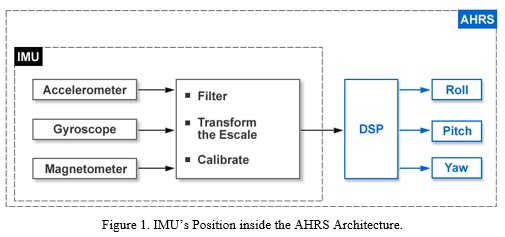
<body><![CDATA[<p><font size="2" face="Verdana, Arial, Helvetica, sans-serif">The above described sensors are used within  an Inertial Measurement Unit (IMU). An IMU takes the raw values of the sensors and filters the information, transforming it later into units from different  physical parameters. Finally, the data is calibrated with temperature because  measurements are sensitive to it <em>(Leyton 2009)</em>.</font></p>     <p><font size="2" face="Verdana, Arial, Helvetica, sans-serif">As it&rsquo;s shown in <a href="#f01">Figure 1</a>, an IMU is an important component within an AHRS and the signal  obtained at its output is passed through a Digital signal  Processing (DSP) block to obtain  the roll, pitch and yaw values.  Inside the DSP block, estimation and  fusion mechanisms are executed in order to fusion  the sensors&rsquo; contribution. Note that an AHRS  solution differs from a traditional  Inertial Navigation System (INS) which provides  additional information about the speed, in addition to the estimation of the orientation and position <em>(Leyton 2009)</em>.</font></p>     <p><font size="2" face="Verdana, Arial, Helvetica, sans-serif">AHRS systems are typically  integrated together with electronic  flight information systems to  build an aircraft&rsquo;s main flight monitor. In addition, they can be combined with flight data computers in order to materialize  what is known as an Air Data, Attitude and  Heading Reference System (ADAHRS), which  provides extra information like  wind speed, altitude and air  temperature <em>(Leyton 2009)</em>.</font></p>     <p align="center"><img src="/img/revistas/rcci/v11n1/f0102117.jpg" alt="f01" width="505" height="237"><a name="f01"></a></p>     <p><font size="2"><strong><font face="Verdana, Arial, Helvetica, sans-serif">Motivation  and Objectives</font></strong> </font></p>     <p><font size="2" face="Verdana, Arial, Helvetica, sans-serif">The cost of an AHRS certified by the FAA  (Federal Aviation Administration)  is quite high, which, together with the American embargo  restrictions, make really hard to buy a device for Cuban enterprises. Two of the popular choices in the international market are:</font></p> <ul>       <li>         <p><font size="2" face="Verdana, Arial, Helvetica, sans-serif">MTI device, Xsens manufacturer, 3 000 EUR <em> (March 2013g)</em>. </font></p>   </li>       <li>         <p><font size="2" face="Verdana, Arial, Helvetica, sans-serif">3DM-GX device, Micro Strain manufacturer, 3500  USD <em> (March 2013f)</em>.</font></p>   </li>     ]]></body>
<body><![CDATA[</ul>     <p><font size="2" face="Verdana, Arial, Helvetica, sans-serif">In order to facilitate the  equipment&rsquo;s acquisition, the authors set as the goal of the current  investigation the building of a device from sensors and other integrated circuits.  In addition to the construction, it is also an objective to keep expenses as  low as possible, so the alternative will be advantageous when compared to the  purchase of commercial equipment. Besides using several individual components,  the authors must program a sensors fusion algorithm into a microcontroller,  which constitutes the hardest task of the schedule. For achieving this, the  most important choices are: Kalman filters and DCM.     <br>   Kalman filters have many  applications in different estimation  problems and are very popular <em>(Casta&ntilde;eda C&aacute;rdenas et al. 2013; Cucu 2012; Melero Cazorla 2012; Rodr&iacute;guez Mu&ntilde;oz 2003)</em>, although its implementation is often intricate. Documentation  dedicated to them is available in multiple publications (Brookner 1998; Grewal  and Andrews 2001).    <br>   The DCM method, presented in (Premerlani and  Bizard 2009), is based on an IMU to develop applications for airplanes and helicopters. The theory  is supported on the necessity of  a method that respects the  nonlinearity of the rotation group (group of all possible rotations).  Similarly, multiple investigations can  be found based on this approximation  (Piechocki 2012; Sevilla Fern&aacute;ndez 2014; Teixeira Rita 2009). </font></p>     <p><font size="2" face="Verdana, Arial, Helvetica, sans-serif"><strong>Contributions</strong> </font></p>     <p><font size="2" face="Verdana, Arial, Helvetica, sans-serif">Authors choose the DCM method because they believe it is the easiest to implement and fits correctly with the  problem at hand. Using this technique, they develop an AHRS device with  reduced money expenses, validating its correct  performance by checking the effective detection  of the Pitch and Roll  angles after placing the solution  on a surface submitted to rotations. </font></p>     <p>&nbsp;</p>     <p><font face="Verdana, Arial, Helvetica, sans-serif"><strong><font size="3">MATERIALS and METHODS </font></strong></font></p>     <p><font size="2" face="Verdana, Arial, Helvetica, sans-serif">In this  section, the <em>Direction Cosine Matrix method, </em>used in the project as  fusion algorithm for the outputs from accelerometers and  gyroscopes, <em>is briefly described</em>. Likewise, integrated circuits included in the implementation are presented, facilitating thereby the  reproduction of the design.</font></p>     <p><font size="2" face="Verdana, Arial, Helvetica, sans-serif"><strong>DCM Algorithm</strong> </font></p>     ]]></body>
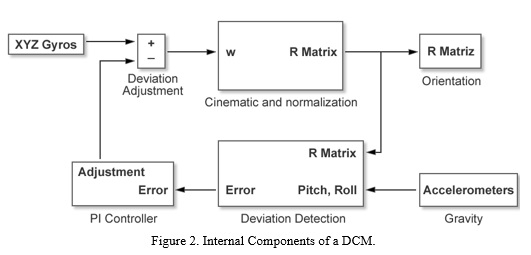
<body><![CDATA[<p><font size="2" face="Verdana, Arial, Helvetica, sans-serif">In the current project, a  Direct Cosine Matrix algorithm is utilized for the fusion of the contributions from  different sensors. Its operation principles are described below.</font></p>     <p><font size="2" face="Verdana, Arial, Helvetica, sans-serif">The gyroscopes stand out as the main source  of orientation information. By  handling &nbsp;their contribution, the  authors proceed to integrate the nonlinear differential equation that  describes the rotation dynamics, in a process that must be performed at a high speed <em>(Blanc 2013)</em>. Numerical  integration errors gradually violate the  orthogonally restrictions that the DCM must meet; introducing  thus some deviations <em>(Macias et al. 2012)</em>. Deviations are then mixed with the mistakes corresponding to the shift in the gyroscopes as the error&rsquo;s  magnitude gradually increases.</font></p>     <p><font size="2" face="Verdana, Arial, Helvetica, sans-serif">In order to correct the mistakes,  reference vectors and a negative feedback PI (Proportional  Integral) controller are employed. Therefore, imperfections are corrected by a faster mechanism that the one that generates  them, avoiding the accumulation <em>(Blanc 2013)</em>.</font></p>     <p align="center"><img src="/img/revistas/rcci/v11n1/f0202117.jpg" alt="f02" width="531" height="255"><a name="f02"></a></p>     <p><font size="2" face="Verdana, Arial, Helvetica, sans-serif"><a href="#f02">Figure 2</a> shows how a feedback connection is maintained in order to correct the values obtained from  the gyroscopes. The feedback information  is used by the direction cosine  matrix to put together the orientation  matrix, which corrects the deviation of the gyroscopes  also by employing the contribution taken from the accelerometers. Afterwards, the PI controller performs the  adjustment.</font></p>     <p><font size="2" face="Verdana, Arial, Helvetica, sans-serif"><strong>Used  Components</strong> </font></p>     <p><font size="2" face="Verdana, Arial, Helvetica, sans-serif">To complete the device&rsquo;s design, besides several distributed  components, four integrated circuits  corresponding to one accelerometer, two gyroscopes and one  microcontroller were employed. This section briefly describes them.</font></p>     <p><font size="2" face="Verdana, Arial, Helvetica, sans-serif"><strong>ADXL335  Accelerometer</strong> </font></p>     <p><font size="2" face="Verdana, Arial, Helvetica, sans-serif">The ADXL335 integrated circuit is a small accelerometer that measures acceleration in the three axes with a minimum full-scale range of  &plusmn; 3 g (1g  = 9.8m/s<sup>2</sup>). Its output signals are analog  voltages proportional to the acceleration measured in each axis (March 2013a).</font></p>     <p><font size="2" face="Verdana, Arial, Helvetica, sans-serif">The signal&rsquo;s bandwidth is controllable by the user if  a capacitor is added. The corresponding filtration produces improvements in the measurements&rsquo; resolution and prevents aliasing. The bandwidth  may be selected for the X and Y axes from 0.5 Hz to 1600 Hz and for the Z axis from  0.5 Hz to 550  Hz. In the developed design, authors used 0.1&mu;F capacitors establishing a bandwidth of 50 Hz. </font></p>     ]]></body>
<body><![CDATA[<p><font size="2"><strong><font face="Verdana, Arial, Helvetica, sans-serif">LPR530AL and  LY530ALH Gyroscopes</font></strong> </font></p>     <p><font size="2" face="Verdana, Arial, Helvetica, sans-serif">The LPR530AL integrated circuit is  an analog gyroscope capable of  measuring angular rate along  two axes (allowing to find the Pitch  and Roll angles). It has a scale of 300 &deg;/s and  is qualified for measuring, with -3 dB of the nominal bandwidth, up to 140 Hz  (March 2013b).</font></p>     <p><font size="2" face="Verdana, Arial, Helvetica, sans-serif">The gyroscope is the combination  of an actuator and an integrated  accelerometer in one micromechanical structure. This structure includes  a sensor element composed by a  single transmission mass which, maintained in constant oscillatory motion, it is capable of reacting when an angular rate is applied.  Finally, a CMOS integrated circuit provides the measured  angular rate through an analog voltage output (March 2013b).    <br>   The previously described integrated circuit  is utilized together with the LY530ALH model, which has a single output, to produce a three-axis gyroscope. The characteristics of both devices are very similar,  making them easier to attach.</font></p>     <p><font size="2" face="Verdana, Arial, Helvetica, sans-serif"><strong>PIC 18F2525  Microcontroller</strong></font></p>     <p><font size="2" face="Verdana, Arial, Helvetica, sans-serif">Dotted of a high  computational development,  the 18F2525 PIC microcontroller includes  various peripherals such as counters, a serial port and an Analog-to-Digital Converter (ADC) (March 2013c). Thanks to the wide range of options offered, among which it worth highlighting the  alternatives for selecting the oscillator, the  authors choose the model as the responsible of performing the calculations for  estimating the Pitch and Roll angles,  besides making effective the correction of the values  obtained by the gyroscopes. </font></p>     <p><font size="2" face="Verdana, Arial, Helvetica, sans-serif">For the design of the AHRS device, an external oscillator  was used with an output of 16 MHz. The internal elements  employed for programming the fusion  algorithm were the <em>Timer0</em>, the ADC  module, and the EUSART (Enhanced Universal Synchronous  Asynchronous Receiver Transmitter)</font></p>     <p>&nbsp;</p>     <p><font face="Verdana, Arial, Helvetica, sans-serif"><strong><font size="3">RESULTS</font></strong></font></p>     <p><font size="2" face="Verdana, Arial, Helvetica, sans-serif">The current Section shows the final AHRS  hardware solution that resulted from  a simulation optimized in the PROTEL (PRocedure  Oriented Type Enforcing  Language) software (<a href="#_ENREF_5" title=", March 2013 #45">March 2013e</a>). Similarly, the sequence of programming steps meant to be executed by the  microcontroller, which was developed using CCS C Compiler for PIC18  family through the MPLAB IDE v8.43 software application (<a href="#_ENREF_4" title=", March 2013 #44">March 2013d</a>), is presented.</font></p>     ]]></body>
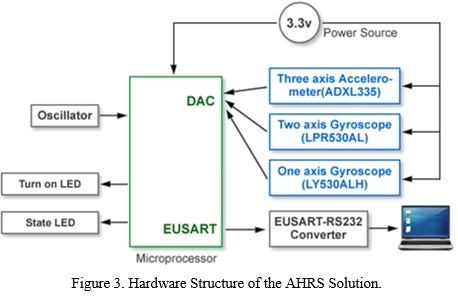
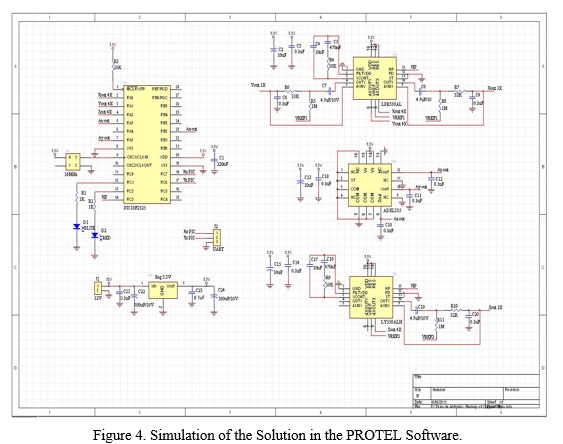
<body><![CDATA[<p><font size="2" face="Verdana, Arial, Helvetica, sans-serif"><strong>Hardware  Solution</strong> </font></p>     <p><font size="2" face="Verdana, Arial, Helvetica, sans-serif">Figure 3 shows the hardware structure of  the final AHRS solution. It can  be observed that the sensors are  connected to different channels  of the multiplexer of the microcontroller&rsquo;s  DAC. Channels zero  and one are occupied by  the amplified outputs of the LY530ALH and LPR530AL integrated circuits. The rest of the  outputs, which are not amplified, are passed through a high-pass filter consisting  of a 4.7 uF capacitor and a 1 M<img src="/img/revistas/rcci/v11n1/fo0102117.jpg" alt="fo01" width="11" height="11"> &nbsp;resistor connected to ground,  followed by a low-pass filter including a 33 K<img src="/img/revistas/rcci/v11n1/fo0102117.jpg" alt="fo01" width="11" height="11"> &nbsp;resistor and a 1 uF capacitor.  This is done by following the sensors&rsquo; manufacturer recommendations. </font></p>     <p><font size="2" face="Verdana, Arial, Helvetica, sans-serif">In the case of the ADXL335 integrated circuit, 0.1 uF capacitors  are attached to its outputs in  order to limit the signals&rsquo; bandwidth  to 50 Hz. The  three outputs of this circuit  are connected to the channels three, four and eight of the DAC. Channels five,  six and seven are only functional in devices  having 13 channels in the converter; the ADXL335  has eight channels.</font></p>     <p><font size="2" face="Verdana, Arial, Helvetica, sans-serif">The PIC 18F2525 microcontroller  is responsible for processing the data  from the sensors and estimating the Pitch and  Roll angles, information  that will be transmitted via the serial  port. The authors connected a personal  computer to this port, which allowed to adjust the deviation constants of the PI controller and to observe the behavior of the system after applying different signals.</font></p>     <p><font size="2" face="Verdana, Arial, Helvetica, sans-serif">As it is revealed in <a href="#f03">Figure 3</a>, two LEDs  (Light Emitting Diodes)  are incorporated in the schema. One of  them turns on when the system is  operating and the other one indicates the occurrence of saturation in a gyroscope.</font></p>     <p align="center"><img src="/img/revistas/rcci/v11n1/f0302117.jpg" alt="f03" width="458" height="299"><a name="f03"></a></p>     <p>&nbsp;</p>     <p align="center"><img src="/img/revistas/rcci/v11n1/f0402117.jpg" alt="f04" width="563" height="444"><a name="f04"></a></p>     <p><font size="2" face="Verdana, Arial, Helvetica, sans-serif">Before implementing the solution, the  architecture was tested in  PROTEL software (March 2013e)(March 2013e). <a href="#f04">Figure 4</a> shows a screenshot  of the application where all included elements are displayed.</font></p>     <p><font size="2" face="Verdana, Arial, Helvetica, sans-serif">After simulating the previously described  hardware structure and finish  testing its correct operation, the authors proceeded  to program the microcontroller  for performing the sensors fusion by means of the DCM method. The sequence of configuration steps is described below.</font></p>     ]]></body>
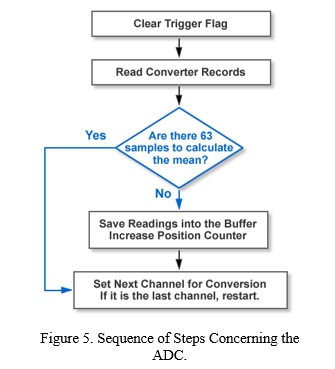
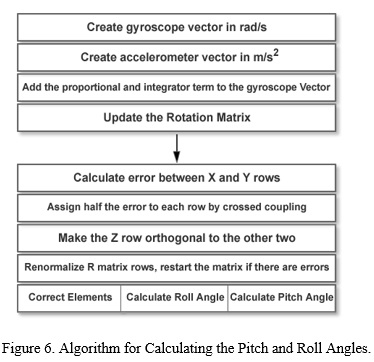
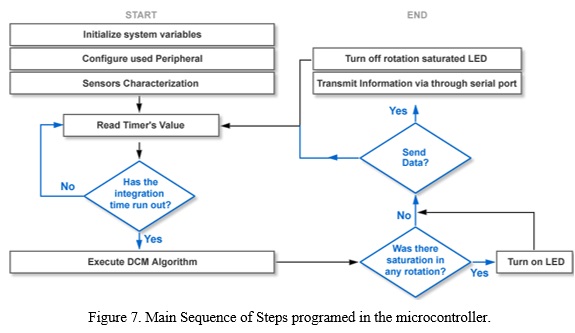
<body><![CDATA[<p><font size="2" face="Verdana, Arial, Helvetica, sans-serif"><strong>Software  Algorithm</strong> </font></p>     <p><font size="2" face="Verdana, Arial, Helvetica, sans-serif">Software development contains everything related  to the execution of the functions which together provide the orientation information. The program developed for the PIC 18F2525 microcontroller was achieved in the C programming language, using the CCS  C compiler for  the PIC18 family, through the MPLAB IDE  v8.43 software.</font></p>     <p><font size="2" face="Verdana, Arial, Helvetica, sans-serif"><a href="#f05">Figure 5</a> shows the algorithm concerning the ADC. Sensors&rsquo; samples are  stored in a data buffer for  the later averaging of the values.  The procedure ensures an increase in the converter&rsquo;s resolution by performing an oversampling. </font></p>     <p align="center"><img src="/img/revistas/rcci/v11n1/f0502117.jpg" alt="f05" width="335" height="369"><a name="f05"></a> <img src="/img/revistas/rcci/v11n1/f0602117.jpg" alt="f06" width="374" height="362"><a name="f06"></a></p>     <p><font size="2" face="Verdana, Arial, Helvetica, sans-serif"><a href="#f06">Figure 6</a> illustrates the algorithm for calculating  the Pitch and Roll parameters. The first part of the  sequence is intended to update  the rotation matrix, being executed for  each integration step with  the values obtained from the gyroscopes.  Renormalization is performed subsequently ensuring that the rows of the matrix are orthogonal  between each other and that its length is equal to one. Then the array  elements are corrected using  the information provided by the  accelerometers, and the estimated orientation is finally calculated.</font></p>     <p><font size="2" face="Verdana, Arial, Helvetica, sans-serif">The main execution algorithm is given in  <a href="#f07">Figure 7</a> where the sequence for de DAC  (<a href="#f05">Figure 5</a>) is incorporated in the step &quot;Read Timer&rsquo;s  value&quot; and the calculation of  the Pitch and Roll parameters (<a href="#f06">Figure 6</a>) appears under the  name &quot;Execute DCM Algorithm&quot;.  This implies that <a href="#f05">Figure 5</a>, <a href="#f06">Figure 6</a> and <a href="#f07">Figure 7</a> contain the full sequence  programed in the microcontroller.</font></p>     <p align="center"><img src="/img/revistas/rcci/v11n1/f0702117.jpg" alt="f07" width="575" height="333"><a name="f07"></a></p>     <p><font size="2" face="Verdana, Arial, Helvetica, sans-serif">The hardware scheme and the sequence  of programming steps introduced in the microcontroller were described in this section. A more  detailed explanation of the methodology followed by the authors can be found in  the full-version of the investigation (Hechavarr&iacute;a Junco 2011). The next one makes an evaluation on the effectiveness of the implementation.</font></p>     <p>&nbsp;</p>     <p><font face="Verdana, Arial, Helvetica, sans-serif" size="3"><B>DISCUSSION</B></font></p>     ]]></body>
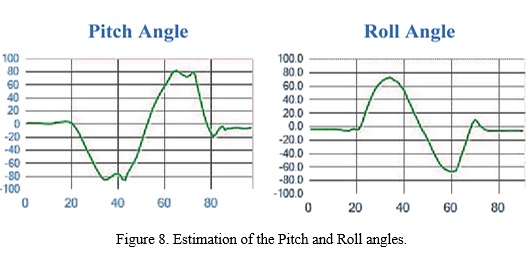
<body><![CDATA[<p><font size="2" face="Verdana, Arial, Helvetica, sans-serif">In order to check the correct  operation of the built AHRS solution,  an application was created in C ++  that reads the PC serial port and plots the Pitch  and Roll estimations. <a href="#f08">Figure 8</a> displays  some resulting draws taken from measurements performed over bodies under rotation.  The X axis  represents the time in seconds and the Y the rotated angle. Accordingly, the  correct estimation of the angles with  a resolution of less than one  degree is achieved.</font></p>     <p><font size="2" face="Verdana, Arial, Helvetica, sans-serif">In addition to the accurately estimation of the Pitch and  Roll angles, the constructed device was achieved at  a cost 60 times inferior than the  commercial alternatives. This justifies the time and efforts invested  in the research. <a href="/img/revistas/rcci/v11n1/t0102117.jpg" target="_blank">Table I</a> splits the price into the cost of each element. </font></p>     <p align="center"><img src="/img/revistas/rcci/v11n1/f0802117.jpg" alt="f08" width="532" height="254"><a name="f08"></a></p>     <p><strong><font size="3" face="Verdana, Arial, Helvetica, sans-serif">CONCLUSIONS</font></strong></p>     <p><font size="2" face="Verdana, Arial, Helvetica, sans-serif">An AHRS device was created,  capable of recognizing the  Pitch and Roll  angles for a rotating body with very good accuracy. Achieved using  a DCM algorithm, the solution was implemented at a cost 60 times inferior than its market price. The main utilized components were the PIC 18F2525 microcontroller, the ADXL335 (Accelerometer) and the LPR530AL (Gyroscope)  integrated circuits. The PROTEL software was  used for testing before building  the device and the sequence of  steps programed in the microcontroller was developed in C  language with the CCS C compiler through the  MPLAB IDE v8.43  software.</font></p>     <p><font size="3"><strong><font face="Verdana, Arial, Helvetica, sans-serif">RECOMMENDATIONS</font></strong></font></p>     <p><font size="2" face="Verdana, Arial, Helvetica, sans-serif">The designed system ignores  the centripetal acceleration that is originated  when describing a circular path. The limitation can be corrected if a GPS (Global  Positioning System) receiver is added to the structure. Moreover, the  inclusion of a three axis  magnetometer for working with the yaw angle would  allow providing the magnetic field  acting on the body.</font></p>     <p><font size="2" face="Verdana, Arial, Helvetica, sans-serif">The microcontroller used by the authors is  not designed to perform calculations with matrices in an efficient  manner. Therefore, the use of  a model of the PIC 30F family is recommended  to facilitate the programming of algorithms  in future DCM implementations. </font></p>     <p>&nbsp;</p>     <p align="left"><font face="Verdana, Arial, Helvetica, sans-serif" size="3"><B>REFERENCIAS  BIBLIOGR&Aacute;FICAS</B></font>     ]]></body>
<body><![CDATA[<p><font size="2"><a><font face="Verdana, Arial, Helvetica, sans-serif">ANALOG DEVICES. ADXL335. [data sheet]. In<em>. </em></font></a><font face="Verdana, Arial, Helvetica, sans-serif"><a href="http://www.analog.com/static/imported-files/data_sheets/ADXL335.pdf">http://www.analog.com/static/imported-files/data_sheets/ADXL335.pdf</a>, March 2013a. </font></font></p>     <p><font size="2" face="Verdana, Arial, Helvetica, sans-serif"><a>LPR530AL. MEMS motion sensor [data sheet]. In<em>. </em>https://</a><a href="http://www.sparkfun.com/datasheets/Sensors/IMU/lpr530al.pdf">www.sparkfun.com/datasheets/Sensors/IMU/lpr530al.pdf</a>, March 2013b. </font></p>     <p><font size="2" face="Verdana, Arial, Helvetica, sans-serif"><a>Microchip. PIC 18f2525/2620/4525/4620. [data sheet]. In<em>. </em></a><u>http://ww1.microchip.com/downloads/en/DeviceDoc  /39626e.pdf, March 2013c</u>. </font></p>     <p><font size="2" face="Verdana, Arial, Helvetica, sans-serif"><a>MPLAB IDE v8.43 In<em>. </em></a><a href="http://www.microchip.com/forums/m466151.aspx">http://www.microchip.com/forums/m466151.aspx</a>, March 2013d. </font></p>     <p><font size="2" face="Verdana, Arial, Helvetica, sans-serif"><a>P&aacute;gina Oficial de PROTEL. In<em>. </em></a><a href="http://www.altium.com/">http://www.altium.com/</a>, March 2013e. </font></p>     <p><font size="2" face="Verdana, Arial, Helvetica, sans-serif"><a>Precios del dispositivo 3DM-GX, fabricante Micro Strain. In<em>. </em></a><a href="http://www.microstrain.com/inertial/3dm-gx3-45">http://www.microstrain.com/inertial/3dm-gx3-45</a>, March 2013f. </font></p>     <p><font size="2" face="Verdana, Arial, Helvetica, sans-serif"><a>Precios para el dispositivo MTI, fabricante Xsens. In<em>. </em></a>http://es.farnell.com/Search?storeId=10176&amp;catalogId=15001&amp;langId=-5&amp;st=dev%20kits&amp;sort=P_MAN_BRAND  _NAME|1&amp;beginIndex=2, March 2013g. </font></p>     <!-- ref --><p><font size="2" face="Verdana, Arial, Helvetica, sans-serif"><a>ALMEIDA CYPRIANO, L. Study and Design of an Adaptive Control Law for  Spacecraft Attitude Control.&nbsp; Czech  Technical University, 2014.    </a> </font></p>     <!-- ref --><p><font size="2" face="Verdana, Arial, Helvetica, sans-serif"><a>ANDREJASIC, M. MEMS Accelerometers. 2005.    </a> </font></p>     <!-- ref --><p><font size="2" face="Verdana, Arial, Helvetica, sans-serif"><a>BLANC, H. Inertial and optical hybrid head tracking for helicopter  simulators. 2013.    </a> </font></p>     <!-- ref --><p><font size="2" face="Verdana, Arial, Helvetica, sans-serif"><a>BROOKNER, E. <em>Tracking and Kalman  Filtering Made Easy</em>. Edtion ed.: John Wiley &amp; Sons, 1998. ISBN  0-471-18407-1.    </a> </font></p>     <!-- ref --><p><font size="2" face="Verdana, Arial, Helvetica, sans-serif"><a>CASTA&Ntilde;EDA C&Aacute;RDENAS, J. A., M. A. NIETO ARIAS AND V. A. ORTIZ BRAVO  An&aacute;lisis y Aplicaci&oacute;n del Filtro de Kalman a una Se&ntilde;al con Ruido Aleatorio.  Scienitia et Technica, Universidad Tecnol&oacute;gica de Pereira,&nbsp; 2013, 18(1).    </a> </font></p>     <!-- ref --><p><font size="2" face="Verdana, Arial, Helvetica, sans-serif"><a>CASTRO PESCADOR, A. M. Fusi&oacute;n Sens&oacute;rica INS/GPS para Navegaci&oacute;n en  Plaformas M&oacute;viles.&nbsp; Universidad Militar  Nueva Granada, 2013.    </a> </font></p>     <!-- ref --><p><font size="2" face="Verdana, Arial, Helvetica, sans-serif"><a>CUCU, L. Applying Kalman Filtering on a Quadruped Robot.  Microengineering,&nbsp; 2012.    </a> </font></p>     <!-- ref --><p><font size="2" face="Verdana, Arial, Helvetica, sans-serif"><a>DEHZANGI, O., Z. ZHAO, M.-M. BIDMESHKI, J. BIGGAN, et al. The Impact of  Vibrotactile Biofeedback on the Excessive Walking Sway and the Postural Control  in Elderly. Wireless Health,&nbsp; 2013.    </a> </font></p>     <!-- ref --><p><font size="2" face="Verdana, Arial, Helvetica, sans-serif"><a>FRISOLI, M. A., C. A. CIFUENTES, A. FRIZERA, A. SANTIAGO, et al. Sensor  Portable para Registro Cinem&aacute;tico por Comunicaci&oacute;n ZigBee. Facultad de  Ingenier&iacute;a, Universidad Nacional de Entre R&iacute;os,&nbsp;  2011.    </a> </font></p>     <!-- ref --><p><font size="2" face="Verdana, Arial, Helvetica, sans-serif"><a>GREWAL, M. S. AND A. P. ANDREWS <em>Kalman  Filtering: Theory and Practice using MATLAB</em>. Edtion ed.: John Wiley &amp;  Sons, 2001. ISBN 0-471-39254-5.    </a> </font></p>     <!-- ref --><p><font size="2" face="Verdana, Arial, Helvetica, sans-serif"><a>HECHAVARR&Iacute;A JUNCO, A. Propuesta de Dise&ntilde;o de un Sistema de Referencia  de Orientaci&oacute;n y Rumbo.&nbsp; Instituto  Superior Polit&eacute;cnico Jos&eacute; Antonio Echeverr&iacute;a (ISPJAE-CUJAE), 2011.    </a> </font></p>     <!-- ref --><p><font size="2" face="Verdana, Arial, Helvetica, sans-serif"><a>LEYTON, H. Desarrollo, Implementaci&oacute;n y Prueba de un Filtro de Kalman  del tipo UKF para un Veh&iacute;culo A&eacute;reo no Tripulado.&nbsp; Escuela de Ciencias y Humanidades, 2009.    </a> </font></p>     <!-- ref --><p><font size="2" face="Verdana, Arial, Helvetica, sans-serif"><a>MACIAS, E., D. TORRES AND S. RAVINDRAN. Nine-Axis Sensor Fusion Using  the Direction Cosine Matrix Algorithm on the MSP430F5xx Family, Application  Report. 2012.    </a> </font></p>     <!-- ref --><p><font size="2" face="Verdana, Arial, Helvetica, sans-serif"><a>MELERO CAZORLA, D. Modelado din&aacute;mico y dise&ntilde;o de estrategia de control  mediante estimadores para el vuelo aut&oacute;nomo de un quadrotor.&nbsp; Universitas Almeriensis, 2012.    </a> </font></p>     <!-- ref --><p><font size="2" face="Verdana, Arial, Helvetica, sans-serif"><a>NERHOLM, P. A. MEMS Inertial Navigation System. 2011.    </a> </font></p>     <!-- ref --><p><font size="2" face="Verdana, Arial, Helvetica, sans-serif"><a>PIECHOCKI, J. Estudio de la Din&aacute;mica del Vuelo de un Decelerador  Aerodin&aacute;mico Basado en el Concepto de Pararrotor.&nbsp; Universidad Nacional de la Plata 2012.    </a> </font></p>     <!-- ref --><p><font size="2" face="Verdana, Arial, Helvetica, sans-serif"><a>PREMERLANI, W. AND P. BIZARD <em>Direction  Cosine Matrix IMU: Theory</em>. Edtion ed., 2009.    </a> </font></p>     <!-- ref --><p><font size="2" face="Verdana, Arial, Helvetica, sans-serif"><a>RODR&Iacute;GUEZ MU&Ntilde;OZ, P. Aplicaci&oacute;n del Filtro de Kalman al Seguimiento de  Objetos en Secuencias de Im&aacute;genes.&nbsp;  Universidad Rey Juan Carlos, 2003.    </a> </font></p>     <!-- ref --><p><font size="2" face="Verdana, Arial, Helvetica, sans-serif"><a>SEVILLA FERN&Aacute;NDEZ, L. Modelado y Control de un Cuadric&oacute;ptero.&nbsp; Universidad Pont&iacute;fica Comillas, 2014.    </a> </font></p>     <!-- ref --><p><font size="2" face="Verdana, Arial, Helvetica, sans-serif"><a>TEIXEIRA RITA, T. D. Controlo de Helic&oacute;pteros de  Aeromodelismo.&nbsp; Instituto Superior  T&eacute;cnico Universidad T&eacute;cnica de Lisboa, 2009.    </a></font></p>     <p align="left">     <p name="_ENREF_1">&nbsp;</p>     <p><font size="2" face="Verdana, Arial, Helvetica, sans-serif">Recibido: 02/11/2015    ]]></body>
<body><![CDATA[<br> Aceptado: 30/05/2016</font></p>      ]]></body><back>
<ref-list>
<ref id="B1">
<nlm-citation citation-type="">
<person-group person-group-type="author">
<name>
<surname><![CDATA[ANALOG DEVICES]]></surname>
</name>
</person-group>
<source><![CDATA[ADXL33]]></source>
<year>2013</year>
<month>a</month>
</nlm-citation>
</ref>
<ref id="B2">
<nlm-citation citation-type="">
<person-group person-group-type="author">
<name>
<surname><![CDATA[LPR530AL]]></surname>
</name>
</person-group>
<source><![CDATA[MEMS motion sensor]]></source>
<year>Marc</year>
<month>h </month>
<day>20</day>
</nlm-citation>
</ref>
<ref id="B3">
<nlm-citation citation-type="">
<person-group person-group-type="author">
<name>
<surname><![CDATA[Microchip]]></surname>
</name>
</person-group>
<source><![CDATA[PIC 18f2525/2620/4525/4620]]></source>
<year>Marc</year>
<month>h </month>
<day>20</day>
</nlm-citation>
</ref>
<ref id="B4">
<nlm-citation citation-type="">
<person-group person-group-type="author">
<name>
<surname><![CDATA[MPLAB]]></surname>
</name>
</person-group>
<source><![CDATA[IDE v8.43]]></source>
<year>Marc</year>
<month>h </month>
<day>20</day>
</nlm-citation>
</ref>
<ref id="B5">
<nlm-citation citation-type="">
<person-group person-group-type="author">
<name>
<surname><![CDATA[Página Oficial]]></surname>
</name>
</person-group>
<source><![CDATA[de PROTEL]]></source>
<year>Marc</year>
<month>h </month>
<day>20</day>
</nlm-citation>
</ref>
<ref id="B6">
<nlm-citation citation-type="">
<person-group person-group-type="author">
<name>
<surname><![CDATA[Precios del dispositivo]]></surname>
</name>
</person-group>
<source><![CDATA[3DM-GX, fabricante Micro Strain]]></source>
<year>Marc</year>
<month>h </month>
<day>20</day>
</nlm-citation>
</ref>
<ref id="B7">
<nlm-citation citation-type="">
<person-group person-group-type="author">
<name>
<surname><![CDATA[Precios para el dispositivo MTI]]></surname>
</name>
</person-group>
<source><![CDATA[fabricante Xsens]]></source>
<year>Marc</year>
<month>h </month>
<day>20</day>
</nlm-citation>
</ref>
<ref id="B8">
<nlm-citation citation-type="book">
<person-group person-group-type="author">
<name>
<surname><![CDATA[ALMEIDA CYPRIANO]]></surname>
<given-names><![CDATA[L]]></given-names>
</name>
</person-group>
<source><![CDATA[Study and Design of an Adaptive Control Law for Spacecraft Attitude Control]]></source>
<year>2014</year>
<publisher-name><![CDATA[Czech Technical University]]></publisher-name>
</nlm-citation>
</ref>
<ref id="B9">
<nlm-citation citation-type="">
<person-group person-group-type="author">
<name>
<surname><![CDATA[ANDREJASIC]]></surname>
<given-names><![CDATA[M]]></given-names>
</name>
</person-group>
<source><![CDATA[MEMS Accelerometers]]></source>
<year>2005</year>
</nlm-citation>
</ref>
<ref id="B10">
<nlm-citation citation-type="">
<person-group person-group-type="author">
<name>
<surname><![CDATA[BLANC]]></surname>
<given-names><![CDATA[H]]></given-names>
</name>
</person-group>
<source><![CDATA[Inertial and optical hybrid head tracking for helicopter simulators.]]></source>
<year>2013</year>
</nlm-citation>
</ref>
<ref id="B11">
<nlm-citation citation-type="book">
<person-group person-group-type="author">
<name>
<surname><![CDATA[BROOKNER]]></surname>
<given-names><![CDATA[E]]></given-names>
</name>
</person-group>
<source><![CDATA[Tracking and Kalman Filtering Made Easy]]></source>
<year>1998</year>
<publisher-name><![CDATA[John Wiley & Sons]]></publisher-name>
</nlm-citation>
</ref>
<ref id="B12">
<nlm-citation citation-type="book">
<person-group person-group-type="author">
<name>
<surname><![CDATA[CASTAÑEDA CÁRDENAS]]></surname>
<given-names><![CDATA[J. A]]></given-names>
</name>
<name>
<surname><![CDATA[NIETO ARIAS]]></surname>
<given-names><![CDATA[M. A]]></given-names>
</name>
<name>
<surname><![CDATA[ORTIZ BRAVO]]></surname>
<given-names><![CDATA[V. A.]]></given-names>
</name>
</person-group>
<article-title xml:lang="es"><![CDATA[Análisis y Aplicación del Filtro de Kalman a una Señal con Ruido Aleatorio]]></article-title>
<source><![CDATA[]]></source>
<year>2013</year>
<volume>18</volume>
<numero>1</numero>
<issue>1</issue>
<publisher-name><![CDATA[Universidad Tecnológica de Pereira]]></publisher-name>
</nlm-citation>
</ref>
<ref id="B13">
<nlm-citation citation-type="book">
<person-group person-group-type="author">
<name>
<surname><![CDATA[CASTRO PESCADOR]]></surname>
<given-names><![CDATA[A. M]]></given-names>
</name>
</person-group>
<source><![CDATA[Fusión Sensórica INS/GPS para Navegación en Plaformas Móviles.]]></source>
<year>2013</year>
<publisher-name><![CDATA[Universidad Militar Nueva Granada]]></publisher-name>
</nlm-citation>
</ref>
<ref id="B14">
<nlm-citation citation-type="">
<person-group person-group-type="author">
<name>
<surname><![CDATA[CUCU]]></surname>
<given-names><![CDATA[L]]></given-names>
</name>
</person-group>
<source><![CDATA[Applying Kalman Filtering on a Quadruped Robot]]></source>
<year>2012</year>
</nlm-citation>
</ref>
<ref id="B15">
<nlm-citation citation-type="">
<person-group person-group-type="author">
<name>
<surname><![CDATA[DEHZANGI]]></surname>
<given-names><![CDATA[O]]></given-names>
</name>
<name>
<surname><![CDATA[ZHAO]]></surname>
<given-names><![CDATA[Z]]></given-names>
</name>
<name>
<surname><![CDATA[BIDMESHKI]]></surname>
<given-names><![CDATA[M.-M]]></given-names>
</name>
<name>
<surname><![CDATA[BIGGAN]]></surname>
<given-names><![CDATA[J]]></given-names>
</name>
</person-group>
<source><![CDATA[The Impact of Vibrotactile Biofeedback on the Excessive Walking Sway and the Postural Control in Elderly]]></source>
<year>2013</year>
</nlm-citation>
</ref>
<ref id="B16">
<nlm-citation citation-type="book">
<person-group person-group-type="author">
<name>
<surname><![CDATA[FRISOLI]]></surname>
<given-names><![CDATA[M. A]]></given-names>
</name>
<name>
<surname><![CDATA[CIFUENTES]]></surname>
<given-names><![CDATA[C. A]]></given-names>
</name>
<name>
<surname><![CDATA[FRIZERA]]></surname>
<given-names><![CDATA[A]]></given-names>
</name>
<name>
<surname><![CDATA[SANTIAGO]]></surname>
<given-names><![CDATA[A]]></given-names>
</name>
</person-group>
<source><![CDATA[Sensor Portable para Registro Cinemático por Comunicación ZigBee.]]></source>
<year>2011</year>
<publisher-name><![CDATA[Universidad Nacional de Entre Ríos]]></publisher-name>
</nlm-citation>
</ref>
<ref id="B17">
<nlm-citation citation-type="book">
<person-group person-group-type="author">
<name>
<surname><![CDATA[GREWAL]]></surname>
<given-names><![CDATA[M. S]]></given-names>
</name>
<name>
<surname><![CDATA[ANDREWS]]></surname>
<given-names><![CDATA[A. P]]></given-names>
</name>
</person-group>
<source><![CDATA[Kalman Filtering: Theory and Practice using MATLAB]]></source>
<year>2001</year>
<publisher-name><![CDATA[John Wiley & Sons]]></publisher-name>
</nlm-citation>
</ref>
<ref id="B18">
<nlm-citation citation-type="book">
<person-group person-group-type="author">
<name>
<surname><![CDATA[HECHAVARRÍA JUNCO]]></surname>
<given-names><![CDATA[A]]></given-names>
</name>
</person-group>
<source><![CDATA[Propuesta de Diseño de un Sistema de Referencia de Orientación y Rumbo]]></source>
<year>2011</year>
<publisher-name><![CDATA[Instituto Superior Politécnico José Antonio Echeverría (ISPJAE-CUJAE),]]></publisher-name>
</nlm-citation>
</ref>
<ref id="B19">
<nlm-citation citation-type="book">
<person-group person-group-type="author">
<name>
<surname><![CDATA[LEYTON]]></surname>
<given-names><![CDATA[H]]></given-names>
</name>
</person-group>
<source><![CDATA[Desarrollo, Implementación y Prueba de un Filtro de Kalman del tipo UKF para un Vehículo Aéreo no Tripulado.]]></source>
<year>2009</year>
<publisher-name><![CDATA[Escuela de Ciencias y Humanidades]]></publisher-name>
</nlm-citation>
</ref>
<ref id="B20">
<nlm-citation citation-type="">
<person-group person-group-type="author">
<name>
<surname><![CDATA[MACIAS]]></surname>
<given-names><![CDATA[E]]></given-names>
</name>
<name>
<surname><![CDATA[TORRES]]></surname>
<given-names><![CDATA[D]]></given-names>
</name>
<name>
<surname><![CDATA[RAVINDRAN]]></surname>
<given-names><![CDATA[S]]></given-names>
</name>
</person-group>
<source><![CDATA[Nine-Axis Sensor Fusion Using the Direction Cosine Matrix Algorithm on the MSP430F5xx Family]]></source>
<year>2012</year>
</nlm-citation>
</ref>
<ref id="B21">
<nlm-citation citation-type="book">
<person-group person-group-type="author">
<name>
<surname><![CDATA[MELERO CAZORLA]]></surname>
<given-names><![CDATA[D]]></given-names>
</name>
</person-group>
<source><![CDATA[Modelado dinámico y diseño de estrategia de control mediante estimadores para el vuelo autónomo de un quadrotor.]]></source>
<year>2012</year>
<publisher-name><![CDATA[Universitas Almeriensis]]></publisher-name>
</nlm-citation>
</ref>
<ref id="B22">
<nlm-citation citation-type="">
<person-group person-group-type="author">
<name>
<surname><![CDATA[NERHOLM]]></surname>
<given-names><![CDATA[P. A]]></given-names>
</name>
</person-group>
<source><![CDATA[MEMS Inertial Navigation System]]></source>
<year>2011</year>
</nlm-citation>
</ref>
<ref id="B23">
<nlm-citation citation-type="book">
<person-group person-group-type="author">
<name>
<surname><![CDATA[PIECHOCKI]]></surname>
<given-names><![CDATA[J]]></given-names>
</name>
</person-group>
<source><![CDATA[Estudio de la Dinámica del Vuelo de un Decelerador Aerodinámico Basado en el Concepto de Pararrotor]]></source>
<year>2012</year>
<publisher-name><![CDATA[Universidad Nacional de la Plata]]></publisher-name>
</nlm-citation>
</ref>
<ref id="B24">
<nlm-citation citation-type="">
<person-group person-group-type="author">
<name>
<surname><![CDATA[PREMERLANI]]></surname>
<given-names><![CDATA[W]]></given-names>
</name>
<name>
<surname><![CDATA[BIZARD]]></surname>
<given-names><![CDATA[P]]></given-names>
</name>
</person-group>
<source><![CDATA[Direction Cosine Matrix IMU: Theory]]></source>
<year>2009</year>
</nlm-citation>
</ref>
<ref id="B25">
<nlm-citation citation-type="book">
<person-group person-group-type="author">
<name>
<surname><![CDATA[RODRÍGUEZ MUÑOZ]]></surname>
<given-names><![CDATA[P]]></given-names>
</name>
</person-group>
<source><![CDATA[Aplicación del Filtro de Kalman al Seguimiento de Objetos en Secuencias de Imágenes]]></source>
<year>2003</year>
<publisher-name><![CDATA[Universidad Rey Juan Carlos]]></publisher-name>
</nlm-citation>
</ref>
<ref id="B26">
<nlm-citation citation-type="book">
<person-group person-group-type="author">
<name>
<surname><![CDATA[SEVILLA FERNÁNDEZ]]></surname>
<given-names><![CDATA[L]]></given-names>
</name>
</person-group>
<source><![CDATA[Modelado y Control de un Cuadricóptero]]></source>
<year>2014</year>
<publisher-name><![CDATA[Universidad Pontífica Comillas]]></publisher-name>
</nlm-citation>
</ref>
<ref id="B27">
<nlm-citation citation-type="book">
<person-group person-group-type="author">
<name>
<surname><![CDATA[TEIXEIRA RITA]]></surname>
<given-names><![CDATA[T. D]]></given-names>
</name>
</person-group>
<source><![CDATA[Controlo de Helicópteros de Aeromodelismo]]></source>
<year>2009</year>
<publisher-name><![CDATA[Instituto Superior Técnico Universidad Técnica de Lisboa]]></publisher-name>
</nlm-citation>
</ref>
</ref-list>
</back>
</article>