<?xml version="1.0" encoding="ISO-8859-1"?><article xmlns:mml="http://www.w3.org/1998/Math/MathML" xmlns:xlink="http://www.w3.org/1999/xlink" xmlns:xsi="http://www.w3.org/2001/XMLSchema-instance">
<front>
<journal-meta>
<journal-id>2227-1899</journal-id>
<journal-title><![CDATA[Revista Cubana de Ciencias Informáticas]]></journal-title>
<abbrev-journal-title><![CDATA[Rev cuba cienc informat]]></abbrev-journal-title>
<issn>2227-1899</issn>
<publisher>
<publisher-name><![CDATA[Editorial Ediciones Futuro]]></publisher-name>
</publisher>
</journal-meta>
<article-meta>
<article-id>S2227-18992018000400001</article-id>
<title-group>
<article-title xml:lang="en"><![CDATA[Test signal generator for the evaluation of detection algorithms of the number of sources.]]></article-title>
<article-title xml:lang="es"><![CDATA[Generador de señales de prueba para la evaluación de algoritmos detectores del número de fuentes.]]></article-title>
</title-group>
<contrib-group>
<contrib contrib-type="author">
<name>
<surname><![CDATA[Ortigueira Ruiz]]></surname>
<given-names><![CDATA[Raydel]]></given-names>
</name>
<xref ref-type="aff" rid="A01"/>
</contrib>
</contrib-group>
<aff id="A01">
<institution><![CDATA[,Universidad Tecnológica de La Habana Facultad Ingeniería en Telecomunicaciones y Electrónica ]]></institution>
<addr-line><![CDATA[ ]]></addr-line>
</aff>
<pub-date pub-type="pub">
<day>00</day>
<month>12</month>
<year>2018</year>
</pub-date>
<pub-date pub-type="epub">
<day>00</day>
<month>12</month>
<year>2018</year>
</pub-date>
<volume>12</volume>
<numero>4</numero>
<fpage>1</fpage>
<lpage>16</lpage>
<copyright-statement/>
<copyright-year/>
<self-uri xlink:href="http://scielo.sld.cu/scielo.php?script=sci_arttext&amp;pid=S2227-18992018000400001&amp;lng=en&amp;nrm=iso"></self-uri><self-uri xlink:href="http://scielo.sld.cu/scielo.php?script=sci_abstract&amp;pid=S2227-18992018000400001&amp;lng=en&amp;nrm=iso"></self-uri><self-uri xlink:href="http://scielo.sld.cu/scielo.php?script=sci_pdf&amp;pid=S2227-18992018000400001&amp;lng=en&amp;nrm=iso"></self-uri><abstract abstract-type="short" xml:lang="en"><p><![CDATA[The aim of this work is to design and implement a computational tool that allows generating, visualizing and configuring test signals required for the evaluation and comparison of detection algorithms of the number of sources. The software designed was based on a source generation model whose components were grouped into two sets: one dedicated to the waveforms generation and another one dedicated to the propagation channel. The programming of these components was done in MATLAB language. The implemented tool has two configurable modes of operation: the first one generates the test signals as a MATLAB function and the second one allows the user to visualize how the waveform of a test signal is formed, through a graphical interface. The proposed software is easy to use since the user only needs basic knowledge of signals to configure it, in addition, it allows creating the same scenarios to test and compare other detection techniques. The tool obtained is a convenient way to obtain test signals when you do not have the adequate equipment to generate them. The graphic interface implemented can be used as a virtual signaling laboratory for engineering students, since it allows observing the waveform that is modified by the elements present in the generation model.]]></p></abstract>
<abstract abstract-type="short" xml:lang="es"><p><![CDATA[El objetivo de este trabajo fue diseñar e implementar una herramienta computacional que permitiera generar, visualizar y configurar las señales de prueba necesarias para la evaluación y comparación de algoritmos detectores del número de fuentes. El software diseñado fue basado en un modelo de generación de fuentes cuyos componentes fueron agrupados en dos conjuntos: uno dedicado a la generación de formas de onda y otro dedicado al canal de propagación. La programación de estos componentes fue realizada en el lenguaje MATLAB. La herramienta implementada posee dos modos configurables de operación: el primero genera las señales de prueba como una función de MATLAB y el segundo permite al usuario visualizar como es conformada la forma de onda de una señal de prueba, mediante una interfaz gráfica. El software propuesto es fácil de usar ya que el usuario solo necesita conocimientos básicos de señales para configurarlo, además, permite crear iguales escenarios para poner a prueba y comparar otras técnicas de detección. La herramienta obtenida constituye una conveniente forma para obtener señales de prueba, cuando no se cuente con el equipamiento adecuado para generarlas. La interfaz gráfica implementada puede ser utilizada como laboratorio virtual de señales para estudiantes de ingeniería, dado que permite observar la forma de onda que es modificada por los elementos presentes en el modelo de generación.]]></p></abstract>
<kwd-group>
<kwd lng="en"><![CDATA[detection algorithms]]></kwd>
<kwd lng="en"><![CDATA[source number]]></kwd>
<kwd lng="en"><![CDATA[test signals generator]]></kwd>
<kwd lng="es"><![CDATA[algoritmos detectores]]></kwd>
<kwd lng="es"><![CDATA[generador de señales de prueba]]></kwd>
<kwd lng="es"><![CDATA[número de fuentes]]></kwd>
</kwd-group>
</article-meta>
</front><body><![CDATA[ <p align="right"><font face="Verdana, Arial, Helvetica, sans-serif" size="2"><B>ART&Iacute;CULO  ORIGINAL</B></font></p>     <p>&nbsp;</p>     <p><font size="4"><strong><font face="Verdana, Arial, Helvetica, sans-serif">Test signal generator for the evaluation  of detection algorithms of the number of sources.</font></strong></font></p>     <p>&nbsp;</p>     <p><font size="3"><strong><font face="Verdana, Arial, Helvetica, sans-serif">Generador de se&ntilde;ales de prueba  para la evaluaci&oacute;n de algoritmos detectores del n&uacute;mero de fuentes.</font></strong></font></p>     <p>&nbsp;</p>     <p>&nbsp;</p>     <P><font size="2"><strong><font face="Verdana, Arial, Helvetica, sans-serif">Raydel Ortigueira Ruiz<strong><sup>1*</sup></strong></font></strong></font></p>     <p><font size="2" face="Verdana, Arial, Helvetica, sans-serif"><sup>1</sup>Facultad  Ingenier&iacute;a en Telecomunicaciones y Electr&oacute;nica. Universidad Tecnol&oacute;gica de La  Habana. Calle 114, # 11901, e/ Ciclov&iacute;a y Rotonda, Marianao. La Habana. Cuba.</font> <font size="2" face="Verdana, Arial, Helvetica, sans-serif">    <br> </font></p>     ]]></body>
<body><![CDATA[<P><font face="Verdana, Arial, Helvetica, sans-serif"><span class="class"><font size="2">*Autor para la correspondencia: </font></span></font><font size="2" face="Verdana, Arial, Helvetica, sans-serif"> <a href="mailto:jova@uci.cu">rortiqueira89@gmail.com</a></font><font face="Verdana, Arial, Helvetica, sans-serif"><a href="mailto:losorio@ismm.edu.cu"></a> </font>     <p>&nbsp;</p>     <p>&nbsp;</p> <hr>     <P><font size="2" face="Verdana, Arial, Helvetica, sans-serif"><b>ABSTRACT</b></font>     <p><font size="2" face="Verdana, Arial, Helvetica, sans-serif">The aim of this work is to design and implement a computational tool  that allows generating, visualizing and configuring test signals required for  the evaluation and comparison of detection algorithms of the number of sources.  The software designed was based on a source generation model whose components  were grouped into two sets: one dedicated to the waveforms generation and  another one dedicated to the propagation channel. The programming of these  components was done in MATLAB language. The implemented tool has two  configurable modes of operation: the first one generates the test signals as a  MATLAB function and the second one allows the user to visualize how the  waveform of a test signal is formed, through a graphical interface. The  proposed software is easy to use since the user only needs basic knowledge of  signals to configure it, in addition, it allows creating the same scenarios to  test and compare other detection techniques. The tool obtained is a convenient  way to obtain test signals when you do not have the adequate equipment to  generate them. The graphic interface implemented can be used as a virtual  signaling laboratory for engineering students, since it allows observing the  waveform that is modified by the elements present in the generation model.</font></p>     <p><font size="2" face="Verdana, Arial, Helvetica, sans-serif"><b>Key words<span lang=EN-GB>:</span></b></font> <font size="2" face="Verdana, Arial, Helvetica, sans-serif">detection algorithms, source number, test signals generator.</font></p> <hr>     <p><font size="2" face="Verdana, Arial, Helvetica, sans-serif"><b>RESUMEN</b> </font></p>     <p><em><font size="2" face="Verdana, Arial, Helvetica, sans-serif">El objetivo de este trabajo fue dise&ntilde;ar e implementar una  herramienta computacional que permitiera generar, visualizar y configurar las  se&ntilde;ales de prueba necesarias para la evaluaci&oacute;n y comparaci&oacute;n de algoritmos  detectores del n&uacute;mero de fuentes. El software dise&ntilde;ado fue basado en un modelo  de generaci&oacute;n de fuentes cuyos componentes fueron agrupados en dos conjuntos:  uno dedicado a la generaci&oacute;n de formas de onda y otro dedicado al canal de  propagaci&oacute;n. La programaci&oacute;n de estos componentes fue realizada en el lenguaje  MATLAB. La herramienta implementada posee dos modos configurables de operaci&oacute;n:  el primero genera las se&ntilde;ales de prueba como una funci&oacute;n de MATLAB y el segundo  permite al usuario visualizar como es conformada la forma de onda de una se&ntilde;al  de prueba, mediante una interfaz gr&aacute;fica. El software propuesto es f&aacute;cil de  usar ya que el usuario solo necesita conocimientos b&aacute;sicos de se&ntilde;ales para  configurarlo, adem&aacute;s, permite crear iguales escenarios para poner a prueba y  comparar otras t&eacute;cnicas de detecci&oacute;n. La herramienta obtenida constituye una  conveniente forma para obtener se&ntilde;ales de prueba, cuando no se cuente con el  equipamiento adecuado para generarlas. La interfaz gr&aacute;fica implementada puede  ser utilizada como laboratorio virtual de se&ntilde;ales para estudiantes de  ingenier&iacute;a, dado que permite observar la forma de onda que es modificada por  los elementos presentes en el modelo de generaci&oacute;n.</font></em></p>     <p><font size="2" face="Verdana, Arial, Helvetica, sans-serif"><b>Palabras clave<span lang=EN-GB>: </span></b><em>algoritmos detectores, generador de se&ntilde;ales de prueba, n&uacute;mero de fuentes.</em></font></p> <hr>     <p>&nbsp;</p>     ]]></body>
<body><![CDATA[<p>&nbsp;</p>     <p><font size="3" face="Verdana, Arial, Helvetica, sans-serif"><b>INTRODUCTION</b></font></p>     <p><font size="2" face="Verdana, Arial, Helvetica, sans-serif">The  processing of signals received by sensor arrays can generally be separated into  two problems: the first one is to detect the number of sources and the second  one is to isolate and analyze the signal produced by each source. Many of the  algorithms for separating and processing array signals make the assumption that  the number of sources is known a priori and may give misleading results if the  wrong number of sources is used, (Qiu et al., 2015; Gao et al., 2015; Li and Liu, 2016; Wang and Zhan, 2015). A good example are the errors  produced by many high resolution bearing estimation algorithms (e.g., MUSIC)  when the wrong number of sources is assumed. Accordingly, to determine  correctly how many signals are present is an important step for processing  array signals. That leads to the fact that detector algorithms of the number of  sources are often implemented on devices as a previous stage to other  algorithms. To carry out a successful implementation, an evaluation process of  detector algorithms must be made, which allows to determine what algorithm is  the most effective in accordance with the variations of the received signals.</font></p>     <p><font size="2" face="Verdana, Arial, Helvetica, sans-serif">In  the consulted references, the algorithms found are tested by using signals  whose parameters are not specified with sufficient detail, (Sekmen and Bingul, 1999; Huang et al., 2007; Cheng et al., 2014; Guimar&atilde;es and de Souza, 2014; Du et al., 2015; Guimaraes et al., 2015; Huang et al., 2015; Tian and Xu, 2015; Yang et al., 2015; Wenzhao et al., 2016; Zarei et al., 2016; Zhang and Chen, 2016). This situation makes it a hard to  suitably reproduce the experiments and to achieve similar results to those  obtained by the authors. Because of this, it will be difficult for other  researchers to check the effectiveness of these algorithms and compare them  with others under the same conditions.</font></p>     <p><font size="2" face="Verdana, Arial, Helvetica, sans-serif">Therefore, the aim of this article is  to design and implement a computational tool that allows generating,  visualizing, and configuring a prototype of a test signal, by means of which  the rest of signals can be generated for the assessment and comparison of  detector algorithms of the number of sources.</font></p>     <p><font size="2" face="Verdana, Arial, Helvetica, sans-serif">The designed tool has two operation modes: one that  works as a MATLAB function and another one that works as a visualization tool.  In both modes, they are generated in-phase and quadrature components whose  waveforms are modified according to a configuration set. </font></p>     <p>&nbsp;</p>     <p><font face="Verdana, Arial, Helvetica, sans-serif"><strong><font size="3">MATERIALS Y METHODS </font></strong></font></p>     <p><font size="2" face="Verdana, Arial, Helvetica, sans-serif">The  generation model of test signals that was proposed for designing this software  is part of a simulation diagram that aims at evaluating the performance of  detector algorithms, in accordance to the variations of the received signals  (<a href="/img/revistas/rcci/v12n4/f0101418.jpg" target="_blank">Figure 1</a>). &nbsp;This diagram is made up of  two stages: the receiver stage where a digital signal processor works and the  source generator stage which contains the proposed generation model. The  components belonging to the model were grouped into two collections: one  dedicated to the waveform generation and another one dedicated to the  propagation channel. For simplicity, the components are a generator of binary  polar non return to zero signals (NRZ), a generator of In-phase and Quadrature  components (I &amp; Q), a Raised Cosine Filter (RCF), a Multipath Fading  channel and an Additive White Gaussian Noise channel (AWGN).</font></p>     <p><font size="2"><strong><font face="Verdana, Arial, Helvetica, sans-serif">Baseband signal</font></strong></font></p>     ]]></body>
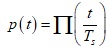
<body><![CDATA[<p><font size="2" face="Verdana, Arial, Helvetica, sans-serif">When several messages are  transmitted, they are first encoded into a sequence of bits called baseband  signal. This sequence is grouped into k &nbsp;bits to form M symbols, where M=2<sup>k</sup>. A system using a symbol set size of M is referred to as an <em>M</em>-<em>ary</em> system. The duration of one symbol  is denoted as Ts and Tb is the time that it takes to send 1 bit of data, both are  related by Ts =kTb. The bit rate and the symbol rate of the binary signal are Rb = 1/Tb &nbsp;and Rs = 1/Tb, respectively, where Rs =Rb/k. Multilevel NRZ line code was selected to represent the  waveform of the baseband signal (Couch,  2012) </font></p>     <p><font size="2"><strong><font face="Verdana, Arial, Helvetica, sans-serif">Bandpass modulation</font></strong></font></p>     <p><font size="2" face="Verdana, Arial, Helvetica, sans-serif">Bandpass modulation can be defined as  the process whereby the amplitude, frequency, or phase of a carrier wave, or a  combination of them, is varied in accordance with the information to be  transmitted. This bandpass signal is called the modulated signal, and the  baseband source signal is called the modulating signal. As a result of that,  bandpass digital modulation is known as the process by which shaped pulses,  that represent digital symbols, modulate a carrier wave. </font></p>     <p><font size="2" face="Verdana, Arial, Helvetica, sans-serif">Any modulated bandpass digital signal can be  expressed in the general quadrature-carrier form </font></p>     <p align="center"><img src="/img/revistas/rcci/v12n4/fo0101418.jpg" alt="fo01" width="357" height="33"></p>     <p><font size="2" face="Verdana, Arial, Helvetica, sans-serif">where <em>f</em>c &nbsp;is the carrier frequency  and <em>g</em>(t)is known as the complex envelope and expressed as</font></p>     <p align="center"><img src="/img/revistas/rcci/v12n4/fo0201418.jpg" alt="fo02" width="145" height="25"></p>     <p><font size="2" face="Verdana, Arial, Helvetica, sans-serif">Here, <em>x</em>i(t) &nbsp;and <em>x</em>q(t) &nbsp;are called time  variant in-phase and quadrature components and both contain the baseband  modulating signals. These components are represented by</font></p>     <p align="center"><img src="/img/revistas/rcci/v12n4/fo0301418.jpg" alt="fo03" width="362" height="43"></p>     <p><font size="2" face="Verdana, Arial, Helvetica, sans-serif">where p(t)&nbsp;is the symbol pulse  shape and is expressed as</font></p>     ]]></body>
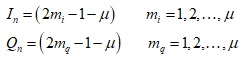
<body><![CDATA[<p align="center"><img src="/img/revistas/rcci/v12n4/fo0401418.jpg" alt="fo04" width="110" height="47"></p>     <p><font size="2"><em><font face="Verdana, Arial, Helvetica, sans-serif">I</font></em><font face="Verdana, Arial, Helvetica, sans-serif">n &nbsp;and <em>Q</em>n denote amplitude discrete levels that correspond to the  desired modulation type. These levels represent the <em>n-</em>th symbols in the message sequence, so the amplitudes belong to a  set of M discrete values (Couch, 2012).</font></font></p>     <p><font size="2"><strong><font face="Verdana, Arial, Helvetica, sans-serif">In-phase and Quadrature amplitude discrete levels for M-ary  PSK and M-ary QAM </font></strong></font></p>     <p><font size="2" face="Verdana, Arial, Helvetica, sans-serif">The <em>M-ary </em>PSK  (Multilevel Phase Shift Keying) and the <em>M-ary </em>QAM (Quadrature Amplitude Modulation) modulations were mainly selected for  designing this software for being used in the data modulation of the wireless  communications system Long Term Evolution, although these modulations are also  used in other wireless communication services. </font></p>     <p><font size="2" face="Verdana, Arial, Helvetica, sans-serif">In <em>M-ary</em> PSK  modulation, the modulating data signal shifts the phase of the bandpass  waveform to one of <em>M</em> states, where  each of them has a duration <em>T</em>s. The <em>I</em>n &nbsp;and <em>Q</em>n &nbsp;amplitude discrete  levels to generate modulated signal waveform are obtained by</font></p>     <p align="center"><img src="/img/revistas/rcci/v12n4/fo0501418.jpg" alt="fo05" width="406" height="50"></p>     <p><font size="2" face="Verdana, Arial, Helvetica, sans-serif">In <em>M-ary</em> QAM, the modulating data signal varies the phase and the  amplitude of the carrier wave to one of <em>M</em> states. To generate the <em>I</em>n and <em>Q</em>n &nbsp;amplitude, discrete  levels belonging to this modulation, the transmitted symbols are partitioned  into two streams of equal length. Each obtained subsequence is converted into  an amplitude discrete level that forms a set of &micro;&nbsp;possible amplitudes.  The obtained amplitudes from each subsequence are taken as <em>I</em>n &nbsp;and <em>Q</em>n &nbsp;levels and are  represented by</font></p>     <p align="center"><img src="/img/revistas/rcci/v12n4/fo0601418.jpg" alt="fo06" width="243" height="59"></p>     <p><font size="2" face="Verdana, Arial, Helvetica, sans-serif">where mi&nbsp;and mq denote the possible amplitudes corresponding to each <em>I</em>n and <em>Q</em>n &nbsp;subsequence,  respectively. To design this software, it was taken the relationship M=&micro;<sup>2</sup> to provide a square  constellation modulation (Carlson et al., 2002)</font></p>     <p><font size="2"><strong><font face="Verdana, Arial, Helvetica, sans-serif">Raised Cosine Filter</font></strong><font face="Verdana, Arial, Helvetica, sans-serif">    ]]></body>
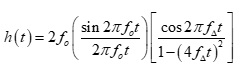
<body><![CDATA[<br>   <br clear="ALL"> RCF is defined as a low pass  filter used to restrict the bandwidth of the rectangular multilevel pulses and  to minimize the intersymbol interference when they pass through a communication  system. Its impulse response and its frequency response are given by </font></font></p>     <p align="center"><img src="/img/revistas/rcci/v12n4/fo0701418.jpg" alt="fo07" width="316" height="143"><img src="/img/revistas/rcci/v12n4/fo0801418.jpg" alt="fo08" width="241" height="76"></p>     <p align="center"><img src="/img/revistas/rcci/v12n4/fo0901418.jpg" alt="fo09" width="301" height="48"></p>     <p><font size="2" face="Verdana, Arial, Helvetica, sans-serif">where <em>f</em>o&nbsp;is the 6-dB bandwidth  of the filter, B &nbsp;is the absolute  bandwidth and <em>R </em>is the Rolloff  factor, which is defined as fractional excess bandwidth with respect to<em> f</em>o. </font></p>     <p><font size="2"><strong><font face="Verdana, Arial, Helvetica, sans-serif">Multipath Fading and Additive Gaussian Noise Channels</font></strong><font face="Verdana, Arial, Helvetica, sans-serif">.</font></font></p>     <p><font size="2" face="Verdana, Arial, Helvetica, sans-serif">In a wireless mobile  communication system, a signal can travel from transmitter to receiver over  multiple reflective paths. This phenomenon is known as multipath propagation,  which can cause fluctuations in the received signal&rsquo;s amplitude, phase, and  angle of arrival, thus causing the so called multipath fading<strong>. </strong>The multipath fading channels have a  time variant impulse response that is produced by constantly changing physical  characteristics of the media. The chosen multipath fading manifestation for  this software was Rayleigh fading, since it is mainly a multipath fading produced  in absence of a line of sight between the transmitter and the receiver. The  channel used is based on a discrete multipath channel known as the  tapped-delay-line (TDL) channel model, which basically works as a lowpass  filter. (Iskander, 2008; ITU-R, 2017) </font></p>     <p><font size="2" face="Verdana, Arial, Helvetica, sans-serif">The Additive White Gaussian  Noise channel is obtained by generating Gaussian random number using a MATLAB  function known as <em>randn</em>. A variance  for random variable is computed starting from signal to noise ratio and signal  average power at the channel input.</font></p>     <p><font size="2" face="Verdana, Arial, Helvetica, sans-serif"><strong>Programming language and develop environment.</strong></font></p>     <p><font size="2" face="Verdana, Arial, Helvetica, sans-serif">MATLAB is a high level language and interactive  environment for numerical computation, visualization, and programming. It  offers an integrated developing environment, which is available  for UNIX, Windows, Mac OS X and GNU/Linux platforms. It  was chosen for this software because it allows the implementation of  algorithms, the creation of graphical interfaces, the communication with  programs on other languages and with other hardware devices and it  enables to reach solutions faster than traditional programming languages, such  as C/C++ or Java. </font></p>     <p>&nbsp;</p>     ]]></body>
<body><![CDATA[<p><font face="Verdana, Arial, Helvetica, sans-serif"><strong><font size="3">RESULTS Y DISCUSSION </font></strong></font></p>     <p><font size="2"><strong><font face="Verdana, Arial, Helvetica, sans-serif">System modules </font></strong><font face="Verdana, Arial, Helvetica, sans-serif">    <br>   This section describes the results of applying the  mathematic models which were presented in the previous section. For carrying  out the design of this software this paper proposes the following modules:</font></font></p> <ul type="disc">       <li>         <p><font size="2" face="Verdana, Arial, Helvetica, sans-serif">IQ_levels: It converts       binary data stream to <em>I</em>n &nbsp;and <em>Q</em>n &nbsp;amplitude       discrete values according to the selected modulation.</font></p>   </li>       <li>         <p><font size="2" face="Verdana, Arial, Helvetica, sans-serif">RCF: It makes the       impulse and frequency responses of the Raised Cosine Filter.</font></p>   </li>       <li>         <p><font size="2" face="Verdana, Arial, Helvetica, sans-serif">Multipath_ch: <strong>&nbsp;</strong>It makes the impulse responses of the Multipath  Rayleigh Fading Channel for which ten paths and an attenuation among paths of  1dB were assigned.</font></p>   </li>       <li>         ]]></body>
<body><![CDATA[<p><font size="2" face="Verdana, Arial, Helvetica, sans-serif">AWGN_ch:       It adds white Gaussian noise according to input signal power and signal to       noise ratio.</font></p>   </li>       <li>         <p><font size="2" face="Verdana, Arial, Helvetica, sans-serif">PolarNRZ_wf:       It generates the binary polar NRZ waveform associated with a generated       bits stream.</font></p>   </li>       <li>         <p><font size="2" face="Verdana, Arial, Helvetica, sans-serif">IQ_wf:       It returns the in-phase and quadrature components waveform associated with       the corresponding <em>I</em>n &nbsp;and <em>Q</em>n&nbsp;amplitudes.</font></p>   </li>       <li>         <p><font size="2" face="Verdana, Arial, Helvetica, sans-serif">RCF_wf:       It allows the in-phase and quadrature components waveform to pass through       the designed Raised Cosine Filter.</font></p>   </li>       <li>         <p><font size="2" face="Verdana, Arial, Helvetica, sans-serif">Gaussian_wf:       It allows the in-phase and quadrature components waveform to pass through       the Additive White Gaussian Noise Channel.</font></p>   </li>       <li>         ]]></body>
<body><![CDATA[<p><font size="2" face="Verdana, Arial, Helvetica, sans-serif">Fading_wf:       It allows the In-phase and Quadrature components waveform to pass through       the Multipath Rayleigh Fading Channel.</font></p>   </li>       <li>         <p><font size="2" face="Verdana, Arial, Helvetica, sans-serif">Quadrature_wf:       It generates the bandpass signal waveform by using a quadrature modulator.</font></p>   </li>       <li>         <p><font size="2" face="Verdana, Arial, Helvetica, sans-serif">Graphics: It has all the functions to generate each  graphic from the interface menu. </font></p>   </li>     </ul>     <p><font size="2"><strong><font face="Verdana, Arial, Helvetica, sans-serif">Components Diagram</font></strong><font face="Verdana, Arial, Helvetica, sans-serif"><strong>&nbsp; </strong>    <br> The  component diagrams are used to structure the implementation model in terms of  implementation subsystems and show the relationships among the implementation  elements. The diagram associated with the proposed tool is shown in <a href="/img/revistas/rcci/v12n4/f0201418.jpg" target="_blank">Figure 2</a>.</font></font></p>     <p><font size="2"><strong><font face="Verdana, Arial, Helvetica, sans-serif">Modes of operation</font></strong></font></p>     <p><font size="2" face="Verdana, Arial, Helvetica, sans-serif">A MATLAB function was created called <em>signal_generator</em>, which is composed by  two operation modes, two configuration objects and several M files that support  it. The <em>signal_generator</em> function has  three input arguments; the first one is the <em>Mode</em> argument whose values are assigned as 0 or 1 to establish the Generator or  Interface modes, respectively, and the other two are configuration objects  created by the <em>transmission</em> and <em>channel </em>functions. The <em>signal_generator </em>function is shown below </font></p>     ]]></body>
<body><![CDATA[<p align="center"><font size="2" face="Verdana, Arial, Helvetica, sans-serif"><em>sg = signal_generator(Mode,ht,ch);</em></font></p>     <p><font size="2" face="Verdana, Arial, Helvetica, sans-serif">To use the <em>signal_generator</em> function as an interface, the <em>Mode</em> variable must first be set to 1,  this is needed to store the quantities used in the visualization. In this mode,  the signals visualization tool is opened up, which allows the user to visualize  several graphics associated with the signal generation process. To use the <em>signal_generator</em> function as a generator, the <em>Mode</em> variable  must be set to 0. In this mode, the generated in-phase and quadrature  components are only returned after being modified through generator components.  <a href="/img/revistas/rcci/v12n4/f0301418.jpg" target="_blank">Figure 3</a> illustrates how the <em>signal_generator</em> function is used in both modes.</font></p>     <p><font size="2"><strong><font face="Verdana, Arial, Helvetica, sans-serif">Interface mode </font></strong></font></p>     <p><font size="2" face="Verdana, Arial, Helvetica, sans-serif"><a href="#f04">Figure 4</a> shows a  snapshot of the visualization tool, which allows the user to visualize several  quantities associated  with the configuration objects. The interface consists of several sections: two  dedicated to configure the propagation channel and transmission parameters,  three dedicated to choose and visualize impulse and frequency responses  belonging to Raised Cosine Filter used on the transmission configuration, and  one dedicated to choose the graphics that correspond to the signal generation  stages.</font></p>     <p align="center"><img src="/img/revistas/rcci/v12n4/f0401418.jpg" alt="f04" width="487" height="295"><a name="f04"></a></p>     <p><font size="2"><strong><font face="Verdana, Arial, Helvetica, sans-serif">Graphics generated by the  interface</font></strong></font></p>     <p><font size="2" face="Verdana, Arial, Helvetica, sans-serif"><a href="#f05">Figure  5</a> is a snapshot of the user interface where the graphic menu generated by the  tool is shown. As it can be seen, there are 6 kinds of graphics: five for the  graphic menu and one dedicated to show impulse and frequency responses  belonging to Raised Cosine Filter, according to the chosen Rolloff factor.</font></p>     <p><font size="2" face="Verdana, Arial, Helvetica, sans-serif">Then, all graphics produced by the tool will be  shown, for which the configuration values on the previous snapshot were taken.  <a href="/img/revistas/rcci/v12n4/f0601418.jpg" target="_blank">Figure 6</a> shows a random binary data stream represented as a Polar NRZ signal,  the In-phase and Quadrature components waveform associated with binary data  stream and its corresponding spectrums. <a href="/img/revistas/rcci/v12n4/f0701418.jpg" target="_blank">Figure 7</a>, <a href="/img/revistas/rcci/v12n4/f0801418.jpg" target="_blank">Figure 8</a> and <a href="/img/revistas/rcci/v12n4/f0901418.jpg" target="_blank">Figure 9</a> have two rows where  each of them represent the same components waveform from Figure 6 together with  their spectrums, before and after being modified by the model components.  Figure 7 illustrates the signals filtered by the selected Raised Cosine Filter,  where new waveforms have restricted bandwidths and rounded tops instead of flat  levels. Figure 8 shows the fluctuations produced by constantly changing  physical characteristics of the Multipath Rayleigh Fading Channel on the  components waveform. Figure 9 shows the effect of the Additive White Gaussian  Noise Channel on components waveform where it is clearly seen how the signals  are altered with more severity, what is also observable in the components  spectrum. <a href="#f10">Figure 10</a> illustrates the components waveform and their corresponding  amplitude modulations and <a href="#f11">Figure 11</a> shows components waveform after passing  through the quadrature modulator together with their spectrums. <a href="/img/revistas/rcci/v12n4/f0701418.jpg" target="_blank">Figure 7</a>, <a href="/img/revistas/rcci/v12n4/f0801418.jpg" target="_blank">Figure 8</a>, <a href="/img/revistas/rcci/v12n4/f0901418.jpg" target="_blank">Figure 9</a>  are of own elaboration.</font></p>     <p align="center"><font size="2" face="Verdana, Arial, Helvetica, sans-serif"><img src="/img/revistas/rcci/v12n4/f0501418.jpg" alt="f05" width="498" height="300"><a name="f05"></a></font></p>     <p align="center"><img src="/img/revistas/rcci/v12n4/f1001418.jpg" alt="f10" width="470" height="328"><a name="f10"></a></p>     ]]></body>
<body><![CDATA[<p align="center"><img src="/img/revistas/rcci/v12n4/f1101418.jpg" alt="f11" width="492" height="338"><a name="f11"></a></p>     <p><font size="2" face="Verdana, Arial, Helvetica, sans-serif">The signals generated by this  software constitute a good approach to the signals received by any receiver. The  proposed tool allows users to configure and watch the signals generation  process and to choose those that will be used in the algorithms evaluation.  Accordingly, users can also store the samples belonging to these signals in  DAT-files, what later allows modifying their average powers varying their  amplitudes. In addition, these modified and stored samples can be handled by  other software based on MATLAB or imported by any programmable logic device  that is compatible with this type of files.</font></p>     <p>&nbsp;</p>     <p><font face="Verdana, Arial, Helvetica, sans-serif" size="3"><B>CONCLUSIONS</B></font></p>     <p><font size="2" face="Verdana, Arial, Helvetica, sans-serif">The software developed  provides a convenient way to get test signals, when the suitable devices to  generate them are not available. The implemented graphical interface is easy to  configure since the user only needs basic knowledges about signals; in  addition, it allows watching the waveform which is modified by present elements  in the generation model, so it can be used as a virtual signal laboratory for  engineering students.</font></p>     <p><font size="2" face="Verdana, Arial, Helvetica, sans-serif">The detector algorithms created by the scientific  community can now be tested by using signals whose parameters can be specified  with enough details. This software will allow the suitable reproduction of the  experiments and the achievement of similar results to those obtained by the  authors. As a result, it will be easier for other researchers to check the  effectiveness of these algorithms and compare them with others under the same  conditions. </font></p>     <p>&nbsp;</p>     <p align="left"><font face="Verdana, Arial, Helvetica, sans-serif" size="3"><B>REFERENCES</B></font>     <!-- ref --><p><font size="2" face="Verdana, Arial, Helvetica, sans-serif">CARLSON, A.B.;  CRILLY, P.B.; RUTLEDGE, J.C. <em>Communication  Systems</em>. Fourth ed; 2002.    </font></p>     ]]></body>
<body><![CDATA[<!-- ref --><p><font size="2" face="Verdana, Arial, Helvetica, sans-serif">CHENG,  Q.; PAL, P.; TSUJI, M.; HUA, Y. <em>An MDL  algorithm for detecting more sources than sensors using outer-products of array  output</em>. IEEE Transactions on Signal Processing. 2014; 62(24):6438-6453.    </font></p>     <!-- ref --><p><font size="2" face="Verdana, Arial, Helvetica, sans-serif">COUCH, L.W. <em>Digital and Analog Communication Systems</em>.  Eighth ed; 2012 </font><!-- ref --><p><font size="2" face="Verdana, Arial, Helvetica, sans-serif">DU,  F.; LI, Y.; JIN, S. <em>Statistical Analysis  of the Performance of MDL Enumeration for Multiple-Missed Detection in Array  Processing</em>. Sensors. 2015; 15(8):20250-20266.    </font></p>     <!-- ref --><p><font size="2" face="Verdana, Arial, Helvetica, sans-serif">GAO,  Y.; XU, J.; JIA, X.; LONG, T. <em>A novel  joint method for source number and DOA estimation for closely spaced sources</em>.  IEEE China Summit and International Conference on Signal and Information  Processing (ChinaSIP): IEEE; 2015. p.128-131.    </font></p>     <!-- ref --><p><font size="2" face="Verdana, Arial, Helvetica, sans-serif">GUIMAR&Atilde;ES,  D.A.; DE SOUZA, R.A. <em>Simple and efficient  algorithm for improving the MDL estimator of the number of sources</em>.  Sensors. 2014; 14(10):19477-19492.    </font></p>     <!-- ref --><p><font size="2" face="Verdana, Arial, Helvetica, sans-serif">GUIMAR&Atilde;ES,  D.A.; SOARES, P.M.; DE SOUZA, R.A.A. <em>An  Empirical Method for Estimating the Number of Signal Sources</em>. IEEE Latin  America Transactions. 2015; 13(7):2057-2064.    </font></p>     <!-- ref --><p><font size="2" face="Verdana, Arial, Helvetica, sans-serif">HUANG,  L.; QIAN, C.; SO, H.C.; FANG, J. <em>Source  enumeration for large array using shrinkage-based detectors with small samples</em>.  IEEE Transactions on Aerospace and Electronic Systems. 2015; 51(1):344-357.    </font></p>     <!-- ref --><p><font size="2" face="Verdana, Arial, Helvetica, sans-serif">HUANG,  L.; WU, S.; LI, X. <em>Reduced-rank MDL  method for source enumeration in high-resolution array processing</em>. IEEE  Transactions on Signal Processing. 2007; 55(12):5658-5667.    </font></p>     <!-- ref --><p><font size="2" face="Verdana, Arial, Helvetica, sans-serif">ISKANDER,  C.D. <em>A MATLAB-based object-oriented  approach to multipath fading channel simulation</em>. Hi-Tek Multisystems. 2008;  21.    </font></p>     <!-- ref --><p><font size="2" face="Verdana, Arial, Helvetica, sans-serif">ITU-R. <em>Multipath propagation and parameterization  of its characteristics</em> In: Union, I.T., editor. Vol. P.1407-6 (06/2017);  2017.    </font></p>     <!-- ref --><p><font size="2" face="Verdana, Arial, Helvetica, sans-serif">LI,  Y.; LIU, C. <em>An improved estimation  algorithm of the source number with fewer sensors than sources</em>. 2016  Progress in Electromagnetic Research Symposium (PIERS): IEEE; 2016. p.  4981-4985.    </font></p>     <!-- ref --><p><font size="2" face="Verdana, Arial, Helvetica, sans-serif">QIU,  Z.; HE, Z.; CUI, M. <em>A method for signal  source number estimation based on MUSIC algorithm</em>. International Conference  on Communication Problem-Solving (ICCP): IEEE; 2015. p. 344-346.    </font></p>     <!-- ref --><p><font size="2" face="Verdana, Arial, Helvetica, sans-serif">SEKMEN,  A.S.; BINGUL, Z. <em>Comparison of algorithms  for detection of the number of signal sources</em>. IEEE Southeastcon'99  Proceedings IEEE; 1999. p. 70-73.    </font></p>     <!-- ref --><p><font size="2" face="Verdana, Arial, Helvetica, sans-serif">TIAN,  Y.; XU, H. <em>Extended-aperture DOA  estimation with unknown number of sources</em>. Electronics Letters. 2015;  51(7):583-584.    </font></p>     <!-- ref --><p><font size="2" face="Verdana, Arial, Helvetica, sans-serif">WANG,  R.; ZHAN, Y. <em>A method of dynamic DOA  estimation with an unknown number of sources</em>. IEEE International Conference  on Mechatronics and Automation (ICMA): IEEE; 2015. p. 104-109.    </font></p>     <!-- ref --><p><font size="2" face="Verdana, Arial, Helvetica, sans-serif">WENZHAO,  Z.; SHENGGUO, S.; ZHONGRUI, Z.; JINWEI, S. <em>Detection  of Number of Source and DOA Estimation in Phase-Mode Space Using Uniform  Circular Acoustic Vector Sensor Array</em>. 2016 6th International Conference on  Instrumentation &amp; Measurement, Computer, Communication and Control (IMCCC):  IEEE; 2016. p.361-365.    </font></p>     <!-- ref --><p><font size="2" face="Verdana, Arial, Helvetica, sans-serif">YANG,  X.; LI, S.; HU, X.; ZENG, T. <em>Improved MDL  method for estimation of source number at subarray level</em>. Electronics  Letters. 2015; 52(1):85-86.    </font></p>     <!-- ref --><p><font size="2" face="Verdana, Arial, Helvetica, sans-serif">ZAREI,  A.; GHASSEMI, F.; MORADI, M.H. <em>Information  based source number estimation for probabilistic common spatial pattern in  motor imagery BCI system</em>. 24th Iranian Conference on Electrical Engineering  (ICEE): IEEE; 2016. p. 555-560.    </font></p>     <!-- ref --><p><font size="2" face="Verdana, Arial, Helvetica, sans-serif">ZHANG, G.; CHEN, H. <em>Source number estimation algorithm based on wide-band compressed  sensing</em>. IEEE Information Technology, Networking, Electronic and Automation  Control Conference: IEEE; 2016. p. 216-219.     </font></p>     <p name="_ENREF_1">&nbsp;</p>     <p name="_ENREF_1">&nbsp;</p>     <p><font size="2" face="Verdana, Arial, Helvetica, sans-serif">Recibido: 06/11/2017    ]]></body>
<body><![CDATA[<br> Aceptado: 12/10/2018</font></p>      ]]></body><back>
<ref-list>
<ref id="B1">
<nlm-citation citation-type="">
<person-group person-group-type="author">
<name>
<surname><![CDATA[CARLSON]]></surname>
<given-names><![CDATA[A.B]]></given-names>
</name>
<name>
<surname><![CDATA[CRILLY]]></surname>
<given-names><![CDATA[P.B]]></given-names>
</name>
<name>
<surname><![CDATA[RUTLEDGE]]></surname>
<given-names><![CDATA[J.C]]></given-names>
</name>
</person-group>
<source><![CDATA[Communication Systems.]]></source>
<year>2002</year>
<edition>Fourth</edition>
</nlm-citation>
</ref>
<ref id="B2">
<nlm-citation citation-type="">
<person-group person-group-type="author">
<name>
<surname><![CDATA[CHENG]]></surname>
<given-names><![CDATA[Q]]></given-names>
</name>
<name>
<surname><![CDATA[PAL]]></surname>
<given-names><![CDATA[P]]></given-names>
</name>
<name>
<surname><![CDATA[TSUJI]]></surname>
<given-names><![CDATA[M]]></given-names>
</name>
<name>
<surname><![CDATA[HUA]]></surname>
<given-names><![CDATA[Y]]></given-names>
</name>
</person-group>
<article-title xml:lang="en"><![CDATA[An MDL algorithm for detecting more sources than sensors using outer-products of array output.]]></article-title>
<source><![CDATA[]]></source>
<year>2014</year>
<volume>62</volume>
<numero>24</numero>
<issue>24</issue>
<page-range>6438-6453</page-range></nlm-citation>
</ref>
<ref id="B3">
<nlm-citation citation-type="">
<person-group person-group-type="author">
<name>
<surname><![CDATA[COUCH]]></surname>
<given-names><![CDATA[L.W]]></given-names>
</name>
</person-group>
<source><![CDATA[Digital and Analog Communication Systems]]></source>
<year>2012</year>
<edition>Eighth</edition>
</nlm-citation>
</ref>
<ref id="B4">
<nlm-citation citation-type="">
<person-group person-group-type="author">
<name>
<surname><![CDATA[DU]]></surname>
<given-names><![CDATA[F]]></given-names>
</name>
<name>
<surname><![CDATA[LI]]></surname>
<given-names><![CDATA[Y]]></given-names>
</name>
<name>
<surname><![CDATA[JIN]]></surname>
<given-names><![CDATA[S]]></given-names>
</name>
</person-group>
<article-title xml:lang="en"><![CDATA[Statistical Analysis of the Performance of MDL Enumeration for Multiple-Missed Detection in Array Processing]]></article-title>
<source><![CDATA[]]></source>
<year>2015</year>
<volume>15</volume>
<numero>8</numero>
<issue>8</issue>
<page-range>20250-20266</page-range></nlm-citation>
</ref>
<ref id="B5">
<nlm-citation citation-type="book">
<person-group person-group-type="author">
<name>
<surname><![CDATA[GAO]]></surname>
<given-names><![CDATA[Y]]></given-names>
</name>
<name>
<surname><![CDATA[XU]]></surname>
<given-names><![CDATA[J]]></given-names>
</name>
<name>
<surname><![CDATA[JIA]]></surname>
<given-names><![CDATA[X]]></given-names>
</name>
<name>
<surname><![CDATA[LONG]]></surname>
<given-names><![CDATA[T]]></given-names>
</name>
</person-group>
<source><![CDATA[A novel joint method for source number and DOA estimation for closely spaced sources.]]></source>
<year>2015</year>
<page-range>128-131</page-range><publisher-name><![CDATA[ChinaSIP]]></publisher-name>
</nlm-citation>
</ref>
<ref id="B6">
<nlm-citation citation-type="">
<person-group person-group-type="author">
<name>
<surname><![CDATA[GUIMARÃES]]></surname>
<given-names><![CDATA[D.A]]></given-names>
</name>
<name>
<surname><![CDATA[DE SOUZA]]></surname>
<given-names><![CDATA[R.A]]></given-names>
</name>
</person-group>
<article-title xml:lang="en"><![CDATA[Simple and efficient algorithm for improving the MDL estimator of the number of sources]]></article-title>
<source><![CDATA[]]></source>
<year>2014</year>
<volume>14</volume>
<numero>10</numero>
<issue>10</issue>
<page-range>19477-19492</page-range></nlm-citation>
</ref>
<ref id="B7">
<nlm-citation citation-type="">
<person-group person-group-type="author">
<name>
<surname><![CDATA[GUIMARÃES]]></surname>
<given-names><![CDATA[D.A]]></given-names>
</name>
<name>
<surname><![CDATA[SOARES]]></surname>
<given-names><![CDATA[P.M]]></given-names>
</name>
<name>
<surname><![CDATA[DE SOUZA]]></surname>
<given-names><![CDATA[R.A.A]]></given-names>
</name>
</person-group>
<article-title xml:lang="en"><![CDATA[An Empirical Method for Estimating the Number of Signal Sources]]></article-title>
<source><![CDATA[]]></source>
<year>2015</year>
<volume>13</volume>
<numero>7</numero>
<issue>7</issue>
<page-range>2057-2064</page-range></nlm-citation>
</ref>
<ref id="B8">
<nlm-citation citation-type="">
<person-group person-group-type="author">
<name>
<surname><![CDATA[HUANG]]></surname>
<given-names><![CDATA[L]]></given-names>
</name>
<name>
<surname><![CDATA[QIAN]]></surname>
<given-names><![CDATA[C]]></given-names>
</name>
<name>
<surname><![CDATA[SO]]></surname>
<given-names><![CDATA[H.C]]></given-names>
</name>
<name>
<surname><![CDATA[FANG]]></surname>
<given-names><![CDATA[J]]></given-names>
</name>
</person-group>
<article-title xml:lang="en"><![CDATA[Source enumeration for large array using shrinkage-based detectors with small samples]]></article-title>
<source><![CDATA[]]></source>
<year>2015</year>
<volume>51</volume>
<numero>1</numero>
<issue>1</issue>
<page-range>344-357</page-range></nlm-citation>
</ref>
<ref id="B9">
<nlm-citation citation-type="">
<person-group person-group-type="author">
<name>
<surname><![CDATA[HUANG]]></surname>
<given-names><![CDATA[L]]></given-names>
</name>
<name>
<surname><![CDATA[WU]]></surname>
<given-names><![CDATA[S]]></given-names>
</name>
<name>
<surname><![CDATA[LI]]></surname>
<given-names><![CDATA[X]]></given-names>
</name>
</person-group>
<article-title xml:lang="en"><![CDATA[Reduced-rank MDL method for source enumeration in high-resolution array processing]]></article-title>
<source><![CDATA[]]></source>
<year>2007</year>
<volume>55</volume>
<numero>12</numero>
<issue>12</issue>
<page-range>5658-5667</page-range></nlm-citation>
</ref>
<ref id="B10">
<nlm-citation citation-type="">
<person-group person-group-type="author">
<name>
<surname><![CDATA[ISKANDER]]></surname>
<given-names><![CDATA[C.D]]></given-names>
</name>
</person-group>
<source><![CDATA[A MATLAB-based object-oriented approach to multipath fading channel simulation.]]></source>
<year>2008</year>
<volume>21</volume>
</nlm-citation>
</ref>
<ref id="B11">
<nlm-citation citation-type="">
<collab>ITU-R</collab>
<source><![CDATA[Multipath propagation and parameterization of its characteristics]]></source>
<year>2017</year>
<volume>P.1407-6 (06/2017)</volume>
</nlm-citation>
</ref>
<ref id="B12">
<nlm-citation citation-type="book">
<person-group person-group-type="author">
<name>
<surname><![CDATA[LI]]></surname>
<given-names><![CDATA[Y]]></given-names>
</name>
<name>
<surname><![CDATA[LIU]]></surname>
<given-names><![CDATA[C]]></given-names>
</name>
</person-group>
<source><![CDATA[An improved estimation algorithm of the source number with fewer sensors than sources.]]></source>
<year>2016</year>
<page-range>4981-4985</page-range><publisher-name><![CDATA[IEEE]]></publisher-name>
</nlm-citation>
</ref>
<ref id="B13">
<nlm-citation citation-type="book">
<person-group person-group-type="author">
<name>
<surname><![CDATA[QIU]]></surname>
<given-names><![CDATA[Z]]></given-names>
</name>
<name>
<surname><![CDATA[HE]]></surname>
<given-names><![CDATA[Z]]></given-names>
</name>
<name>
<surname><![CDATA[CUI]]></surname>
<given-names><![CDATA[M]]></given-names>
</name>
</person-group>
<source><![CDATA[A method for signal source number estimation based on MUSIC algorithm. International Conference on Communication Problem-Solving (ICCP)]]></source>
<year>2015</year>
<page-range>344-346</page-range><publisher-name><![CDATA[IEEE]]></publisher-name>
</nlm-citation>
</ref>
<ref id="B14">
<nlm-citation citation-type="book">
<person-group person-group-type="author">
<name>
<surname><![CDATA[SEKMEN]]></surname>
<given-names><![CDATA[A.S]]></given-names>
</name>
<name>
<surname><![CDATA[BINGUL]]></surname>
<given-names><![CDATA[Z]]></given-names>
</name>
</person-group>
<source><![CDATA[Comparison of algorithms for detection of the number of signal sources.]]></source>
<year>1999</year>
<page-range>70-73</page-range><publisher-name><![CDATA[IEEE]]></publisher-name>
</nlm-citation>
</ref>
<ref id="B15">
<nlm-citation citation-type="">
<person-group person-group-type="author">
<name>
<surname><![CDATA[TIAN]]></surname>
<given-names><![CDATA[Y]]></given-names>
</name>
<name>
<surname><![CDATA[XU]]></surname>
<given-names><![CDATA[H]]></given-names>
</name>
</person-group>
<article-title xml:lang="en"><![CDATA[Extended-aperture DOA estimation with unknown number of sources.]]></article-title>
<source><![CDATA[]]></source>
<year>2015</year>
<volume>51</volume>
<numero>7</numero>
<issue>7</issue>
<page-range>583-584</page-range></nlm-citation>
</ref>
<ref id="B16">
<nlm-citation citation-type="book">
<person-group person-group-type="author">
<name>
<surname><![CDATA[WANG]]></surname>
<given-names><![CDATA[R]]></given-names>
</name>
<name>
<surname><![CDATA[ZHAN]]></surname>
<given-names><![CDATA[Y]]></given-names>
</name>
</person-group>
<source><![CDATA[A method of dynamic DOA estimation with an unknown number of sources.]]></source>
<year>2015</year>
<page-range>104-109</page-range><publisher-name><![CDATA[IEEE]]></publisher-name>
</nlm-citation>
</ref>
<ref id="B17">
<nlm-citation citation-type="book">
<person-group person-group-type="author">
<name>
<surname><![CDATA[WENZHAO]]></surname>
<given-names><![CDATA[Z]]></given-names>
</name>
<name>
<surname><![CDATA[SHENGGUO]]></surname>
<given-names><![CDATA[S]]></given-names>
</name>
<name>
<surname><![CDATA[ZHONGRUI]]></surname>
<given-names><![CDATA[Z]]></given-names>
</name>
<name>
<surname><![CDATA[JINWEI]]></surname>
<given-names><![CDATA[S]]></given-names>
</name>
</person-group>
<source><![CDATA[Detection of Number of Source and DOA Estimation in Phase-Mode Space Using Uniform Circular Acoustic Vector Sensor Array.]]></source>
<year>2016</year>
<page-range>361-365</page-range><publisher-name><![CDATA[IEEE]]></publisher-name>
</nlm-citation>
</ref>
<ref id="B18">
<nlm-citation citation-type="">
<person-group person-group-type="author">
<name>
<surname><![CDATA[YANG]]></surname>
<given-names><![CDATA[X]]></given-names>
</name>
<name>
<surname><![CDATA[LI]]></surname>
<given-names><![CDATA[S]]></given-names>
</name>
<name>
<surname><![CDATA[HU]]></surname>
<given-names><![CDATA[X]]></given-names>
</name>
<name>
<surname><![CDATA[ZENG]]></surname>
<given-names><![CDATA[T]]></given-names>
</name>
</person-group>
<article-title xml:lang="en"><![CDATA[Improved MDL method for estimation of source number at subarray level.]]></article-title>
<source><![CDATA[]]></source>
<year>2015</year>
<volume>52</volume>
<numero>1</numero>
<issue>1</issue>
<page-range>85-86</page-range></nlm-citation>
</ref>
<ref id="B19">
<nlm-citation citation-type="">
<person-group person-group-type="author">
<name>
<surname><![CDATA[ZAREI]]></surname>
<given-names><![CDATA[A]]></given-names>
</name>
<name>
<surname><![CDATA[GHASSEMI]]></surname>
<given-names><![CDATA[F]]></given-names>
</name>
<name>
<surname><![CDATA[MORADI]]></surname>
<given-names><![CDATA[M.H]]></given-names>
</name>
</person-group>
<source><![CDATA[Information based source number estimation for probabilistic common spatial pattern in motor imagery BCI system.]]></source>
<year>2016</year>
<page-range>555-560</page-range></nlm-citation>
</ref>
<ref id="B20">
<nlm-citation citation-type="book">
<person-group person-group-type="author">
<name>
<surname><![CDATA[ZHANG]]></surname>
<given-names><![CDATA[G]]></given-names>
</name>
<name>
<surname><![CDATA[CHEN]]></surname>
<given-names><![CDATA[H]]></given-names>
</name>
</person-group>
<source><![CDATA[Source number estimation algorithm based on wide-band compressed sensing.]]></source>
<year>2016</year>
<page-range>216-219</page-range><publisher-name><![CDATA[IEEE]]></publisher-name>
</nlm-citation>
</ref>
</ref-list>
</back>
</article>