<?xml version="1.0" encoding="ISO-8859-1"?><article xmlns:mml="http://www.w3.org/1998/Math/MathML" xmlns:xlink="http://www.w3.org/1999/xlink" xmlns:xsi="http://www.w3.org/2001/XMLSchema-instance">
<front>
<journal-meta>
<journal-id>2307-2113</journal-id>
<journal-title><![CDATA[Revista Cubana de Información en Ciencias de la Salud]]></journal-title>
<abbrev-journal-title><![CDATA[Rev. cuba. inf. cienc. salud]]></abbrev-journal-title>
<issn>2307-2113</issn>
<publisher>
<publisher-name><![CDATA[Centro Nacional de Información de Ciencias MédicasEditorial Ciencias Médicas]]></publisher-name>
</publisher>
</journal-meta>
<article-meta>
<article-id>S2307-21132018000100004</article-id>
<title-group>
<article-title xml:lang="en"><![CDATA[The use of an application to record information on Dentistry patients from the perspective of dental surgeons]]></article-title>
<article-title xml:lang="es"><![CDATA[Uso de una aplicación para registrar información sobre pacientes estomatológicos desde la perspectiva de los cirujanos dentales]]></article-title>
</title-group>
<contrib-group>
<contrib contrib-type="author">
<name>
<surname><![CDATA[Tavares]]></surname>
<given-names><![CDATA[Aglae Regina]]></given-names>
</name>
<xref ref-type="aff" rid="A01"/>
</contrib>
<contrib contrib-type="author">
<name>
<surname><![CDATA[Caetano]]></surname>
<given-names><![CDATA[Anne Monica]]></given-names>
</name>
<xref ref-type="aff" rid="A01"/>
</contrib>
<contrib contrib-type="author">
<name>
<surname><![CDATA[Monken de Assis]]></surname>
<given-names><![CDATA[Sonia Francisca]]></given-names>
</name>
<xref ref-type="aff" rid="A01"/>
</contrib>
<contrib contrib-type="author">
<name>
<surname><![CDATA[Jansiski Motta]]></surname>
<given-names><![CDATA[Lara]]></given-names>
</name>
<xref ref-type="aff" rid="A01"/>
</contrib>
</contrib-group>
<aff id="A01">
<institution><![CDATA[,University Nove de Julho  ]]></institution>
<addr-line><![CDATA[São Paulo ]]></addr-line>
<country>Brasil</country>
</aff>
<pub-date pub-type="pub">
<day>00</day>
<month>03</month>
<year>2018</year>
</pub-date>
<pub-date pub-type="epub">
<day>00</day>
<month>03</month>
<year>2018</year>
</pub-date>
<volume>29</volume>
<numero>1</numero>
<fpage>41</fpage>
<lpage>54</lpage>
<copyright-statement/>
<copyright-year/>
<self-uri xlink:href="http://scielo.sld.cu/scielo.php?script=sci_arttext&amp;pid=S2307-21132018000100004&amp;lng=en&amp;nrm=iso"></self-uri><self-uri xlink:href="http://scielo.sld.cu/scielo.php?script=sci_abstract&amp;pid=S2307-21132018000100004&amp;lng=en&amp;nrm=iso"></self-uri><self-uri xlink:href="http://scielo.sld.cu/scielo.php?script=sci_pdf&amp;pid=S2307-21132018000100004&amp;lng=en&amp;nrm=iso"></self-uri><abstract abstract-type="short" xml:lang="en"><p><![CDATA[Dental records are complex documents and not all dental surgeons have been careful to fill them correctly. On the other hand, a number of apps for professional support has been observed on the market aimed at healthcare. The purpose of this study was to show how dental surgeons have noticed the technology of mobile devices and how it would help in their work routine by analysing an application for recording patient information. This study was exploratory, qualitative, descriptive, and transversal, with data obtained through a semi-structured interview with open-ended questions applied to ten dental surgeons who have downloaded the App OdontoExame as study population. The answers were analysed by the content analysis technique. The results showed that this technology could be useful in storing information. Besides, 90 % of respondents stated that the application would help in clinical practices, while 10 % considered such a technology still limited to this function.]]></p></abstract>
<abstract abstract-type="short" xml:lang="es"><p><![CDATA[Los registros estomatológicos son documentos complejos y no todos los cirujanos dentales han sido cuidadosos al llenarlos correctamente. Por otra parte, un conjunto de aplicaciones de apoyo profesional han aparecido en el mercado, las que están dirigidas a la atención médica. El propósito del presente estudio es mostrar cómo los cirujanos dentales han notado la presencia de la tecnología de dispositivos móviles y cómo esta los podría ayudar en su trabajo diario, a partir del análisis de una aplicación para el registro de información de los pacientes. Se trata de un estudio exploratorio, cualitativo, descriptivo y transversal, basado en datos obtenidos mediante una entrevista semiestructurada con preguntas abiertas dirigidas a una población de diez cirujanos dentales que han descargado la aplicación OdontoExame. Las respuestas se analizaron aplicando la técnica de análisis de contenidos. Los resultados mostraron que esa tecnología puede ser útil para almacenar información. El 90 % de los encuestados plantearon que la aplicación podría ser útil en la práctica clínica, mientras que el 10 % consideró que esta aún estaba limitada a esa función.]]></p></abstract>
<kwd-group>
<kwd lng="es"><![CDATA[dentists]]></kwd>
<kwd lng="es"><![CDATA[dental records]]></kwd>
<kwd lng="es"><![CDATA[smartphone]]></kwd>
<kwd lng="es"><![CDATA[handheld]]></kwd>
<kwd lng="es"><![CDATA[mobile applications]]></kwd>
<kwd lng="es"><![CDATA[estomatólogos]]></kwd>
<kwd lng="es"><![CDATA[registros dentales]]></kwd>
<kwd lng="es"><![CDATA[teléfono inteligente]]></kwd>
<kwd lng="es"><![CDATA[portátil]]></kwd>
<kwd lng="es"><![CDATA[aplicaciones móviles]]></kwd>
</kwd-group>
</article-meta>
</front><body><![CDATA[ <p align="right"><font face="Verdana, Arial, Helvetica, sans-serif" size="2">    <b>ART&#205;CULO ORIGINAL </b></font></p>     <p align="left">&nbsp;</p>     <p align="left"><b><font face="Verdana, Arial, Helvetica, sans-serif" size="2"><font size="4">The    use of an application to record information on Dentistry patients from the perspective    of dental surgeons </font></font></b></p>     <p>&nbsp; </p>     <p><font face="Verdana, Arial, Helvetica, sans-serif" size="2"><b><font size="3">Uso    de una aplicaci&#243;n para registrar informaci&#243;n sobre pacientes estomatol&#243;gicos    desde la perspectiva de los cirujanos dentales </font></b> </font></p>     <p>&nbsp; </p>     <p>&nbsp;</p>     <p><font face="Verdana, Arial, Helvetica, sans-serif" size="2"><b>Aglae Regina    Tavares, Anne Monica Caetano, Sonia Francisca Monken de Assis, Lara Jansiski    Motta </b> </font></p>     <p> <font face="Verdana, Arial, Helvetica, sans-serif" size="2">University Nove    de Julho. S&#227;o Paulo, Brasil. </font></p>     <p>&nbsp;</p>     ]]></body>
<body><![CDATA[<p>&nbsp;</p> <hr>     <p><font face="Verdana, Arial, Helvetica, sans-serif" size="2"><b>ABSTRACT </b>    </font></p>     <p align="left"><font face="Verdana, Arial, Helvetica, sans-serif" size="2"> Dental    records are complex documents and not all dental surgeons have been careful    to fill them correctly. On the other hand, a number of apps for professional    support has been observed on the market aimed at healthcare. The purpose of    this study was to show how dental surgeons have noticed the technology of mobile    devices and how it would help in their work routine by analysing an application    for recording patient information. This study was exploratory, qualitative,    descriptive, and transversal, with data obtained through a semi-structured interview    with open-ended questions applied to ten dental surgeons who have downloaded    the App OdontoExame as study population. The answers were analysed by the content    analysis technique. The results showed that this technology could be useful    in storing information. Besides, 90 % of respondents stated that the application    would help in clinical practices, while 10 % considered such a technology still    limited to this function. </font></p>     <p> <font face="Verdana, Arial, Helvetica, sans-serif" size="2"><b>Key words:</b>    dentists; dental records; smartphone; handheld; mobile applications</font></p> <hr>     <p><font face="Verdana, Arial, Helvetica, sans-serif" size="2"><b>RESUMEN</b>    </font></p>     <p><font face="Verdana, Arial, Helvetica, sans-serif" size="2"> Los registros    estomatol&#243;gicos son documentos complejos y no todos los cirujanos dentales    han sido cuidadosos al llenarlos correctamente. Por otra parte, un conjunto    de aplicaciones de apoyo profesional han aparecido en el mercado, las que est&#225;n    dirigidas a la atenci&#243;n m&#233;dica. El prop&#243;sito del presente estudio    es mostrar c&#243;mo los cirujanos dentales han notado la presencia de la tecnolog&#237;a    de dispositivos m&#243;viles y c&#243;mo esta los podr&#237;a ayudar en su trabajo    diario, a partir del an&#225;lisis de una aplicaci&#243;n para el registro de    informaci&#243;n de los pacientes. Se trata de un estudio exploratorio, cualitativo,    descriptivo y transversal, basado en datos obtenidos mediante una entrevista    semiestructurada con preguntas abiertas dirigidas a una poblaci&#243;n de diez    cirujanos dentales que han descargado la aplicaci&#243;n OdontoExame. Las respuestas    se analizaron aplicando la t&#233;cnica de an&#225;lisis de contenidos. Los    resultados mostraron que esa tecnolog&#237;a puede ser &#250;til para almacenar    informaci&#243;n. El 90 % de los encuestados plantearon que la aplicaci&#243;n    podr&#237;a ser &#250;til en la pr&#225;ctica cl&#237;nica, mientras que el    10 % consider&#243; que esta a&#250;n estaba limitada a esa funci&#243;n. </font></p>     <p> <font face="Verdana, Arial, Helvetica, sans-serif" size="2"><b>Palabras clave:</b>    estomat&#243;logos; registros dentales; tel&#233;fono inteligente; port&#225;til;    aplicaciones m&#243;viles. </font></p> <hr>     <p>&nbsp;</p>     <p>&nbsp; </p>     <p><font face="Verdana, Arial, Helvetica, sans-serif" size="3"><b>INTRODUCTION</b>    </font><font face="Verdana, Arial, Helvetica, sans-serif" size="2"> </font></p>     ]]></body>
<body><![CDATA[<p align="left"><font face="Verdana, Arial, Helvetica, sans-serif" size="2"> The    World Health Organisation (WHO) has emphasized the mobility as a fundamental    factor to improve the quality of health information systems.<sup>1</sup> Among    Brazilians, 40 % of them use smartphones every day at least, 27 % prefer to    have no television instead of smartphones, and 73 % of mobile users do not leave    their homes without their devices.<sup>2</sup> </font></p>     <p align="left"><font face="Verdana, Arial, Helvetica, sans-serif" size="2"> Among    other functions, such devices have been used by health professionals in studies,    information exchanges, image evaluation, and interpretation of lab results,    leading to rapid and accurate decision-making.<sup>3</sup> Furthermore, these    intelligent mobiles have been considered handheld computers for personal use    everywhere 24 h a day. Thus, such devices can facilitate healthcare, since professionals    of this acting area frequently transit through institutions that provide services    and among different workplaces.<sup>4</sup> Due to the improvement of web browsers    in smartphones, information in free applications became easier to be found.    In 2017, more than 1.7 billion people are predicted to download healthcare applications,    generating a revenue around 26 million dollars in the m-Health market (information    and decisions on health through mobiles, smartphones, and tablets). This market    of mobile applications in health is aimed at professionals, patients, and people    interested in such a type of information.<sup>5</sup> Smartphones combine conventional    functions with advanced computing, thus enabling the use of applications (Apps),    which are downloaded in smartphones,<sup>6</sup> providing accessibility, low    cost, mobility, multimedia experience, geolocation, and information exchanges.<sup>7</sup>    </font></p>     <p align="left"><font face="Verdana, Arial, Helvetica, sans-serif" size="2">The    advent of information age in health combined with technology overcame administrative    functions for other areas including prevention support, health promotion, control    of diseases, and drug prescriptions. The expansion and the constant evolution    of the Information and Communication Technologies (ICT) have facilitated managerial    and professional decision-making objectively and rapidly,<sup>8</sup> and its    use has been widely described as Electronic Health (e-Health), which includes    telemedicine, electronic medical records, healthcare decision support systems,    e-Learning tools, and mobile health. This technology showed to be a facilitator    in the development of healthcare delivery systems, providing improvements in    this sector, promoting access to healthcare, increasing the coverage of services,    helping in the solution when human resources for health are scarce, and improving    the quality and the refinement of interventions in primary healthcare.<sup>9</sup>    Thus, e-Health has emerged as a model involving concepts of health, technology,    and trade in health services, considering that wireless communication also led    to an advance in this area, especially in telemedicine. In this context, a new    segment of e-Health emerged: Mobile Health or m-Health.<sup>10</sup> The WHO    defined m-Health as &#8220;practices of medicine and public health supported    by mobile decision-making (mobile devices) through mobile computers (smartphones    and tablets), using wireless technology&#8221; <em>(World Health Organization    [WHO] s.d.).</em> </font></p>     <p> <font face="Verdana, Arial, Helvetica, sans-serif" size="2"><a></a><a></a>    <a></a> <a></a> RATIONALE FOR THE STUDY </font></p>     <p align="left"><font face="Verdana, Arial, Helvetica, sans-serif" size="2"> Dental    surgeons have a work of great responsibility in society for acting directly    on the health of people. Due to its ability, ethical and legal standards guide    them in their work activity, including clinical activities, procedures related    to the elaboration of drug prescriptions, dental certificates, filling of medical    records, anamnesis records, radiographs, and photos, i.e. anything that may    constitute a legal document. Thus, dental records are used in the performance    of their functions.<sup>11</sup> </font></p>     <p align="left"><font face="Verdana, Arial, Helvetica, sans-serif" size="2"> Dental    records are a group of documents containing all information on the clinic or    hospital life of people. Such information are stored in clinics, offices, health    centres or hospitals and are confidential, since their access is only authorized    to health professionals and patients. <sup>12</sup> They are used as instruments    of consultation, follow-up, medical-hospital statistics, confirmation of appropriate    patient care, information exchanges among healthcare professionals, and as exculpatory    and incriminatory documents.<sup>12</sup> Furthermore, it must be emphasized    that dental records are also used for human identification when the professional    is requested for this purpose.<sup>13</sup> All documents involving and recording    dental procedures can be considered documentation in dentistry, including copies    of prescriptions, written guidelines, e-mails, radiographs, and study models.    Their elaboration and maintenance must be legible and updated. The conservation    must be in own file physically or digitally.<sup>13</sup> </font></p>     <p align="left"><font face="Verdana, Arial, Helvetica, sans-serif" size="2"> Dental    treatment is a complex activity, exceeding technical aspects of clinical procedures.    Thus, dental records are not coadjuvant in dental practices, but unfortunately    this professional category seamlessly lets pass the real importance of having    such documents with complete and adequate information.<sup>14</sup> Studies    have reported several errors in filling records, including unreadable writing,    erasures, incomplete records, incorrect identification of professionals, and    lack of patient signature.<sup>15 </sup> Despite seeking to end the treatment    properly, dental surgeons have not done the same in their records, often not    writing information observed from beginning to end of treatment.<sup>14</sup>    </font></p>     <p align="left"><font face="Verdana, Arial, Helvetica, sans-serif" size="2"> In    2017, three billion people are predicted to have smartphones and half of them    will use applications (Apps).<sup>16</sup> Thus, such a technology can be more    easily used to help work activities of people who deal with these devices.<sup>4</sup>    In this sense, smartphone applications in healthcare have been developed, offering    solutions to several tasks, thus becoming frequent their use in decision-making    and changes in clinical practices.<sup>17</sup> The use of smartphone applications    has become increasingly popular and with potential health care, although their    clinical utility and efficiency are still unknown.<sup>18</sup> The following    main research question was defined in order to direct the present study:    What is the perception of dental surgeons on the use of applications for recording    patient information to help their clinical practice? </font></p>     <p align="left"><font face="Verdana, Arial, Helvetica, sans-serif" size="2"> LITERATURE    REVIEW <br/>   <b> <br/>   </b> <b>Innovation in health</b> </font></p>     <p align="left"><font face="Verdana, Arial, Helvetica, sans-serif" size="2"> In    the last few decades, unprecedented transformation and technological innovation    processes has been observed in healthcare. Thus, processes need to be reviewed    in public and private sectors, as well as investing in technologies capable    of increasing the control and improving healthcare quality.<sup>8</sup> Besides    consisting of an area with particular characteristics due to its involvement    in human life, health belongs to the sector of services, thus sharing lineaments    in the production process of the tertiary sector and regarding technological    innovation.<sup>19</sup> However, the technology assumes the training of professionals    who will use it in order to make this resource a conduit and not a purpose itself.<sup>20</sup>    </font></p>     ]]></body>
<body><![CDATA[<p align="left"> <font face="Verdana, Arial, Helvetica, sans-serif" size="2">For    an effective innovation, all its connections must be established in their proper    places and with a suitable functioning among them. <sup>21</sup> The popularization    of laptops and smartphones have been considered by many people as the most shocking    technological revolution recently, after revolution caused by Internet and social    networks.<sup>22</sup> For years, mobile computing overcame the number of personal    computers, becoming an interpersonal communication system quintessentially.    <sup>23</sup> </font></p>     <p align="left"> <font face="Verdana, Arial, Helvetica, sans-serif" size="2">Information    and Communication Technologies (ICT) for WHO have emphasized the care provision    to public health, studies, and health-related activities. They mainly benefit    developing countries, offering strategic support tools for the evolution of    healthcare as to planning, assistance, study, and education.<sup>24 </sup>ICT    facilitate the meeting of specialists, help in diagnoses, and provide opportunity    for continuing education, thus promoting the satisfaction of the healthcare    team. Furthermore, they reduce the distance between the professional and the    patient, shortening the wait time of forwarding, leading to a higher efficiency    of processes and lower expenses.<sup>25</sup> </font></p>     <p align="left"><font face="Verdana, Arial, Helvetica, sans-serif" size="2"> The    Brazilian Society of Health Informatics (SBIS) classify the action of ICTs into    the following areas: Health Information Systems, Electronic Patient Record,    Telemedicine, Decision Support System, Biological Signal Processing, Medical    Image Processing, Internet in Healthcare, and Standardization of Health Information.<sup>26</sup>    The use of ICTs in healthcare is named e-Health,<sup>27</sup> which is defined    as health information available on the Internet, enabling rapid information    exchanges among doctors, patients and health professionals with other specialists    regardless of the distance.<sup>25</sup> </font></p>     <p align="left"><font face="Verdana, Arial, Helvetica, sans-serif" size="2"> The    e-Health has increasingly become an important method to access healthcare. It    can reduce its disparity and improve population health as a whole. It enables    clinical decision-making, the sharing of information between professionals and    patients, scheduling, preventions, and monitoring of chronic diseases.<sup>28</sup>    On January 09, 2007, <i>Steve Jobs</i>, Chief Executive Officer (CEO) of Apple    Inc., presented to the world the iPhone 2G and its operating system, iOS. This    event triggered a rapid evolution of smartphones and applications, which opened    new potentials for studies and development whether freely or not freely downloaded,    including applications for m-Health.<sup>5</sup> </font></p>     <p align="left"><font face="Verdana, Arial, Helvetica, sans-serif" size="2"> Mobile    Health or m-Health is the term used in medical and public health practices supported    by mobile devices (smartphones and tablets). This area is a sub-segment of e-Health,    consisting of the use of Information and Communication Technology to help healthcare.    Its utility can include the use of mobile devices to collect clinical data of    patients and community; health information for professionals, researchers, patients;    besides a direct care provision via mobile telemedicine.<sup>29</sup> Such devices    have a range of functions of mobile communication using text messages (Short    Message Service - SMS), photos and videos (Multimedia Messaging Service - MMS),    phone (in smartphones) and access to Internet for reproduction of multimedia    and support to software applications.<sup>30</sup> </font></p>     <p align="left"><font face="Verdana, Arial, Helvetica, sans-serif" size="2"> The    m-Heath is basically aimed at consumers and can be a promising tool of health    support. However, its interventions have a little theoretical background, with    limiting factors to its use, including costs of applications and devices, increased    workload, workflow disturbed by professional colleagues, and lack of familiarity    with the technology, although mobile communication is part of the daily life    of most people.<sup>30</sup> With more than 1 billion smartphones and 100 million    tablets worldwide, such devices can be a precious tool in healthcare management,<sup>31</sup>    although their clinical utility and efficiency are known.<sup>18</sup> </font></p>     <p> </p>     <p><font face="Verdana, Arial, Helvetica, sans-serif" size="2"> Decision-making    is a common procedure in health practice. Thus, technological resources and    computers can support this action.<sup>32</sup> Furthermore, health professionals    need to know technologies enabling dynamism and productivity in their work.<sup>33</sup>    Health area has been considered a great field for the development of mobile    technologies aimed at facilitating the routine of professionals.<sup>34</sup>    Smartphones and tablets are popular due to access to Internet and information,    including the possibility of downloading applications (Apps) providing several    tools to help professionals,<sup>35</sup> besides providing distance communication.<sup>36</sup>    Although the number of health-related applications has increased, it is not    certain how many of them are based on evidences or developed by reliable health    organizations. Other concerns include the confidentiality of patient information    and the use of applications in front of people.<sup>6</sup> </font></p>     <p align="left"><font face="Verdana, Arial, Helvetica, sans-serif" size="2"> The    documentation on patient care has become crucial, so that modest, incomplete,    and disordered records can no longer be accepted, which are observed in great    part of hospital services. However, a major problem has been detected in the    training of health professionals dealing with patient records, including doctors,    technicians, and nurses.<sup>37</sup> The lack of organization and attention    to records make professionals vulnerable to declarations of patients regarding    their defence. Furthermore, actions brought against dental surgeons have gradually    increased, and they are frequently based on the lack of documentation, the type    of obligation assumed by professionals or communication failure between patients    and professionals.<sup>13</sup> </font></p>     <p align="left">&nbsp;</p>     ]]></body>
<body><![CDATA[<p><font face="Verdana, Arial, Helvetica, sans-serif" size="2"> <b><font size="3">RESEARCH    METHODOLOGY </font></b> </font></p>     <p align="left"><font face="Verdana, Arial, Helvetica, sans-serif" size="2"> This    study was exploratory, qualitative, descriptive and transversal, with data obtained    from interviews with ten dental surgeons who have downloaded the App OdontoExame    as study population. The use of iPhone or tablets was considered as criterion    of inclusion, since the proposed App is only available on Apple Store. The receptivity    of professionals regarding the proposed theme was also considered, since affinity    with the research was a facilitator at this stage. The sample was selected through    social network of researchers, thus consisting of a convenience sample. The    answers were analysed by the content analysis technique described by <i>Bardin.</i>    <sup>38</sup> This study was approved by the Human Research Ethics Committee    (protocol n. 1.487.249). </font></p>     <p align="left"><font face="Verdana, Arial, Helvetica, sans-serif" size="2"> The    application was selected based on a search for apps providing information similar    to dental records. After this search through downloads, the application &#8221;Odonto    Exame&#8221; was selected for largely attending the criteria of the booklet    Prontu&#225;rio Odontol&#243;gico &#8211; a guideline for compliance with the    requirement found in the subsection VIII, Article 5 of the Code of Ethics in    Dentistry, final report of which was presented to the Federal Council of Dentistry    by the Special Commission instituted by the Decree CFO-SEC-26, of July 24, 2002.    Such an application was produced by the company FUZE.cc, which fabricates applications    for Mobile platforms (iOS and Android) and is established in Jo&#227;o Pessoa    Municipality, Para&#237;ba State, Brazil. </font></p>     <p align="left"><font face="Verdana, Arial, Helvetica, sans-serif" size="2"> Using    Odonto Exame is possible to include the following information: general data;    clinical history, physical, functional, laboratory, imaging, endodontic, periodontal,    pre-surgical, odontopediatric and orthodontic examination; diagnostic summary;    indicated treatment; clinical evolution; and odontogram. By clicking on a patient's    name, the dentist visualizes all the above options. In "Clinical History", the    person's situation is displayed according to the information that is marked,    for example, if he or she has had an orthodontic treatment, if there is a prosthesis,    some lesion, among others. In addition, the procedures done in each query are    stored in descending order of date. </font></p>     <p align="left"><font face="Verdana, Arial, Helvetica, sans-serif" size="2"> The    sample size was based on the saturation, in which Minayo<sup>39</sup> considers    a sufficient number of people when a certain recurrence of information is allowed,    without disregarding odd observations, explanatory potential of which must be    taken into account. </font><font face="Verdana, Arial, Helvetica, sans-serif" size="2">A    semi-structured interview with open-ended questions was used in the present    study. Seven questions related to the use of the application OdontoExame in    the work routine of dental surgeons were elaborated. </font></p>     <p align="left"><font face="Verdana, Arial, Helvetica, sans-serif" size="2"> Required    information for the study were sent by e-mail including an attached tutorial,    besides a Free and Informed Consent Form for respondents. After each professional    includes five patients into the App to familiarize itself and notice its limits    and possibilities in its routine for two months, individual interviews were    performed with previous scheduling aimed at the best form and time for the interviewee    in order to stimulate the depth and the clarity of answers. Among 10 interviews,    three of them were personally performed, while the others (seven) were performed    through the application Facetime with video call during October 2016. Interviews    were recorded and lasted around 30 or 40 minutes and, then, answers to the following    questions were fully transcribed: </font></p>     <blockquote>       <p><font face="Verdana, Arial, Helvetica, sans-serif" size="2"> 1. Do you record      and archive patient information carefully, with the required detail level      in the type of record you use? <br/>     <br/>     </font><font face="Verdana, Arial, Helvetica, sans-serif" size="2">2. Which      difficulties did you notice in the application? <br/>     <br/>     </font><font face="Verdana, Arial, Helvetica, sans-serif" size="2">3. Which      facilities did the application provide in your work? <br/>     <br/>     </font><font face="Verdana, Arial, Helvetica, sans-serif" size="2">4. Do you      consult other applications for professional support? <br/>     <br/>     </font><font face="Verdana, Arial, Helvetica, sans-serif" size="2">5. Are      information offered by such an application sufficient to a successful management      of records? Justify. <br/>     <br/>     </font><font face="Verdana, Arial, Helvetica, sans-serif" size="2">6. What      are the differences between the App proposed in this study and the procedure      you adopt to use records and store information? <br/>     <br/>     </font><font face="Verdana, Arial, Helvetica, sans-serif" size="2">7. Might      an application proposed to record and store patient information help dentists      in their clinical activities? Justify. </font></p> </blockquote>     <p>&nbsp; </p>     <p><font face="Verdana, Arial, Helvetica, sans-serif" size="2"><b><font size="3">R</font></b><font size="3"><b>ESULTS    AND ANALYSIS </b></font></font></p>     ]]></body>
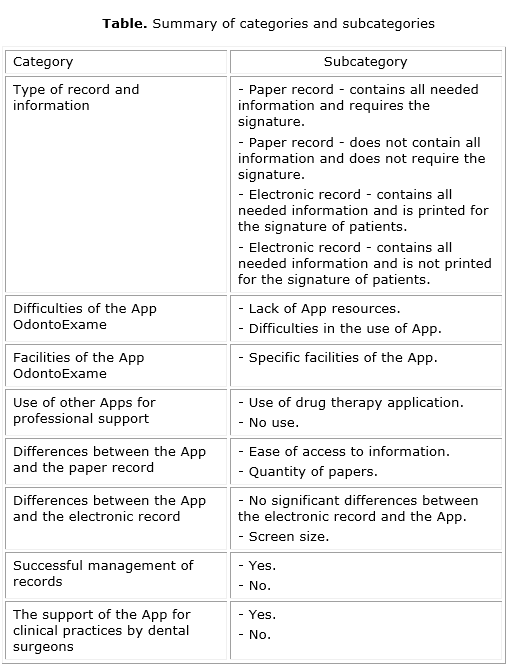
<body><![CDATA[<p align="left"><font face="Verdana, Arial, Helvetica, sans-serif" size="2"> The    exploitation of results was performed as shown in the table. All situations    of records and principles indicated by Bardin<sup>38</sup> regarding the categorization    of answers were considered. Each answer was integrated into its respective group    according to the established categorization criterion and investigation purposes    (<a href="#t1">table</a>). </font></p>     <blockquote>        <p align="center"><img src="/img/revistas/ics/v29n1/t01_1192.gif" width="513" height="672"><a name="t1"></a></p> </blockquote>     <p align="left"> <font face="Verdana, Arial, Helvetica, sans-serif" size="2">Among    interviewed dentists, 40 % of them used paper record, did not fill out all needed    information, and did not require the signature of patients. Furthermore, 10    % of the sample using electronic record did not required the signature despite    registering patient information.  </font><font face="Verdana, Arial, Helvetica, sans-serif" size="2">Such    descriptions corroborate the opinions of some authors,<sup>14,15</sup> who stated    that a part of dental surgeons does not attach sufficient importance to have    a record containing complete and suitable information. Although professionals    seek to finalize the treatment correctly, they have not done the same in their    records. </font></p>     <p align="left"><font face="Verdana, Arial, Helvetica, sans-serif" size="2"> Among    50 % of dental surgeons who stated to record complete patient information including    their signature, 20 and 30 % of them have used paper and electronic records,    respectively. </font><font face="Verdana, Arial, Helvetica, sans-serif" size="2">Such    information corroborate the advantages of electronic records, since the digital    environment contributes as a support tool for organization, management, storage,    capture, and processing of patient information, facilitating decision-making.    Furthermore, the clarity of records, an increase in productivity, data redundancy    elimination, ease of access to available information, a reduction in administrative    costs, and the control and the evaluation of actions were also mentioned, thus    obtaining a complete and consistent information base.<sup>14 </sup>The category    Difficulties in the Use of the App (<a href="#t1">table</a>) is subdivided into    two subcategories: lack of App resources and difficulties in its use. </font></p>     <p align="left"><font face="Verdana, Arial, Helvetica, sans-serif" size="2"> Regarding    the lack of App resources, the lack of options for the following tasks was considered:    paediatric dentistry records, marking of treated teeth in the dental chart,    alert of anamnesis, fields to be filled with essential patient information and    financial statements, besides concern about its safety and legal validity. </font></p>     <p align="left"><font face="Verdana, Arial, Helvetica, sans-serif" size="2"> Although    the App does not include paediatric dentistry, mainly in its dental chart, the    lack of resources detected by dental surgeons partly corroborates the authors    <i>Almeida</i> et al.,<sup>42</sup> who stated that the diversity of the practice    of dentistry in Brazil and the constant advances in dental science have stunted    the production of a static and definitive document. However, the need for writing    a document covering its several segments should be considered.<sup>41</sup>    Thus, the speech of interviewees indicated elements regarding the lack of fields    to be filled with certain data of documents including the number of personal    documents and essential information of patients or their guardians. </font></p>     <p align="left"><font face="Verdana, Arial, Helvetica, sans-serif" size="2"> Screen    size, mentioned by <i>Oliveira</i> et al.<sup>7</sup> and fragility regarding    information safety maintenance, mentioned by <i>Silva</i> et al.<sup>31</sup>    were present in the considerations of respondents. According to <i>Torres</i>    et al.,<sup>33</sup> smaller devices have limited storage capacity and depend    on the use of batteries. Thus, other strategies need to be incorporated for    preventing data loss. The use of systems or cloud computing is an option to    store information or extensive applications, so that collected information can    be sent to a server. Even the device runs out of battery or is misplaced, information    will be assured, representing a great advantage. </font></p>     <p align="left"><font face="Verdana, Arial, Helvetica, sans-serif" size="2"> Although    the proposed App has the option of inserting information as required by professionals,    this resource was considered as a limitation by 30 % of respondents, who reported    a discomfort due to the need for typing patient information case by case. Thus,    for these professionals, the expectation of agility to which such a technology    is proposed was not met by the App. On the other hand, information typing was    considered a facility for 50 % respondents. Among participants, 30 % of them    detected the possibility to save information as PDF files and print them, enabling    paper signatures by patients or professionals as needed, thus becoming a documentation    with legal value. This practice has already been adopted by dentists interviewed    in the present study who have used electronic records. When asked about the    use of other Apps for professional support, drug therapy application was the    most mentioned. </font></p>     <p align="left"><font face="Verdana, Arial, Helvetica, sans-serif" size="2"> Clinical    practices in a dental office often come across doubts and insecurities, mainly    regarding outcomes of decision-making by dental surgeons, considering their    risks and benefits. The annual appearance of new drugs has provided an increase    in the expectation of users concerning the best control and/or treatment of    diseases.<sup>42</sup> </font><font face="Verdana, Arial, Helvetica, sans-serif" size="2">Dental    professionals need to master drug therapy and use it in their patients, emphasizing    possible contraindications in allergic patients, pregnant and breastfeeding    women, or patients with systemic and neurological impairments or requiring special    care.<sup>43</sup> </font></p>     ]]></body>
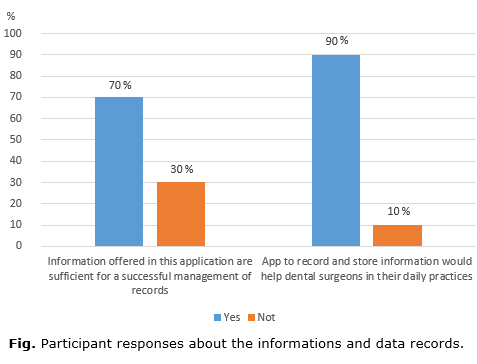
<body><![CDATA[<p align="left"><font face="Verdana, Arial, Helvetica, sans-serif" size="2"> Brazil    is among the largest drug consumers worldwide according to the WHO. <sup>44</sup>    Drugs have influenced the lives of patients and, thus, can lead to benefits    or major damages. The prescription can be the main intervention to be performed    by health professionals for patients, consisting of a personal and dynamic process    subjected to promotional, economic, social, and cultural influences. Then, health    professionals are obliged to keep up to date, since knowledge domain in this    field reduces risks to health.<sup>45 </sup>Finally, in this context, drugs    have technical, economic, political, social and symbolic dimensions. Thus, they    are complex elements in healthcare.<sup>46</sup> </font></p>     <p align="left"><font face="Verdana, Arial, Helvetica, sans-serif" size="2"> The    comparison between the use of the App OdontoExame and paper records by professionals    indicated two subcategories of answers regarding facilities. In the first category    - Ease of access to information - all respondents mentioned typical characteristics    of mobile computing - mobility, speed, remote access, autonomy, independence    of time and location by users, which corroborates the authors <i>Crispin </i>et    al.<sup>47</sup> and ease of its understanding and use, corroborating <i>Oliveira</i>    et al.<sup>48</sup> In addition to these advantages, a better documentation    and ease of data recovery were also reported.<sup>34</sup> </font></p>     <p align="left"><font face="Verdana, Arial, Helvetica, sans-serif" size="2"> Regarding    the category No paper accumulation, only professionals using paper records mentioned    advantages related to gain of time and space. The speech of professionals using    electronic records indicated that they already have such an advantage. </font><font face="Verdana, Arial, Helvetica, sans-serif" size="2">The    comparison between the use of the App OdontoExame and electronic records by    professionals indicated that half of the respondents did not observe significant    differences between both of them. The other half mentioned a lower screen size    than that of computers. </font></p>     <p align="left"><font face="Verdana, Arial, Helvetica, sans-serif" size="2"> When    asked about whether information offered in this application are sufficient for    a successful management of records, 70 % of respondents answered affirmatively    (<a href="#f1">Fig</a>.), some of them remembered useful concepts that they    had learnt and used only in the academic education, although they noticed some    absences. They mentioned the possibility of inserting unavailable information    of their interest. </font></p>     <blockquote>        <p align="center"><img src="/img/revistas/ics/v29n1/f01_1192.jpg" width="477" height="364"><a name="f1"></a></p> </blockquote>     <p align="left"><font face="Verdana, Arial, Helvetica, sans-serif" size="2"> Among    30 % of respondents who did not consider application information sufficient    for a successful management of records, the reasons reported were: precariousness    regarding paediatric dentistry, especially the lack of dental chart for deciduous    teeth; overload of information to be filled in, not always relevant to the clinical    case; and the need for inserting important information that are not available    to be clicked. In dental practices, dental chart is intended for recording all    particularities and procedures presented by patients.<sup>48</sup> Its use allows    dental surgeons to remember the work to be done, the work performed, and information    exchanges among professionals. It consists of a tool for human identification,    enabling the comparison between the current and the previous oral condition.    Thus, dental chart is a document of fundamental importance and should often    be updated.<sup>49</sup> </font></p>     <p align="left"><font face="Verdana, Arial, Helvetica, sans-serif" size="2"> When    asked about whether the use of an App to record and store information would    help dental surgeons in their daily practices, 90 % of respondents answered    affirmatively (<a href="#f1">Fig.</a>). Although younger interviewees showed    greater enthusiasm and familiarity with the App technology, older respondents    demonstrated ability to adapt to changes in the way of working towards technology    regardless of their affinity. Such results corroborate the quarterly report    of the Centre for Studies on Information Technologies and Communication in Brazil    named &#8220;The Sector Overview of the Internet&#8221;, which stated that the    use of Information Technologies and Communication (ITC) leads to remarkable    effects in healthcare in several sectors of society, mainly regarding the quality    of citizen services, the insightful use of available information, and the efficiency    in managing healthcare institutions.<sup>50</sup> </font></p>     <p> </p>     <p>&nbsp;</p>     ]]></body>
<body><![CDATA[<p><font face="Verdana, Arial, Helvetica, sans-serif" size="2"><font size="3"><b>CONCLUSION    </b></font></font></p>     <p align="left"><font face="Verdana, Arial, Helvetica, sans-serif" size="2"> The    respondents detected advantages in inserting mobile computing in their routine.    Although such dental surgeons have noticed failures, difficulties and some expectations    not met by the App at times, these professionals showed a positive view and    sought solutions for limitations making it possible to obtain an affirmative    answer to the question: how do dental surgeon observe the utility of an application    to record and store patient information in their daily routine? The main contribution    of this study was to show the opinion of professionals on the current technological    level of m-Health in the field of dentistry regarding the record of patient    information. Although this study has been carried out with a small group of    dental surgeons, obtained opinions are probably common to professionals using    such a technology. The present study contributed for a reflection on the use    of mobile applications in daily practices, besides providing ideas for the improvement    of applications to the dental office. </font></p>     <p align="left">&nbsp; </p>     <p align="left"><font face="Verdana, Arial, Helvetica, sans-serif" size="2"><b>Participation    of the authors</b> </font></p>     <p align="left"> <font face="Verdana, Arial, Helvetica, sans-serif" size="2"><i>Aglae    R. Tavares</i> , <i>Anne M. Caetano</i>, <i>Sonia F. M. de Assis</i> and <i>Lara    J. Motta</i>, designed the study, analyzed the data and they wrote the first    version of the manuscript. <i>Aglae R. Tavares</i> was involved in the collection,    processing of the data and <i>Lara J. Motta</i> was involved in statistical    analysis of the data. All authors reviewed the writing of the manuscript and    approved the version finally remitted. </font></p>     <p align="left"> <font face="Verdana, Arial, Helvetica, sans-serif" size="2"><b>Conflict    of interests</b> </font></p>     <p align="left"><font face="Verdana, Arial, Helvetica, sans-serif" size="2"> The    authors declare that there is no conflict of interest in this article </font></p>     <p>&nbsp; </p>     <p> <font face="Verdana, Arial, Helvetica, sans-serif" size="2"><b><font size="3">BIBLIOGRAPHIC    REFERENCES</font></b> </font></p>     <!-- ref --><p><font face="Verdana, Arial, Helvetica, sans-serif" size="2"> 1. Forte M, Souza    WL, do Prado AF. Utilizando Dispositivos M&#243;veis no Suporte ao Ensino de    Medicina: Desafios e Propostas. XII Congresso Brasileiro de Inform&#225;tica    em Sa&#250;de; 2011.     </font></p>     <!-- ref --><p><font face="Verdana, Arial, Helvetica, sans-serif" size="2"> 2. Silva LLB,    Pires DF, Neto SC. Desenvolvimento de aplica&#231;&#245;es para dispositivos    m&#243;veis: tipos e exemplo de aplica&#231;&#227;o na plataforma IOS. Franca/SP;    2015.     </font></p>     <!-- ref --><p><font face="Verdana, Arial, Helvetica, sans-serif" size="2"> 3. Souza RCD,    Alves LAC, Haddad AE, Macedo MCS, Ciamponi,AL. Processo de cria&#231;&#227;o    de um aplicativo m&#243;vel na &#225;rea de odontologia para pacientes com necessidades    especiais. Rev ABENO. 2013;13(2):58-61.     </font></p>     <!-- ref --><p><font face="Verdana, Arial, Helvetica, sans-serif" size="2"> 4. Tibes CMDS,    Dias JD, Zem-Mascarenhas SH. Aplicativos m&#243;veis desenvolvidos para a &#225;rea    da sa&#250;de no Brasil: revis&#227;o integrativa da literatura. Rev Mineira    Enfermagem. 2014;18(2):471-86.     </font></p>     <!-- ref --><p><font face="Verdana, Arial, Helvetica, sans-serif" size="2"> 5. Silva BMC.    Performance Evaluation of Cooperation Strategies for m-Health Services and Applications.    Covilh&#227;, Portugal: Tese de Doutorado. Universidade Beira Interior; 2015    [cited February 15 2017]. Available at: <a href="http://ubibliorum.ubi.pt/handle/10400.6/4040" target="_blank">    http://ubibliorum.ubi.pt/handle/10400.6/4040 </a> </font><!-- ref --><p><font face="Verdana, Arial, Helvetica, sans-serif" size="2"> 6. Kairy D, Lehoux    P, Vincent C. Exploring routine use of telemedicine through a case study in    rehabilitation. Revista Panamericana de Salud P&#250;blica. 2014;35(5-6):337-44.        </font></p>     ]]></body>
<body><![CDATA[<!-- ref --><p><font face="Verdana, Arial, Helvetica, sans-serif" size="2"> 7. de Oliveira    TR, da Costa FMR. Desenvolvimento de aplicativo m&#243;vel de refer&#234;ncia    sobre vacina&#231;&#227;o no Brasil. J Health Inform. 2012;4(1):23-7.     </font></p>     <!-- ref --><p><font face="Verdana, Arial, Helvetica, sans-serif" size="2"> 8. Pinochet LHC,    de Souza Lopes A, Silva JS. Inova&#231;&#245;es e tend&#234;ncias aplicadas    nas tecnologias de informa&#231;&#227;o e comunica&#231;&#227;o na gest&#227;o    da sa&#250;de/innovations and trends in applied information and communication    technologies in health management. Rev Gest&#227;o Sist Sa&#250;de. 2014;3(2):11-29.        </font></p>     <!-- ref --><p><font face="Verdana, Arial, Helvetica, sans-serif" size="2"> 9. Shiferaw F,    Zolfo M. The role of information communication technology (ICT) towards universal    health coverage: the first steps of a telemedicine project in Ethiopia. Glob    Health act. 2012; 5(1):15638.     </font></p>     <!-- ref --><p><font face="Verdana, Arial, Helvetica, sans-serif" size="2"> 10. Mart&#237;nez-P&#233;rez    B, De La Torre-D&#237;ez I, L&#243;pez-Coronado M. Mobile health applications    for the most prevalent conditions by the World Health Organization: review and    analysis. J Med Internet res. 2013 [cited February 15 2017] :15(6). Available    at: <a href="https://www.ncbi.nlm.nih.gov/pmc/articles/PMC3713954/" target="_blank">https://www.ncbi.nlm.nih.gov/pmc/articles/PMC3713954/</a>    </font><!-- ref --><p><font face="Verdana, Arial, Helvetica, sans-serif" size="2"> 11. da Silva M.    Documenta&#231;&#227;o em Odontologia e sua import&#226;ncia jur&#237;dica.    Odontologia e Sociedade. 1999;1(1/2):1-3.     </font></p>     <!-- ref --><p><font face="Verdana, Arial, Helvetica, sans-serif" size="2"> 12. de Oliveira    RS, dos Santos JC, da Silva GS. Sistema de Prontu&#225;rio M&#233;dico Eletr&#244;nico    Via Android para Dispositivos M&#243;veis. Engenh Comput Rev. 2013;1(1):5.     </font></p>     <!-- ref --><p><font face="Verdana, Arial, Helvetica, sans-serif" size="2"> 13. Fernandes    RCD. Quantitativo de publica&#231;&#245;es cientificas contemplando a import&#226;ncia    do adequado preenchimento, guarda e conserva&#231;&#227;o de prontu&#225;rios    odontol&#243;gicos nos anos 2013 e 2014. Trabalho de Conclus&#227;o de Curso.    Araruna, PB, Brasil: Universidade Estadual da Para&#237;ba; 2015 [citado 26    de agosto de 2016]. <a href="Disponible%20en:%20http://dspace.bc.uepb.edu.br/jspui/handle/123456789/8082" target="_blank">Disponible    en: http://dspace.bc.uepb.edu.br/jspui/handle/123456789/8082</a> </font><!-- ref --><p><font face="Verdana, Arial, Helvetica, sans-serif" size="2"> 14. de Novaes    Benedicto E, Lages LHR, de Oliveira OF, da Silva RHA, Paranhos LR. A import&#226;ncia    da correta elabora&#231;&#227;o do prontu&#225;rio odontol&#243;gico. Odonto.    2010;18(36):41-50.     </font></p>     <!-- ref --><p><font face="Verdana, Arial, Helvetica, sans-serif" size="2"> 15. Gomes H, de    Lima Gouveia EM, dos Santos SR, Lopes MEL. Auditoria em registros de enfermagem:    revis&#227;o integrativa da literatura [Audit in nursing records: integrative    review in the literature]. Rev Enferm UERJ. 2013;21(3):397-402.     </font></p>     <!-- ref --><p><font face="Verdana, Arial, Helvetica, sans-serif" size="2"> 16. Cowie MR,    Bax J, Bruining N, Cleland JG, Koehler F, Malik M, Vardas P. e-Health: a position    statement of the European Society of Cardiology. Eur Heart J. 2016;37(1):63-6.        </font></p>     <!-- ref --><p><font face="Verdana, Arial, Helvetica, sans-serif" size="2"> 17. Ventola CL.    Mobile devices and Apps for health care professionals: uses and benefits. Pharm    Therap. 2014;39(5):356-64.     </font></p>     ]]></body>
<body><![CDATA[<!-- ref --><p><font face="Verdana, Arial, Helvetica, sans-serif" size="2"> 18. Aardoom JJ,    Dingemans AE, Van Furth EF. E-Health Interventions for Eating Disorders: Emerging    Findings, Issues, and Opportunities. Curr Psych Reports. 2016;18(4):1-8.     </font></p>     <!-- ref --><p><font face="Verdana, Arial, Helvetica, sans-serif" size="2"> 19. Pires DEPD,    Bertoncini JH, S&#225;vio B, Trindade LDL, Matos E, Azambuja E. Inova&#231;&#227;o    tecnol&#243;gica e cargas de trabalho dos profissionais de sa&#250;de: revis&#227;o    da literatura latino-americana. Rev Eletr&#244;n Enfermagem. 2010;12(2):373-9.        </font></p>     <!-- ref --><p><font face="Verdana, Arial, Helvetica, sans-serif" size="2"> 20. Salvador PTCDO,    Oliveira RKMD, Costa TDD, Santos VEP, Tourinho FSV. Tecnologia e inova&#231;&#227;o    para o cuidado em enfermagem. Rev Enfermagem UERJ. 2012;20(1):111-7.     </font></p>     <!-- ref --><p><font face="Verdana, Arial, Helvetica, sans-serif" size="2"> 21. Lorenzetti    J, Trindade LL, Pires E, Ramos SFR. Tecnologia, inova&#231;&#227;o tecnol&#243;gica    e sa&#250;de: uma reflex&#227;o necess&#225;ria, Text Contex Enferm. 2012;21(2):432-9.        </font></p>     <!-- ref --><p><font face="Verdana, Arial, Helvetica, sans-serif" size="2"> 22. Cardoso LDC.    A import&#226;ncia do conhecimento te&#243;rico dos designers digitais, no desenvolvimento    de interfaces em aplicativos para smartphones relacionados ao monitoramento    da sa&#250;de card&#237;aca do usu&#225;rio. Disserta&#231;&#227;o de Mestrado.    S&#227;o Paulo, SP, Brasil: Pontif&#237;cia Universidade Cat&#243;lica de S&#227;o    Paulo. 2016 [citado 19 de abril de 2017]. Disponible en: <a href="https://tede.pucsp.br/handle/handle/18209" target="_blank">    https://tede.pucsp.br/handle/handle/18209 </a> </font><!-- ref --><p><font face="Verdana, Arial, Helvetica, sans-serif" size="2"> 23. Moura A. Gera&#231;&#227;o    m&#243;vel: um ambiente de aprendizagem suportado por tecnologias m&#243;veis    para a &#8220;Gera&#231;&#227;o Polegar". Ed. Universidade do Minho; 2009.     </font></p>     <!-- ref --><p><font face="Verdana, Arial, Helvetica, sans-serif" size="2"> 24. Piropo TGN,    Amaral HOS. Telessa&#250;de, contextos e implica&#231;&#245;es no cen&#225;rio    baiano. Sa&#250;de Deb. 2015;39(104):279-87.     </font></p>     <!-- ref --><p><font face="Verdana, Arial, Helvetica, sans-serif" size="2"> 25. Lopes JE,    Heimann C. Uso das tecnologias da informa&#231;&#227;o e comunica&#231;&#227;o    nas a&#231;&#245;es m&#233;dicas a dist&#226;ncia: um caminho promissor a ser    investido na sa&#250;de. J Health Inform. 2016;8(1):26-30.     </font></p>     <!-- ref --><p><font face="Verdana, Arial, Helvetica, sans-serif" size="2"> 26. Schmitt LEA,    Triska R. Informa&#231;&#227;o na &#225;rea da sa&#250;de em tempos de comunica&#231;&#227;o    m&#243;vel, big data e computa&#231;&#227;o cognitiva. Raz Palab. 2014 [citado    26 de agosto de 2016];18(88). Disponible en: <a href="http://www.redalyc.org/articulo.oa?id=199532731028" target="_blank">http://www.redalyc.org/articulo.oa?id=199532731028</a>    </font><!-- ref --><p><font face="Verdana, Arial, Helvetica, sans-serif" size="2"> 27. Semedo EG.    Avalia&#231;&#227;o da Usabilidade de um Projeto de eHealth, enquadrado na vis&#227;o    europeia de Health Technology Assessment (HTA) [dissertation]. Brasil: Escola    Superior de Comunica&#231;&#227;o Social; 2015.     </font></p>     <!-- ref --><p><font face="Verdana, Arial, Helvetica, sans-serif" size="2"> 28. Chou CF, Bullard    KM, Saaddine JB, Devlin HM, Crews J, Imperatore G, McDivit J, Albright A. Utilization    of e-health services among US adults with diabetes. J Diab Care. 2015;38(12):200-1.        </font></p>     ]]></body>
<body><![CDATA[<!-- ref --><p><font face="Verdana, Arial, Helvetica, sans-serif" size="2"> 30. Nunes K. Aplicativo    para acompanhamento de ocorr&#234;ncias do paciente fora do estabelecimento    de sa&#250;de. Monografia de Especializa&#231;&#227;o. Curitiba, PR. Brasil:    Universidade Tecnol&#243;gica Federal do Paran&#225;; 2014.     </font></p>     <!-- ref --><p><font face="Verdana, Arial, Helvetica, sans-serif" size="2"> 30. Gagnon MP,    Ngangue P, Payne-Gagnon J, Desmartis M. m-Health adoption by healthcare professionals:    a systematic review. J Am Med Inform Assoc. 2016;23(1):212-20.     </font></p>     <!-- ref --><p><font face="Verdana, Arial, Helvetica, sans-serif" size="2"> 31. Silva DAS,    Pereira MMO, Ferreira MC. Terceira idade e tecnologia: um estudo sobre a utiliza&#231;&#227;o    da Internet e do com&#233;rcio eletr&#244;nico. Rev Brasi Gest&#227;o Engenharia.    2015b;(12):61-87.     </font></p>     <!-- ref --><p><font face="Verdana, Arial, Helvetica, sans-serif" size="2"> 32. Marin HF.    Sistemas de informa&#231;&#227;o em sa&#250;de: considera&#231;&#245;es gerais.    J Health Inform. 2010;2(1):20-4.     </font></p>     <!-- ref --><p><font face="Verdana, Arial, Helvetica, sans-serif" size="2"> 33. Torres AAL,    Campos V. Evernote como ferramenta de organiza&#231;&#227;o de informa&#231;&#245;es    em sa&#250;de. Gest&#227;o e Sa&#250;de. 2014;5(2):501-13.     </font></p>     ]]></body>
<body><![CDATA[<!-- ref --><p><font face="Verdana, Arial, Helvetica, sans-serif" size="2"> 34. Paz LF, Maran    V, Machado A, Weber JG. Mobidoctor: uma aplica&#231;&#227;o m&#243;vel para    acesso ao registro eletr&#244;nico de sa&#250;de de pacientes. Rev Bras Inov    Tecnol&#243;g Sa&#250;de. 2013;3(1):37-51.     </font></p>     <!-- ref --><p><font face="Verdana, Arial, Helvetica, sans-serif" size="2"> 35. Pinheiro CCBV,    Carvalho MJ, Carvalho FL. Tecnologias em educa&#231;&#227;o e sa&#250;de: papel    na promo&#231;&#227;o de sa&#250;de bucal. Anais do Semin&#225;rio Tecnologias    Aplicadas a Educa&#231;&#227;o em Sa&#250;de da Universidade Estadual da Bahia,    29-30 October, Salvador, Bahia, Brasil; 2015.     </font></p>     <!-- ref --><p><font face="Verdana, Arial, Helvetica, sans-serif" size="2"> 36. Dhuvad JM,    Dhuvad MM, Kshirsagar RA. Have smartphones contributed in the clinical progress    of oral and maxillofacial surgery? J Clin Diagnost Res. 2015;9(9):ZC22-ZC24.        </font></p>     <!-- ref --><p><font face="Verdana, Arial, Helvetica, sans-serif" size="2"> 37. Rodrigues    JF, Xavier JCB, Adriano AL. A tecnologia da informa&#231;&#227;o na &#225;rea    hospitalar: um caso de implementa&#231;&#227;o de um sistema de registro de    pacientes. Rev Administ Contemp. 2001;5(1):105-20.     </font></p>     <!-- ref --><p><font face="Verdana, Arial, Helvetica, sans-serif" size="2"> 38. Bardin L.    An&#225;lise do Conte&#250;do. Lisboa: LDA; 2000.     </font></p>     ]]></body>
<body><![CDATA[<!-- ref --><p><font face="Verdana, Arial, Helvetica, sans-serif" size="2"> 39. Minayo MCS.    O Desafio do Conhecimento: Pesquisa Qualitativa em Sa&#250;de. Brasil: Hucitec;    2000.     </font></p>     <!-- ref --><p><font face="Verdana, Arial, Helvetica, sans-serif" size="2"> 40. Gambi EMF,    Ferreira JBB, Galv&#227;o MCB. A transi&#231;&#227;o do prontu&#225;rio do paciente    em suporte papel para o prontu&#225;rio eletr&#244;nico do paciente e seu impacto    para os profissionais de um arquivo de institui&#231;&#227;o de sa&#250;de.    Rev Eletr&#244;n Comunic, Inform Inova&#231; em Sa&#250;de. 2013 [citado 19    de abril de 2017];7(2). Disponible en: <a href="http://www.reciis.icict.fiocruz.br/index.php/reciis/article/view/455" target="_blank">http://www.reciis.icict.fiocruz.br/index.php/reciis/article/view/455</a>    </font><!-- ref --><p><font face="Verdana, Arial, Helvetica, sans-serif" size="2"> 41. Almeida CAP,    Zimmermann RD, Cerveira JGV, Julivaldo FSN. Prontu&#225;rio odontol&#243;gico    - uma orienta&#231;&#227;o para o cumprimento da exig&#234;ncia contida no inciso    VIII do art. 5&#186; do C&#243;digo de &#201;tica Odontol&#243;gica. Rio de    Janeiro, Brasil: Relat&#243;rio Final apresentado ao Conselho Federal de Odontologia    pela Comiss&#227;o Especial institu&#237;da pela Portaria CFO-SEC-26, de 24    de julho de 2002; 2004.     </font></p>     <!-- ref --><p><font face="Verdana, Arial, Helvetica, sans-serif" size="2"> 42. Ara&#250;jo    LG, de Biagini FC, Fernandes RL, Caputo IGC, Silva RHA. Conhecimento de acad&#234;micos    de odontologia sobre os aspectos cl&#237;nicos, &#233;ticos e legais da prescri&#231;&#227;o    medicamentosa. Rev Faculd Odontol. 2012;17(1):50-4.     </font></p>     <!-- ref --><p><font face="Verdana, Arial, Helvetica, sans-serif" size="2"> 43. Costa SANL,    Castro RD, Oliveira JA, Cardoso ANS. Prescri&#231;&#227;o medicamentosa: an&#225;lise    sobre o conhecimento dos futuros cirurgi&#245;es-dentistas. Rev Bras Odontol.    2013;70(2):172-7.     </font></p>     <!-- ref --><p><font face="Verdana, Arial, Helvetica, sans-serif" size="2"> 44. Rocha ALR.    Uso Racional de Medicamentos. Monografia de Especializa&#231;&#227;o, Funda&#231;&#227;o    Osvaldo Cruz. Rio de Janeiro, RJ, Brasil: Instituto de Farmacologia em F&#225;rmacos;    2014.     </font></p>     <!-- ref --><p><font face="Verdana, Arial, Helvetica, sans-serif" size="2"> 45. Jain A, Gupta    D, Singh D, Garg Y, Saxena A, Chaudhary H, Singh A, Gupta RK. Knowledge regarding    prescription of drugs among dental students: a descriptive study. J Bas Clin    Pharm. 2015;7(1):12-6.     </font></p>     <!-- ref --><p><font face="Verdana, Arial, Helvetica, sans-serif" size="2"> 46. Alencar TOS,    Alencar BR, Silva DS, Ara&#250;jo JSC, Oliveira SM, Souza RD. Promo&#231;&#227;o    do uso racional de medicamentos: uma experi&#234;ncia na estrat&#233;gia de    sa&#250;de da familia. Rev Bras Prom Sa&#250;de. 2014;27(4):575-82.     </font></p>     <p><font face="Verdana, Arial, Helvetica, sans-serif" size="2"> 47. Crispin Jr    FC, Fernandes AMR. Uma solu&#231;&#227;o em software livre para PEP na &#225;rea    da computa&#231;&#227;o m&#243;vel. Proceedings of the 1<sup>st</sup>. Interdisciplinary    Workshop on Communication for Sustainable Communities. S&#227;o Carlos-S&#227;o    Paulo, Brazil: 27-29 September, 2013. </font></p>     <!-- ref --><p><font face="Verdana, Arial, Helvetica, sans-serif" size="2"> 48. Oliveira DL,    Yarid SD. Prontu&#225;rio odontol&#243;gico sob a &#243;tica de discentes de    Odontologia. Rev Odontol UNESP. 2014;43(3):158-64.     </font></p>     <!-- ref --><p><font face="Verdana, Arial, Helvetica, sans-serif" size="2"> 49. Lugo AJD,    &#193;vila AES, Guti&#233;rrez MPV, Montenegro EJM. Creaci&#243;n de un odontograma    con aplicaciones Web. Rev Iberoam Cienc Computac Inform. 2016;5(10):20-32.     </font></p>     ]]></body>
<body><![CDATA[<!-- ref --><p><font face="Verdana, Arial, Helvetica, sans-serif" size="2"> 50. Barbosa AF,    Bittencourt A, Garroux C, Santos E, Gomes E, Senne F, Coelho I, Mesquita L,    Ribeiro M, Ouriveis M, Sozio ME, Albino R, Alves SJ, Jereissat T, Henriques    V, Oyadomary W. Panorama intersetorial da Internet. TIC no setor sa&#250;de:    disponibilidade e uso das tecnologias de informa&#231;&#227;o e comunica&#231;&#227;o    em estabelecimentos de sa&#250;de brasileiros. Tecnol Sa&#250;de. 2014;(1):1-5.        </font></p>     <p>&nbsp;</p>     <p>&nbsp;</p>     <p><font face="Verdana, Arial, Helvetica, sans-serif" size="2">Recibido: 5 de    diciembre de 2017.    <br>   Aprobado: 19 de febrero de 2018.</font></p>     <p>&nbsp;</p>     <p>&nbsp;</p>      ]]></body><back>
<ref-list>
<ref id="B1">
<label>1</label><nlm-citation citation-type="confpro">
<person-group person-group-type="author">
<name>
<surname><![CDATA[Forte]]></surname>
<given-names><![CDATA[M]]></given-names>
</name>
<name>
<surname><![CDATA[Souza]]></surname>
<given-names><![CDATA[WL]]></given-names>
</name>
<name>
<surname><![CDATA[do Prado]]></surname>
<given-names><![CDATA[AF]]></given-names>
</name>
</person-group>
<source><![CDATA[Utilizando Dispositivos Móveis no Suporte ao Ensino de Medicina: Desafios e Propostas]]></source>
<year>2011</year>
<conf-name><![CDATA[XII Congresso Brasileiro de Informática em Saúde]]></conf-name>
<conf-loc> </conf-loc>
</nlm-citation>
</ref>
<ref id="B2">
<label>2</label><nlm-citation citation-type="">
<person-group person-group-type="author">
<name>
<surname><![CDATA[Silva]]></surname>
<given-names><![CDATA[LLB]]></given-names>
</name>
<name>
<surname><![CDATA[Pires]]></surname>
<given-names><![CDATA[DF]]></given-names>
</name>
<name>
<surname><![CDATA[Neto]]></surname>
<given-names><![CDATA[SC]]></given-names>
</name>
</person-group>
<source><![CDATA[Desenvolvimento de aplicações para dispositivos móveis: tipos e exemplo de aplicação na plataforma IOS]]></source>
<year>2015</year>
<publisher-loc><![CDATA[^eSP SP]]></publisher-loc>
</nlm-citation>
</ref>
<ref id="B3">
<label>3</label><nlm-citation citation-type="journal">
<person-group person-group-type="author">
<name>
<surname><![CDATA[Souza]]></surname>
<given-names><![CDATA[RCD]]></given-names>
</name>
<name>
<surname><![CDATA[Alves]]></surname>
<given-names><![CDATA[LAC]]></given-names>
</name>
<name>
<surname><![CDATA[Haddad]]></surname>
<given-names><![CDATA[AE]]></given-names>
</name>
<name>
<surname><![CDATA[Macedo]]></surname>
<given-names><![CDATA[MCS]]></given-names>
</name>
<name>
<surname><![CDATA[Ciamponi]]></surname>
<given-names><![CDATA[AL]]></given-names>
</name>
</person-group>
<article-title xml:lang="pt"><![CDATA[Processo de criação de um aplicativo móvel na área de odontologia para pacientes com necessidades especiais]]></article-title>
<source><![CDATA[Rev ABENO]]></source>
<year>2013</year>
<volume>13</volume>
<numero>2</numero>
<issue>2</issue>
<page-range>58-61</page-range></nlm-citation>
</ref>
<ref id="B4">
<label>4</label><nlm-citation citation-type="journal">
<person-group person-group-type="author">
<name>
<surname><![CDATA[Tibes]]></surname>
<given-names><![CDATA[CMDS]]></given-names>
</name>
<name>
<surname><![CDATA[Dias]]></surname>
<given-names><![CDATA[JD]]></given-names>
</name>
<name>
<surname><![CDATA[Zem-Mascarenhas]]></surname>
<given-names><![CDATA[SH]]></given-names>
</name>
</person-group>
<article-title xml:lang="pt"><![CDATA[Aplicativos móveis desenvolvidos para a área da saúde no Brasil: revisão integrativa da literatura]]></article-title>
<source><![CDATA[Rev Mineira Enfermagem]]></source>
<year>2014</year>
<volume>18</volume>
<numero>2</numero>
<issue>2</issue>
<page-range>471-86</page-range></nlm-citation>
</ref>
<ref id="B5">
<label>5</label><nlm-citation citation-type="book">
<person-group person-group-type="author">
<name>
<surname><![CDATA[Silva]]></surname>
<given-names><![CDATA[BMC]]></given-names>
</name>
</person-group>
<source><![CDATA[Performance Evaluation of Cooperation Strategies for m-Health Services and Applications]]></source>
<year>2015</year>
<publisher-loc><![CDATA[^eCovilhã Covilhã]]></publisher-loc>
<publisher-name><![CDATA[Universidade Beira Interior]]></publisher-name>
</nlm-citation>
</ref>
<ref id="B6">
<label>6</label><nlm-citation citation-type="journal">
<person-group person-group-type="author">
<name>
<surname><![CDATA[Kairy]]></surname>
<given-names><![CDATA[D]]></given-names>
</name>
<name>
<surname><![CDATA[Lehoux]]></surname>
<given-names><![CDATA[P]]></given-names>
</name>
<name>
<surname><![CDATA[Vincent]]></surname>
<given-names><![CDATA[C]]></given-names>
</name>
</person-group>
<article-title xml:lang="en"><![CDATA[Exploring routine use of telemedicine through a case study in rehabilitation]]></article-title>
<source><![CDATA[Revista Panamericana de Salud Pública]]></source>
<year>2014</year>
<volume>35</volume>
<numero>5-6</numero>
<issue>5-6</issue>
<page-range>337-44</page-range></nlm-citation>
</ref>
<ref id="B7">
<label>7</label><nlm-citation citation-type="journal">
<person-group person-group-type="author">
<name>
<surname><![CDATA[de Oliveira]]></surname>
<given-names><![CDATA[TR]]></given-names>
</name>
<name>
<surname><![CDATA[da Costa]]></surname>
<given-names><![CDATA[FMR]]></given-names>
</name>
</person-group>
<article-title xml:lang="pt"><![CDATA[Desenvolvimento de aplicativo móvel de referência sobre vacinação no Brasil]]></article-title>
<source><![CDATA[J Health Inform]]></source>
<year>2012</year>
<volume>4</volume>
<numero>1</numero>
<issue>1</issue>
<page-range>23-7</page-range></nlm-citation>
</ref>
<ref id="B8">
<label>8</label><nlm-citation citation-type="journal">
<person-group person-group-type="author">
<name>
<surname><![CDATA[Pinochet]]></surname>
<given-names><![CDATA[LHC]]></given-names>
</name>
<name>
<surname><![CDATA[de Souza Lopes]]></surname>
<given-names><![CDATA[A]]></given-names>
</name>
<name>
<surname><![CDATA[Silva]]></surname>
<given-names><![CDATA[JS]]></given-names>
</name>
</person-group>
<article-title xml:lang="pt"><![CDATA[Inovações e tendências aplicadas nas tecnologias de informação e comunicação na gestão da saúde/innovations and trends in applied information and communication technologies in health management]]></article-title>
<source><![CDATA[Rev Gestão Sist Saúde]]></source>
<year>2014</year>
<volume>3</volume>
<numero>2</numero>
<issue>2</issue>
<page-range>11-29</page-range></nlm-citation>
</ref>
<ref id="B9">
<label>9</label><nlm-citation citation-type="journal">
<person-group person-group-type="author">
<name>
<surname><![CDATA[Shiferaw]]></surname>
<given-names><![CDATA[F]]></given-names>
</name>
<name>
<surname><![CDATA[Zolfo]]></surname>
<given-names><![CDATA[M]]></given-names>
</name>
</person-group>
<article-title xml:lang="en"><![CDATA[The role of information communication technology (ICT) towards universal health coverage: the first steps of a telemedicine project in Ethiopia]]></article-title>
<source><![CDATA[Glob Health act]]></source>
<year>2012</year>
<volume>5</volume>
<numero>1</numero>
<issue>1</issue>
<page-range>15638</page-range></nlm-citation>
</ref>
<ref id="B10">
<label>10</label><nlm-citation citation-type="journal">
<person-group person-group-type="author">
<name>
<surname><![CDATA[Martínez-Pérez]]></surname>
<given-names><![CDATA[B]]></given-names>
</name>
<name>
<surname><![CDATA[De La Torre-Díez]]></surname>
<given-names><![CDATA[I]]></given-names>
</name>
<name>
<surname><![CDATA[López Coronado]]></surname>
<given-names><![CDATA[M]]></given-names>
</name>
</person-group>
<article-title xml:lang="en"><![CDATA[Mobile health applications for the most prevalent conditions by the World Health Organization: review and analysis]]></article-title>
<source><![CDATA[J Med]]></source>
<year>2013</year>
<volume>15</volume>
<numero>6</numero>
<issue>6</issue>
</nlm-citation>
</ref>
<ref id="B11">
<label>11</label><nlm-citation citation-type="journal">
<person-group person-group-type="author">
<name>
<surname><![CDATA[da Silva]]></surname>
<given-names><![CDATA[M]]></given-names>
</name>
</person-group>
<article-title xml:lang="pt"><![CDATA[Documentação em Odontologia e sua importância jurídica]]></article-title>
<source><![CDATA[Odontologia e Sociedade]]></source>
<year>1999</year>
<volume>1</volume>
<numero>1/2</numero>
<issue>1/2</issue>
<page-range>1-3</page-range></nlm-citation>
</ref>
<ref id="B12">
<label>12</label><nlm-citation citation-type="journal">
<person-group person-group-type="author">
<name>
<surname><![CDATA[de Oliveira]]></surname>
<given-names><![CDATA[RS]]></given-names>
</name>
<name>
<surname><![CDATA[dos Santos]]></surname>
<given-names><![CDATA[JC]]></given-names>
</name>
<name>
<surname><![CDATA[da Silva]]></surname>
<given-names><![CDATA[GS]]></given-names>
</name>
</person-group>
<article-title xml:lang="pt"><![CDATA[Sistema de Prontuário Médico Eletrônico Via Android para Dispositivos Móveis]]></article-title>
<source><![CDATA[Engenh Comput Rev]]></source>
<year>2013</year>
<volume>1</volume>
<numero>1</numero>
<issue>1</issue>
<page-range>5</page-range></nlm-citation>
</ref>
<ref id="B13">
<label>13</label><nlm-citation citation-type="book">
<person-group person-group-type="author">
<name>
<surname><![CDATA[Fernandes]]></surname>
<given-names><![CDATA[RCD]]></given-names>
</name>
</person-group>
<source><![CDATA[Quantitativo de publicações cientificas contemplando a importância do adequado preenchimento, guarda e conservação de prontuários odontológicos nos anos 2013 e 2014 Trabalho de Conclusão de Curso]]></source>
<year>2015</year>
<publisher-loc><![CDATA[^eAraruna, PB Araruna, PB]]></publisher-loc>
<publisher-name><![CDATA[Universidade Estadual da Paraíba]]></publisher-name>
</nlm-citation>
</ref>
<ref id="B14">
<label>14</label><nlm-citation citation-type="journal">
<person-group person-group-type="author">
<name>
<surname><![CDATA[de Novaes Benedicto]]></surname>
<given-names><![CDATA[E]]></given-names>
</name>
<name>
<surname><![CDATA[Lages]]></surname>
<given-names><![CDATA[LHR]]></given-names>
</name>
<name>
<surname><![CDATA[de Oliveira]]></surname>
<given-names><![CDATA[OF]]></given-names>
</name>
<name>
<surname><![CDATA[da Silva]]></surname>
<given-names><![CDATA[RHA]]></given-names>
</name>
<name>
<surname><![CDATA[Paranhos]]></surname>
<given-names><![CDATA[LR]]></given-names>
</name>
</person-group>
<article-title xml:lang="pt"><![CDATA[A importância da correta elaboração do prontuário odontológico]]></article-title>
<source><![CDATA[Odonto]]></source>
<year>2010</year>
<volume>18</volume>
<numero>36</numero>
<issue>36</issue>
<page-range>41-50</page-range></nlm-citation>
</ref>
<ref id="B15">
<label>15</label><nlm-citation citation-type="journal">
<person-group person-group-type="author">
<name>
<surname><![CDATA[Gomes]]></surname>
<given-names><![CDATA[H]]></given-names>
</name>
<name>
<surname><![CDATA[de Lima Gouveia]]></surname>
<given-names><![CDATA[EM]]></given-names>
</name>
<name>
<surname><![CDATA[dos Santos]]></surname>
<given-names><![CDATA[SR]]></given-names>
</name>
<name>
<surname><![CDATA[Lopes]]></surname>
<given-names><![CDATA[MEL]]></given-names>
</name>
</person-group>
<article-title xml:lang="pt"><![CDATA[Auditoria em registros de enfermagem: revisão integrativa da literatura [Audit in nursing records: integrative review in the literature]. Rev Enferm]]></article-title>
<source><![CDATA[UERJ]]></source>
<year>2013</year>
<volume>21</volume>
<numero>3</numero>
<issue>3</issue>
<page-range>397-402</page-range></nlm-citation>
</ref>
<ref id="B16">
<label>16</label><nlm-citation citation-type="journal">
<person-group person-group-type="author">
<name>
<surname><![CDATA[Cowie]]></surname>
<given-names><![CDATA[MR]]></given-names>
</name>
<name>
<surname><![CDATA[Bax]]></surname>
<given-names><![CDATA[J]]></given-names>
</name>
<name>
<surname><![CDATA[Bruining]]></surname>
<given-names><![CDATA[N]]></given-names>
</name>
<name>
<surname><![CDATA[Cleland]]></surname>
<given-names><![CDATA[JG]]></given-names>
</name>
<name>
<surname><![CDATA[Koehler]]></surname>
<given-names><![CDATA[F]]></given-names>
</name>
<name>
<surname><![CDATA[Malik]]></surname>
<given-names><![CDATA[M]]></given-names>
</name>
<name>
<surname><![CDATA[Vardas]]></surname>
<given-names><![CDATA[P]]></given-names>
</name>
</person-group>
<article-title xml:lang="en"><![CDATA[e-Health: a position statement of the European Society of Cardiology]]></article-title>
<source><![CDATA[Eur Heart]]></source>
<year>2016</year>
<volume>37</volume>
<numero>1</numero>
<issue>1</issue>
<page-range>63-6</page-range></nlm-citation>
</ref>
<ref id="B17">
<label>17</label><nlm-citation citation-type="journal">
<person-group person-group-type="author">
<name>
<surname><![CDATA[Ventola]]></surname>
<given-names><![CDATA[CL]]></given-names>
</name>
</person-group>
<article-title xml:lang="en"><![CDATA[Mobile devices and Apps for health care professionals: uses and benefits]]></article-title>
<source><![CDATA[Pharm Therap]]></source>
<year>2014</year>
<volume>39</volume>
<numero>5</numero>
<issue>5</issue>
<page-range>356-64</page-range></nlm-citation>
</ref>
<ref id="B18">
<label>18</label><nlm-citation citation-type="journal">
<person-group person-group-type="author">
<name>
<surname><![CDATA[Aardoom]]></surname>
<given-names><![CDATA[JJ]]></given-names>
</name>
<name>
<surname><![CDATA[Dingemans]]></surname>
<given-names><![CDATA[AE]]></given-names>
</name>
<name>
<surname><![CDATA[Van Furth]]></surname>
<given-names><![CDATA[EF]]></given-names>
</name>
</person-group>
<article-title xml:lang="en"><![CDATA[E-Health Interventions for Eating Disorders: Emerging Findings, Issues, and Opportunities]]></article-title>
<source><![CDATA[Curr Psych Reports]]></source>
<year>2016</year>
<volume>18</volume>
<numero>4</numero>
<issue>4</issue>
<page-range>1-8</page-range></nlm-citation>
</ref>
<ref id="B19">
<label>19</label><nlm-citation citation-type="journal">
<person-group person-group-type="author">
<name>
<surname><![CDATA[Pires]]></surname>
<given-names><![CDATA[DEPD]]></given-names>
</name>
<name>
<surname><![CDATA[Bertoncini]]></surname>
<given-names><![CDATA[JH]]></given-names>
</name>
<name>
<surname><![CDATA[Sávio]]></surname>
<given-names><![CDATA[B]]></given-names>
</name>
<name>
<surname><![CDATA[Trindade]]></surname>
<given-names><![CDATA[LDL]]></given-names>
</name>
<name>
<surname><![CDATA[Matos]]></surname>
<given-names><![CDATA[E]]></given-names>
</name>
<name>
<surname><![CDATA[Azambuja]]></surname>
<given-names><![CDATA[E]]></given-names>
</name>
</person-group>
<article-title xml:lang="pt"><![CDATA[Inovação tecnológica e cargas de trabalho dos profissionais de saúde: revisão da literatura latino-americana]]></article-title>
<source><![CDATA[Rev Eletrôn Enfermagem]]></source>
<year>2010</year>
<volume>12</volume>
<numero>2</numero>
<issue>2</issue>
<page-range>373-9</page-range></nlm-citation>
</ref>
<ref id="B20">
<label>20</label><nlm-citation citation-type="journal">
<person-group person-group-type="author">
<name>
<surname><![CDATA[Salvador]]></surname>
<given-names><![CDATA[PTCDO]]></given-names>
</name>
<name>
<surname><![CDATA[Oliveira]]></surname>
<given-names><![CDATA[RKMD]]></given-names>
</name>
<name>
<surname><![CDATA[Costa]]></surname>
<given-names><![CDATA[TDD]]></given-names>
</name>
<name>
<surname><![CDATA[Santos]]></surname>
<given-names><![CDATA[VEP]]></given-names>
</name>
<name>
<surname><![CDATA[Tourinho]]></surname>
<given-names><![CDATA[FSV]]></given-names>
</name>
</person-group>
<article-title xml:lang="pt"><![CDATA[Tecnologia e inovação para o cuidado em enfermagem]]></article-title>
<source><![CDATA[Rev Enfermagem UERJ]]></source>
<year>2012</year>
<volume>20</volume>
<numero>1</numero>
<issue>1</issue>
<page-range>111-7</page-range></nlm-citation>
</ref>
<ref id="B21">
<label>21</label><nlm-citation citation-type="journal">
<person-group person-group-type="author">
<name>
<surname><![CDATA[Lorenzetti]]></surname>
<given-names><![CDATA[J]]></given-names>
</name>
<name>
<surname><![CDATA[Trindade]]></surname>
<given-names><![CDATA[LL]]></given-names>
</name>
<name>
<surname><![CDATA[Pires]]></surname>
<given-names><![CDATA[E]]></given-names>
</name>
<name>
<surname><![CDATA[Ramos]]></surname>
<given-names><![CDATA[SFR]]></given-names>
</name>
</person-group>
<article-title xml:lang="pt"><![CDATA[Tecnologia, inovação tecnológica e saúde: uma reflexão necessária, Text Contex]]></article-title>
<source><![CDATA[Enferm]]></source>
<year>2012</year>
<volume>21</volume>
<numero>2</numero>
<issue>2</issue>
<page-range>432-9</page-range></nlm-citation>
</ref>
<ref id="B22">
<label>22</label><nlm-citation citation-type="book">
<person-group person-group-type="author">
<name>
<surname><![CDATA[Cardoso]]></surname>
<given-names><![CDATA[LDC]]></given-names>
</name>
</person-group>
<source><![CDATA[A importância do conhecimento teórico dos designers digitais, no desenvolvimento de interfaces em aplicativos para smartphones relacionados ao monitoramento da saúde cardíaca do usuário. Dissertação de Mestrado]]></source>
<year>2016</year>
<publisher-loc><![CDATA[São Paulo^eSP SP]]></publisher-loc>
<publisher-name><![CDATA[Pontifícia Universidade Católica de São Paulo]]></publisher-name>
</nlm-citation>
</ref>
<ref id="B23">
<label>23</label><nlm-citation citation-type="book">
<person-group person-group-type="author">
<name>
<surname><![CDATA[Moura]]></surname>
<given-names><![CDATA[A]]></given-names>
</name>
</person-group>
<source><![CDATA[Geração móvel: um ambiente de aprendizagem suportado por tecnologias móveis para a "Geração Polegar"]]></source>
<year>2009</year>
<publisher-name><![CDATA[Ed. Universidade do Minho]]></publisher-name>
</nlm-citation>
</ref>
<ref id="B24">
<label>24</label><nlm-citation citation-type="journal">
<person-group person-group-type="author">
<name>
<surname><![CDATA[Piropo]]></surname>
<given-names><![CDATA[TGN]]></given-names>
</name>
<name>
<surname><![CDATA[Amaral]]></surname>
<given-names><![CDATA[HOS]]></given-names>
</name>
</person-group>
<article-title xml:lang="pt"><![CDATA[Telessaúde, contextos e implicações no cenário baiano]]></article-title>
<source><![CDATA[Saúde Deb]]></source>
<year>2015</year>
<volume>39</volume>
<numero>104</numero>
<issue>104</issue>
<page-range>279-87</page-range></nlm-citation>
</ref>
<ref id="B25">
<label>25</label><nlm-citation citation-type="journal">
<person-group person-group-type="author">
<name>
<surname><![CDATA[Lopes]]></surname>
<given-names><![CDATA[JE]]></given-names>
</name>
<name>
<surname><![CDATA[Heimann]]></surname>
<given-names><![CDATA[C]]></given-names>
</name>
</person-group>
<article-title xml:lang="pt"><![CDATA[Uso das tecnologias da informação e comunicação nas ações médicas a distância: um caminho promissor a ser investido na saúde]]></article-title>
<source><![CDATA[J Health Inform]]></source>
<year>2016</year>
<volume>8</volume>
<numero>1</numero>
<issue>1</issue>
<page-range>26-30</page-range></nlm-citation>
</ref>
<ref id="B26">
<label>26</label><nlm-citation citation-type="journal">
<person-group person-group-type="author">
<name>
<surname><![CDATA[Schmitt]]></surname>
<given-names><![CDATA[LEA]]></given-names>
</name>
<name>
<surname><![CDATA[Triska]]></surname>
<given-names><![CDATA[R]]></given-names>
</name>
</person-group>
<article-title xml:lang="pt"><![CDATA[Informação na área da saúde em tempos de comunicação móvel, big data e computação cognitiva]]></article-title>
<source><![CDATA[Raz Palab]]></source>
<year>2014</year>
<volume>18</volume>
<numero>88</numero>
<issue>88</issue>
</nlm-citation>
</ref>
<ref id="B27">
<label>27</label><nlm-citation citation-type="book">
<person-group person-group-type="author">
<name>
<surname><![CDATA[Semedo]]></surname>
<given-names><![CDATA[EG]]></given-names>
</name>
</person-group>
<source><![CDATA[Avaliação da Usabilidade de um Projeto de eHealth, enquadrado na visão europeia de Health Technology Assessment (HTA) dissertation]]></source>
<year>2015</year>
<publisher-name><![CDATA[Escola Superior de Comunicação Social]]></publisher-name>
</nlm-citation>
</ref>
<ref id="B28">
<label>28</label><nlm-citation citation-type="journal">
<person-group person-group-type="author">
<name>
<surname><![CDATA[Chou]]></surname>
<given-names><![CDATA[CF]]></given-names>
</name>
<name>
<surname><![CDATA[Bullard]]></surname>
<given-names><![CDATA[KM]]></given-names>
</name>
<name>
<surname><![CDATA[Saaddine]]></surname>
<given-names><![CDATA[JB]]></given-names>
</name>
<name>
<surname><![CDATA[Devlin]]></surname>
<given-names><![CDATA[HM]]></given-names>
</name>
<name>
<surname><![CDATA[Crews]]></surname>
<given-names><![CDATA[J]]></given-names>
</name>
<name>
<surname><![CDATA[Imperatore]]></surname>
<given-names><![CDATA[G]]></given-names>
</name>
<name>
<surname><![CDATA[McDivit]]></surname>
<given-names><![CDATA[J]]></given-names>
</name>
<name>
<surname><![CDATA[Albright]]></surname>
<given-names><![CDATA[A]]></given-names>
</name>
</person-group>
<article-title xml:lang="en"><![CDATA[Utilization of e-health services among US adults with diabetes]]></article-title>
<source><![CDATA[J Diab Care]]></source>
<year>2015</year>
<volume>38</volume>
<numero>12</numero>
<issue>12</issue>
<page-range>200-1</page-range></nlm-citation>
</ref>
<ref id="B29">
<label>30</label><nlm-citation citation-type="book">
<person-group person-group-type="author">
<name>
<surname><![CDATA[Nunes]]></surname>
<given-names><![CDATA[K]]></given-names>
</name>
</person-group>
<source><![CDATA[Aplicativo para acompanhamento de ocorrências do paciente fora do estabelecimento de saúde.Monografia de Especialização.]]></source>
<year>2014</year>
<publisher-loc><![CDATA[^eCuritiba, PR Curitiba, PR]]></publisher-loc>
<publisher-name><![CDATA[Universidade Tecnológica Federal do Paraná]]></publisher-name>
</nlm-citation>
</ref>
<ref id="B30">
<label>30</label><nlm-citation citation-type="journal">
<person-group person-group-type="author">
<name>
<surname><![CDATA[Gagnon]]></surname>
<given-names><![CDATA[MP]]></given-names>
</name>
<name>
<surname><![CDATA[Ngangue]]></surname>
<given-names><![CDATA[P]]></given-names>
</name>
<name>
<surname><![CDATA[Payne-Gagnon]]></surname>
<given-names><![CDATA[J]]></given-names>
</name>
<name>
<surname><![CDATA[Desmartis]]></surname>
<given-names><![CDATA[M]]></given-names>
</name>
</person-group>
<article-title xml:lang="en"><![CDATA[m-Health adoption by healthcare professionals: a systematic review]]></article-title>
<source><![CDATA[J Am Med Inform Assoc]]></source>
<year>2016</year>
<volume>23</volume>
<numero>1</numero>
<issue>1</issue>
<page-range>212-20</page-range></nlm-citation>
</ref>
<ref id="B31">
<label>31</label><nlm-citation citation-type="journal">
<person-group person-group-type="author">
<name>
<surname><![CDATA[Silva]]></surname>
<given-names><![CDATA[DAS]]></given-names>
</name>
<name>
<surname><![CDATA[Pereira]]></surname>
<given-names><![CDATA[MMO]]></given-names>
</name>
<name>
<surname><![CDATA[Ferreira]]></surname>
<given-names><![CDATA[MC]]></given-names>
</name>
</person-group>
<article-title xml:lang="pt"><![CDATA[Terceira idade e tecnologia: um estudo sobre a utilização da Internet e do comércio eletrônico]]></article-title>
<source><![CDATA[Rev Brasi Gestão Engenharia]]></source>
<year>2015</year>
<month>b</month>
<numero>12</numero>
<issue>12</issue>
<page-range>61-87</page-range></nlm-citation>
</ref>
<ref id="B32">
<label>32</label><nlm-citation citation-type="journal">
<person-group person-group-type="author">
<name>
<surname><![CDATA[Marin]]></surname>
<given-names><![CDATA[HF]]></given-names>
</name>
</person-group>
<article-title xml:lang="pt"><![CDATA[Sistemas de informação em saúde: considerações gerais]]></article-title>
<source><![CDATA[J Health Inform]]></source>
<year>2010</year>
<volume>2</volume>
<numero>1</numero>
<issue>1</issue>
<page-range>20-4</page-range></nlm-citation>
</ref>
<ref id="B33">
<label>33</label><nlm-citation citation-type="journal">
<person-group person-group-type="author">
<name>
<surname><![CDATA[Torres]]></surname>
<given-names><![CDATA[AAL]]></given-names>
</name>
<name>
<surname><![CDATA[Campos]]></surname>
<given-names><![CDATA[V]]></given-names>
</name>
</person-group>
<article-title xml:lang="pt"><![CDATA[Evernote como ferramenta de organização de informações em saúde]]></article-title>
<source><![CDATA[Gestão e Saúde]]></source>
<year>2014</year>
<volume>5</volume>
<numero>2</numero>
<issue>2</issue>
<page-range>501-13</page-range></nlm-citation>
</ref>
<ref id="B34">
<label>34</label><nlm-citation citation-type="journal">
<person-group person-group-type="author">
<name>
<surname><![CDATA[Paz]]></surname>
<given-names><![CDATA[LF]]></given-names>
</name>
<name>
<surname><![CDATA[Maran]]></surname>
<given-names><![CDATA[V]]></given-names>
</name>
<name>
<surname><![CDATA[Machado]]></surname>
<given-names><![CDATA[A]]></given-names>
</name>
<name>
<surname><![CDATA[Weber]]></surname>
<given-names><![CDATA[JG]]></given-names>
</name>
</person-group>
<article-title xml:lang="pt"><![CDATA[Mobidoctor: uma aplicação móvel para acesso ao registro eletrônico de saúde de pacientes]]></article-title>
<source><![CDATA[Rev Bras Inov Tecnológ Saúde]]></source>
<year>2013</year>
<volume>3</volume>
<numero>1</numero>
<issue>1</issue>
<page-range>37-51</page-range></nlm-citation>
</ref>
<ref id="B35">
<label>35</label><nlm-citation citation-type="">
<person-group person-group-type="author">
<name>
<surname><![CDATA[Pinheiro]]></surname>
<given-names><![CDATA[CCBV]]></given-names>
</name>
<name>
<surname><![CDATA[Carvalho]]></surname>
<given-names><![CDATA[MJ]]></given-names>
</name>
<name>
<surname><![CDATA[Carvalho]]></surname>
<given-names><![CDATA[FL]]></given-names>
</name>
</person-group>
<source><![CDATA[Tecnologias em educação e saúde: papel na promoção de saúde bucal. Anais do Seminário Tecnologias Aplicadas a Educação em Saúde da Universidade Estadual da Bahia, 29-30 October Salvador Bahia]]></source>
<year>2015</year>
</nlm-citation>
</ref>
<ref id="B36">
<label>36</label><nlm-citation citation-type="journal">
<person-group person-group-type="author">
<name>
<surname><![CDATA[Dhuvad]]></surname>
<given-names><![CDATA[JM]]></given-names>
</name>
<name>
<surname><![CDATA[Dhuvad]]></surname>
<given-names><![CDATA[MM]]></given-names>
</name>
<name>
<surname><![CDATA[Kshirsagar]]></surname>
<given-names><![CDATA[RA]]></given-names>
</name>
</person-group>
<article-title xml:lang="en"><![CDATA[Have smartphones contributed in the clinical progress of oral and maxillofacial surgery]]></article-title>
<source><![CDATA[J Clin Diagnost Res]]></source>
<year>2015</year>
<volume>9</volume>
<numero>9</numero>
<issue>9</issue>
<page-range>ZC22-ZC24</page-range></nlm-citation>
</ref>
<ref id="B37">
<label>37</label><nlm-citation citation-type="journal">
<person-group person-group-type="author">
<name>
<surname><![CDATA[Rodrigues]]></surname>
<given-names><![CDATA[JF]]></given-names>
</name>
<name>
<surname><![CDATA[Xavier]]></surname>
<given-names><![CDATA[JCB]]></given-names>
</name>
<name>
<surname><![CDATA[Adriano]]></surname>
<given-names><![CDATA[AL]]></given-names>
</name>
</person-group>
<article-title xml:lang="pt"><![CDATA[A tecnologia da informação na área hospitalar: um caso de implementação de um sistema de registro de pacientes]]></article-title>
<source><![CDATA[Rev Administ Contemp]]></source>
<year>2001</year>
<volume>5</volume>
<numero>1</numero>
<issue>1</issue>
<page-range>105-20</page-range></nlm-citation>
</ref>
<ref id="B38">
<label>38</label><nlm-citation citation-type="book">
<person-group person-group-type="author">
<name>
<surname><![CDATA[Bardin]]></surname>
<given-names><![CDATA[L]]></given-names>
</name>
</person-group>
<source><![CDATA[Análise do Conteúdo]]></source>
<year>2000</year>
<publisher-loc><![CDATA[Lisboa ]]></publisher-loc>
<publisher-name><![CDATA[LDA]]></publisher-name>
</nlm-citation>
</ref>
<ref id="B39">
<label>39</label><nlm-citation citation-type="book">
<person-group person-group-type="author">
<name>
<surname><![CDATA[Minayo]]></surname>
<given-names><![CDATA[MCS]]></given-names>
</name>
</person-group>
<source><![CDATA[O Desafio do Conhecimento: Pesquisa Qualitativa em Saúde]]></source>
<year>2000</year>
<publisher-name><![CDATA[Hucitec]]></publisher-name>
</nlm-citation>
</ref>
<ref id="B40">
<label>40</label><nlm-citation citation-type="journal">
<person-group person-group-type="author">
<name>
<surname><![CDATA[Gambi]]></surname>
<given-names><![CDATA[EMF]]></given-names>
</name>
<name>
<surname><![CDATA[Ferreira]]></surname>
<given-names><![CDATA[JBB]]></given-names>
</name>
<name>
<surname><![CDATA[Galvão]]></surname>
<given-names><![CDATA[MCB]]></given-names>
</name>
</person-group>
<article-title xml:lang="pt"><![CDATA[A transição do prontuário do paciente em suporte papel para o prontuário eletrônico do paciente e seu impacto para os profissionais de um arquivo de instituição de saúde]]></article-title>
<source><![CDATA[Rev Eletrôn Comunic, Inform Inovaç em Saúde]]></source>
<year>2013</year>
<volume>7</volume>
<numero>2</numero>
<issue>2</issue>
</nlm-citation>
</ref>
<ref id="B41">
<label>41</label><nlm-citation citation-type="book">
<person-group person-group-type="author">
<name>
<surname><![CDATA[Almeida]]></surname>
<given-names><![CDATA[CAP]]></given-names>
</name>
<name>
<surname><![CDATA[Zimmermann]]></surname>
<given-names><![CDATA[RD]]></given-names>
</name>
<name>
<surname><![CDATA[Cerveira]]></surname>
<given-names><![CDATA[JGV]]></given-names>
</name>
<name>
<surname><![CDATA[Julivaldo]]></surname>
<given-names><![CDATA[FSN]]></given-names>
</name>
</person-group>
<source><![CDATA[Prontuário odontológico - uma orientação para o cumprimento da exigência contida no inciso VIII do art. 5º do Código de Ética Odontológica]]></source>
<year>2004</year>
<publisher-loc><![CDATA[Rio de Janeiro ]]></publisher-loc>
<publisher-name><![CDATA[Relatório Final apresentado ao Conselho Federal de Odontologia pela Comissão Especial instituída pela Portaria CFO-SEC-26, de 24 de julho de 2002]]></publisher-name>
</nlm-citation>
</ref>
<ref id="B42">
<label>42</label><nlm-citation citation-type="journal">
<person-group person-group-type="author">
<name>
<surname><![CDATA[Araújo]]></surname>
<given-names><![CDATA[LG]]></given-names>
</name>
<name>
<surname><![CDATA[de Biagini]]></surname>
<given-names><![CDATA[FC]]></given-names>
</name>
<name>
<surname><![CDATA[Fernandes]]></surname>
<given-names><![CDATA[RL]]></given-names>
</name>
<name>
<surname><![CDATA[Caputo]]></surname>
<given-names><![CDATA[IGC]]></given-names>
</name>
<name>
<surname><![CDATA[Silva]]></surname>
<given-names><![CDATA[RHA]]></given-names>
</name>
</person-group>
<article-title xml:lang="pt"><![CDATA[Conhecimento de acadêmicos de odontologia sobre os aspectos clínicos, éticos e legais da prescrição medicamentosa]]></article-title>
<source><![CDATA[Rev Faculd Odontol]]></source>
<year>2012</year>
<volume>17</volume>
<numero>1</numero>
<issue>1</issue>
<page-range>50-4</page-range></nlm-citation>
</ref>
<ref id="B43">
<label>43</label><nlm-citation citation-type="journal">
<person-group person-group-type="author">
<name>
<surname><![CDATA[Costa]]></surname>
<given-names><![CDATA[SANL]]></given-names>
</name>
<name>
<surname><![CDATA[Castro]]></surname>
<given-names><![CDATA[RD]]></given-names>
</name>
<name>
<surname><![CDATA[Oliveira]]></surname>
<given-names><![CDATA[JA]]></given-names>
</name>
<name>
<surname><![CDATA[Cardoso]]></surname>
<given-names><![CDATA[ANS]]></given-names>
</name>
</person-group>
<article-title xml:lang="pt"><![CDATA[Prescrição medicamentosa: análise sobre o conhecimento dos futuros cirurgiões-dentistas]]></article-title>
<source><![CDATA[Rev Bras Odontol]]></source>
<year>2013</year>
<volume>70</volume>
<numero>2</numero>
<issue>2</issue>
<page-range>172-7</page-range></nlm-citation>
</ref>
<ref id="B44">
<label>44</label><nlm-citation citation-type="book">
<person-group person-group-type="author">
<name>
<surname><![CDATA[Rocha]]></surname>
<given-names><![CDATA[ALR]]></given-names>
</name>
</person-group>
<source><![CDATA[Uso Racional de Medicamentos.Monografia de Especialização, Fundação Osvaldo Cruz. Rio de Janeiro, RJ,]]></source>
<year>2014</year>
<publisher-name><![CDATA[Instituto de Farmacologia em Fármacos]]></publisher-name>
</nlm-citation>
</ref>
<ref id="B45">
<label>45</label><nlm-citation citation-type="journal">
<person-group person-group-type="author">
<name>
<surname><![CDATA[Jain]]></surname>
<given-names><![CDATA[A]]></given-names>
</name>
<name>
<surname><![CDATA[Gupta]]></surname>
<given-names><![CDATA[D]]></given-names>
</name>
<name>
<surname><![CDATA[Singh]]></surname>
<given-names><![CDATA[D]]></given-names>
</name>
<name>
<surname><![CDATA[Garg]]></surname>
<given-names><![CDATA[Y]]></given-names>
</name>
<name>
<surname><![CDATA[Saxena]]></surname>
<given-names><![CDATA[A]]></given-names>
</name>
<name>
<surname><![CDATA[Chaudhary]]></surname>
<given-names><![CDATA[H]]></given-names>
</name>
<name>
<surname><![CDATA[Singh]]></surname>
<given-names><![CDATA[A]]></given-names>
</name>
<name>
<surname><![CDATA[Gupta]]></surname>
<given-names><![CDATA[RK]]></given-names>
</name>
</person-group>
<article-title xml:lang="en"><![CDATA[Knowledge regarding prescription of drugs among dental students: a descriptive study]]></article-title>
<source><![CDATA[J Bas Clin Pharm]]></source>
<year>2015</year>
<volume>7</volume>
<numero>1</numero>
<issue>1</issue>
<page-range>12-6</page-range></nlm-citation>
</ref>
<ref id="B46">
<label>46</label><nlm-citation citation-type="journal">
<person-group person-group-type="author">
<name>
<surname><![CDATA[Alencar]]></surname>
<given-names><![CDATA[TOS]]></given-names>
</name>
<name>
<surname><![CDATA[Alencar]]></surname>
<given-names><![CDATA[BR]]></given-names>
</name>
<name>
<surname><![CDATA[Silva]]></surname>
<given-names><![CDATA[DS]]></given-names>
</name>
<name>
<surname><![CDATA[Araújo]]></surname>
<given-names><![CDATA[JSC]]></given-names>
</name>
<name>
<surname><![CDATA[Oliveira]]></surname>
<given-names><![CDATA[SM]]></given-names>
</name>
<name>
<surname><![CDATA[Souza]]></surname>
<given-names><![CDATA[RD]]></given-names>
</name>
</person-group>
<article-title xml:lang="pt"><![CDATA[Promoção do uso racional de medicamentos: uma experiência na estratégia de saúde da familia]]></article-title>
<source><![CDATA[Rev Bras Prom Saúde]]></source>
<year>2014</year>
<volume>27</volume>
<numero>4</numero>
<issue>4</issue>
<page-range>575-82</page-range></nlm-citation>
</ref>
<ref id="B47">
<label>47</label><nlm-citation citation-type="">
<person-group person-group-type="author">
<name>
<surname><![CDATA[Crispin]]></surname>
<given-names><![CDATA[FC]]></given-names>
</name>
<name>
<surname><![CDATA[Fernandes]]></surname>
<given-names><![CDATA[AMR]]></given-names>
</name>
</person-group>
<source><![CDATA[Uma solução em software livre para PEP na área da computação móvel. Proceedings of the 1st. Interdisciplinary Workshop on Communication for Sustainable Communities]]></source>
<year>27-2</year>
<month>9 </month>
<day>Se</day>
<publisher-loc><![CDATA[São Carlos-São Paulo ]]></publisher-loc>
</nlm-citation>
</ref>
<ref id="B48">
<label>48</label><nlm-citation citation-type="journal">
<person-group person-group-type="author">
<name>
<surname><![CDATA[Oliveira]]></surname>
<given-names><![CDATA[DL]]></given-names>
</name>
<name>
<surname><![CDATA[Yarid]]></surname>
<given-names><![CDATA[SD]]></given-names>
</name>
</person-group>
<article-title xml:lang="pt"><![CDATA[Prontuário odontológico sob a ótica de discentes de Odontologia]]></article-title>
<source><![CDATA[Rev Odontol UNESP]]></source>
<year>2014</year>
<volume>43</volume>
<numero>3</numero>
<issue>3</issue>
<page-range>158-64</page-range></nlm-citation>
</ref>
<ref id="B49">
<label>49</label><nlm-citation citation-type="journal">
<person-group person-group-type="author">
<name>
<surname><![CDATA[Lugo]]></surname>
<given-names><![CDATA[AJD]]></given-names>
</name>
<name>
<surname><![CDATA[Ávila]]></surname>
<given-names><![CDATA[AES]]></given-names>
</name>
<name>
<surname><![CDATA[Gutiérrez]]></surname>
<given-names><![CDATA[MPV]]></given-names>
</name>
<name>
<surname><![CDATA[Montenegro]]></surname>
<given-names><![CDATA[EJM]]></given-names>
</name>
</person-group>
<article-title xml:lang="es"><![CDATA[Creación de un odontograma con aplicaciones Web]]></article-title>
<source><![CDATA[Rev Iberoam Cienc Computac Inform]]></source>
<year>2016</year>
<volume>5</volume>
<numero>10</numero>
<issue>10</issue>
<page-range>20-32</page-range></nlm-citation>
</ref>
<ref id="B50">
<label>50</label><nlm-citation citation-type="journal">
<person-group person-group-type="author">
<name>
<surname><![CDATA[Barbosa]]></surname>
<given-names><![CDATA[AF]]></given-names>
</name>
<name>
<surname><![CDATA[Bittencourt]]></surname>
<given-names><![CDATA[A]]></given-names>
</name>
<name>
<surname><![CDATA[Garroux]]></surname>
<given-names><![CDATA[C]]></given-names>
</name>
<name>
<surname><![CDATA[Santos]]></surname>
<given-names><![CDATA[E]]></given-names>
</name>
<name>
<surname><![CDATA[Gomes]]></surname>
<given-names><![CDATA[E]]></given-names>
</name>
<name>
<surname><![CDATA[Senne]]></surname>
<given-names><![CDATA[F]]></given-names>
</name>
<name>
<surname><![CDATA[Coelho]]></surname>
<given-names><![CDATA[I]]></given-names>
</name>
<name>
<surname><![CDATA[Mesquita]]></surname>
<given-names><![CDATA[L]]></given-names>
</name>
<name>
<surname><![CDATA[Ribeiro]]></surname>
<given-names><![CDATA[M]]></given-names>
</name>
<name>
<surname><![CDATA[Ouriveis]]></surname>
<given-names><![CDATA[M]]></given-names>
</name>
<name>
<surname><![CDATA[Sozio]]></surname>
<given-names><![CDATA[ME]]></given-names>
</name>
<name>
<surname><![CDATA[Albino]]></surname>
<given-names><![CDATA[R]]></given-names>
</name>
<name>
<surname><![CDATA[Alves]]></surname>
<given-names><![CDATA[SJ]]></given-names>
</name>
<name>
<surname><![CDATA[Jereissat]]></surname>
<given-names><![CDATA[T]]></given-names>
</name>
<name>
<surname><![CDATA[Henriques]]></surname>
<given-names><![CDATA[V]]></given-names>
</name>
<name>
<surname><![CDATA[Oyadomary]]></surname>
<given-names><![CDATA[W]]></given-names>
</name>
</person-group>
<article-title xml:lang="pt"><![CDATA[Panorama intersetorial da InternetTIC no setor saúde: disponibilidade e uso das tecnologias de informação e comunicação em estabelecimentos de saúde brasileiros]]></article-title>
<source><![CDATA[Tecnol Saúde]]></source>
<year>2014</year>
<numero>1</numero>
<issue>1</issue>
<page-range>1-5</page-range></nlm-citation>
</ref>
</ref-list>
</back>
</article>